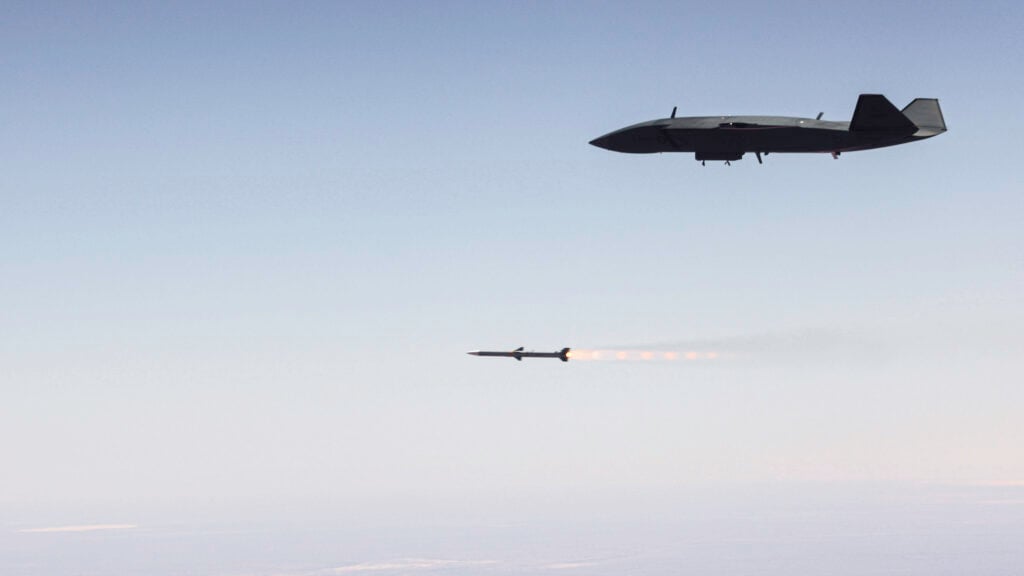
BELFAST — Rheinmetall today announced it is collaborating with Boeing to offer the MQ-28 Ghost Bat as a Collaborative Combat Aircraft (CCA) solution to the German Air Force.
The “strategic partnership” with the US giant is targeting Berlin’s 2029 timeframe for a CCA to enter service, according to a Rheinmetall company statement today.
The firm said it will act as a “system manager” for the MQ-28 in Germany, taking charge of system integration to cover “existing and future command and weapon systems of the Bundeswehr.” Activities in this area will also include managing “adaptation to national requirements and ensuring operational, maintenance, and logistical support.”
Such planning depends on first securing a CCA contract against a group of challengers that include the team of Airbus and Kratos, offering the US firm’s XQ-58A Valkyrie drone. In March, Airbus said it is readying to fly a pair of Valkyrie’s equipped with a “sovereign European mission system” for the first time later this year.
General Atomics Aeronautical Systems (GA-ASI) has also stated company interest in a European CCA, based on the Air Force’s YFQ-42A prototype. Core to the European CCA ambition is a “teamed operation” pairing its “independent U.S. and German aerospace affiliates,” according to a 2025 company statement.
Breaking Defense Europe is coming! Learn more about our new initiative here.
That means that all three of the US firms to express interest are looking at bringing premade designs to a team up with a European firm. However, there is a local option that may emerge in German-based defense and technology start-up Helsing, who could also compete with its CA-1 autonomous aircraft.
Ghost Bat, developed for the Royal Australian Air Force and manufactured in the Asia-Pacific country, has amassed over 150 flights and is made for other allies, said Rheinmetall.
“A proven autonomous CCA, it will act as a force multiplier, teaming with manned platforms to provide critical combat mass in highly contested airspace,” added the company statement. “Its modular design and autonomous behaviours support a broad range of mission capabilities, including reconnaissance, electronic warfare, and the integration of weapons systems.”
The new industry partnership comes after Rheinmetall disclosed talks with Boeing and Lockheed Martin, relating to CCA cooperation, in August 2025. At that time, CEO Armin Pappenger reportedly told investors that Germany could require around 400 CCAs.
“As a matter of principle, we do not comment on potential procurement projects prior to their Parliamentary Approval,” said a German MoD spokesperson in a statement to Breaking Defense.
Rheinmetall’s tie up with Boeing follows a bruising few days for the company, after Pappenger’s disparaging comments about the Ukranian drone industry in the Atlantic drew a wave of online criticism and pushback from Ukraine’s President Volodymyr Zelenskyy.
In the immediate aftermath of Pappenger’s remarks backfiring, Rheinmetall issued a statement on social media saying it has “the utmost respect for the Ukrainian people’s immense efforts in defending themselves against the Russian attack – now for more than four years. Every single woman and man in Ukraine is making an immeasurable contribution.”
Breaking Defense Video