MILAN — The lethal effectiveness of low-altitude drones and missiles in the conflicts in Ukraine and now Iran has pushed NATO to rethink its aerial surveillance capabilities, a senior alliance official told Breaking Defense.
“We’ve seen what is going on in these places. Today the only thing we have is cost-war, where we need to think on an economical basis: the price per shot, the best ways to alert, detect or kill at the better cost [than the enemy],” Adm. Pierre Vandier, NATO’s Supreme Allied Commander Transformation (ACT), said in an interview earlier this month.
Vandier said NATO is rethinking the full gamut of surveillance and defense, including integrated airspace monitoring, command-and-control systems, and air defenses, which are now more critical for sustained warfare than missile quantities alone.
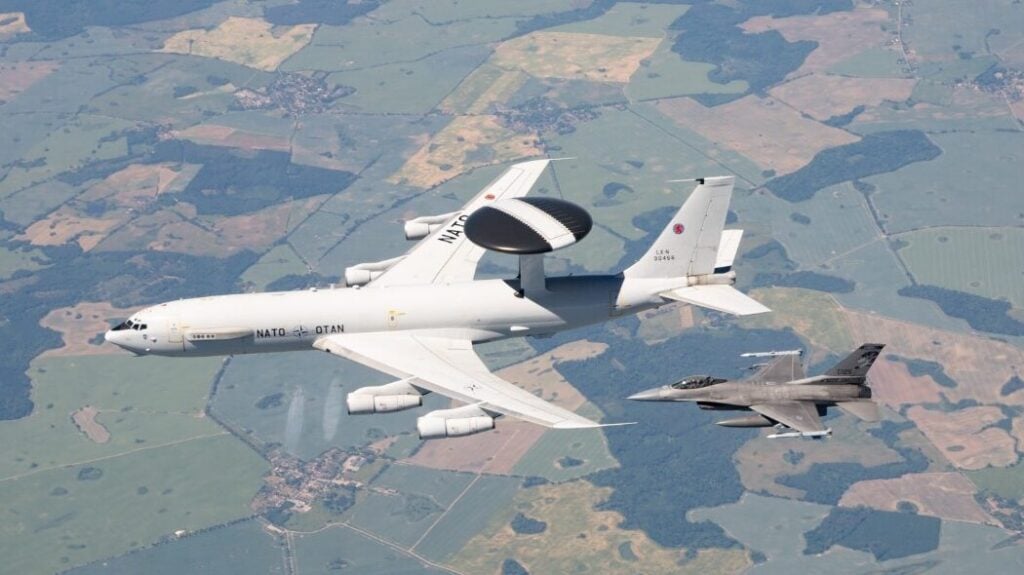
The official pointed to the ongoing Allied Federated Surveillance & Control (AFSC) program as a key element in reinforcing such capabilities. The project seeks to replace the alliance’s aging Boeing E-3A airborne warning and control systems (AWACS) aircraft, which have been in service since the 1980s and are nearing the end of their service life.
The NATO-owned assets are easily identifiable by the distinctive radar domes mounted on their fuselages and are equipped with long-range radars and passive sensors to detect air and surface targets over long distances. They have conducted hundreds of patrol missions along the Baltic and Black Seas and have played a key role in surveying the skies over Ukraine.
Vandier stressed, however, that the next AWACS will not be a single platform, but rather a “system of systems.” NATO wants to move away from reliance on a single asset toward creating a multi-domain surveillance network built from a variety of command-and-control and intelligence systems. (The US is currently pouring money into space-based tracking satellites as part of its multi-domain surveillance system).
“It will use space, airborne, ground components, among others, as well as enhanced radars — that will be very difficult to kill [speaking about AFSC program],” Vandier added.
In November 2025, a multi-billion-dollar deal for the procurement of six Boeing E-7A Wedgetail AWACS as an interim platform to supersede NATO’s E-3A fleet collapsed due to the loss of “strategic and financial foundations.”
To accelerate the program, NATO ACT issued a request for information to industry last month to identify immediate and emerging technologies for detecting, tracking, and identifying aerial threats. The notice identified the targets of interest as those flying at altitudes up to 10,000 feet above ground level.
To prevent a capability gap, a subgroup of 10 member states has agreed to purchase a replacement fleet of airborne early warning platforms as part of the initial AFSC initiative. However, the exact type has yet to be selected, a NATO military officer from the AFSC program at NATO ACT told Breaking Defense.
“NATO expects the enhanced air surveillance program to complement and support the growing air surveillance requirements … that were previously cover[ed] by the NATO E-3A fleet by interconnecting and fusing air surveillance data provided by not only i-AFSC platforms but also by air (podded or manned), ground, maritime or space assets from NATO nations,” added the officer.
The NATO military officer said that, based on the responses, ACT will prepare a capability program plan aimed at producing the first increment of this enhanced air surveillance before the end of 2026.
Breaking Defense Video