WASHINGTON — RTX says it has developed a new electronic attack capability based on a traditionally airborne jammer that’s been modified to work from assets on land or at sea.
Chuck Angus, Director Electronic Attack Systems at Raytheon, said the Raytheon Surface Electronic Attack System was produced after the company “leveraged” the Next Generation Jammer Mid-Band pod’s active electronically scanned arrays and “a couple other small components” so that “instead of putting it on an airplace, [users can] put it on the ground or on a surface ship or on a tactical vehicle.”
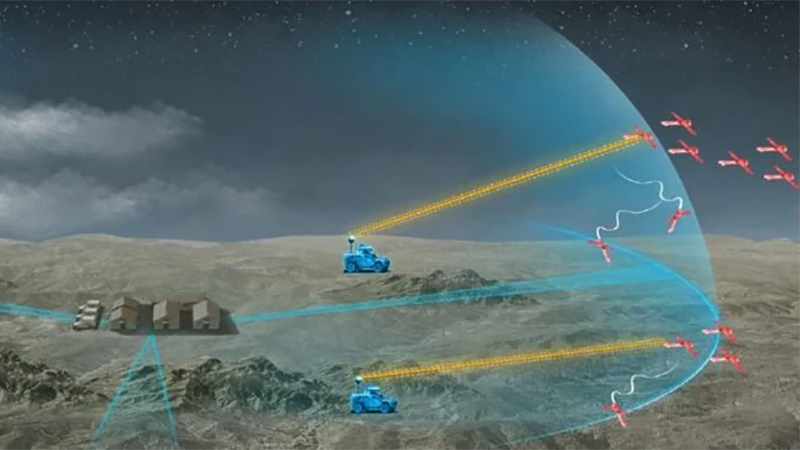
In an interview, Angus told Breaking Defense the system is designed to “generate non-kinetic effects to prevent adversaries from targeting our high-value assets or [to] protect those high-value assets.”
In 2016, Raytheon was contracted to provide NGJ Mid-Band pod aboard EA-18G Growlers, replacing the old ALQ-99 pod. The NGJ program was broken into multiple bands or frequencies of the spectrum, with L3Harris winning the Low-Band in 2024. While the program initially outlined plans for a High-Band, there has not been any funding in the budget for such a capability since at least 2020, with the Navy awarding Raytheon an extension of its contract for an extended range capability in 2023.
Angus said the new, multi-domain system, which was developed with in-house funding, is tailorable depending on what the customer wants when it comes to power and frequency range. There’s a six-foot by six-foot configuration that he said can be used with a tactical vehicle or pick up truck or an unmanned surface ship.
It is currently controlled on a laptop and is capable of conducting defensive actions and offensive activity including methods to interfere with an adversary’s attack before it’s launched, based upon the techniques demonstrated with the NGJ pod.
“You can imagine that if you’re trying to protect an airfield, you can use it there. If you’re try to protect an Army or a Marine outpost, you can do that as well. And then, if you want to put it on the on the surface of the water, there’s lots of ways to go do that, that again, keeps the adversary from surveilling or getting a target quality track on where you are and where you’re not,” Angus said. “There seems to be a lot of demand in the system right now for non-kinetic solutions, especially when you’re talking about firing a bunch of weapons at low cost adversary threats.”
Though the system doesn’t have a military customer yet, Angus said the internal research and develop effort spurred from several requests for information across the Department of Defense regarding non-kinetic, ground-based systems that are mature and relatively inexpensive.
The Army has been on a nearly decade-long journey to rebuild and mature its electronic arsenal after divesting much of its capability following the end of the Cold War. It currently has only fielded a dismounted electronic attack capability and is still looking at what platform-based electronic warfare could look like, having developed a Modular Adapter Kit to mount that platform to vehicles.
The Navy, too, has sought its own electronic attack capabilities, experimenting with them in a surface environment at the annual Silent Swarm event, including testing electromagnetic spectrum capabilities with unmanned platforms.
So far Raytheon has tested the system airborne and developed a demonstrator to take to their ground-based chamber. The plan is to take it to the Point Mugu lab in California, a premier Navy site for EW testing, and demonstrate it later this summer.
PHOTOS: Sea Air Space 2026

 Gallery