The following is an excerpt from War Plan Taiwan: OPLAN 5077 and the U.S. Struggle for the Pacific, published by the Naval Institute Press.
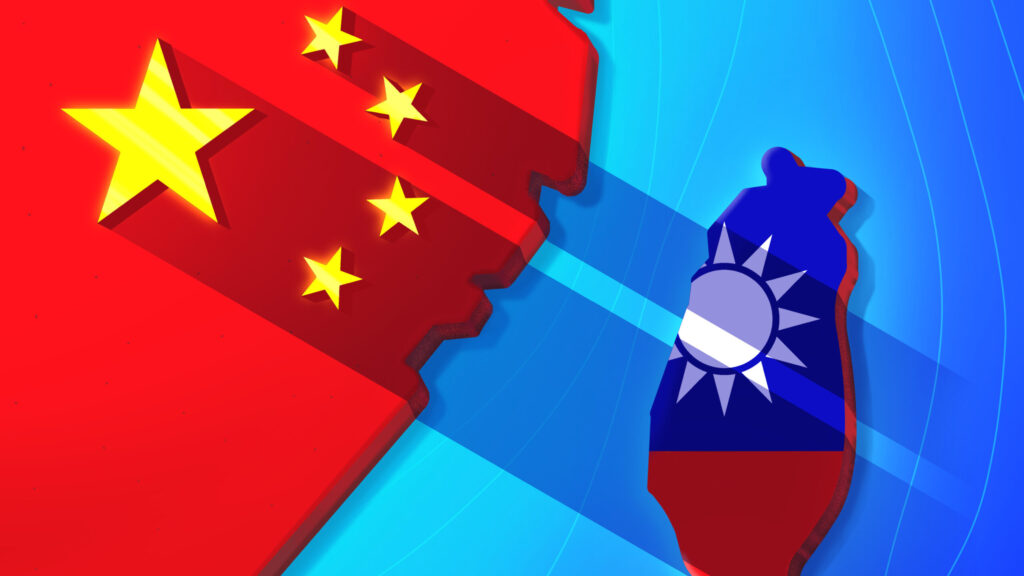
The standard talking points on the imminent threat China poses to Taiwan and the associated risk of a conflict between the United States and the People’s Republic of China (PRC) hardly need reciting. Headlines warning of the PRC preparing to invade the Republic of China (ROC) in the near future have become almost clichés. Even the US Navy’s 2024 Navigation Plan from the Chief of Naval Operations (CNO) has 2027 set as the deadline to be ready for war. More broadly, the United States has designated China its defense “pacing challenge,” stating that “a Taiwan contingency is the pacing scenario.”
The US government has claimed that the People’s Liberation Army (PLA) is developing a capability to invade Taiwan by 2027 but has not asserted that there is an intent by China’s leadership to execute such an operation at that point. For its part, Beijing has continued to accelerate its defense-modernization efforts and exert increasing military pressure on the ROC while denying having an invasion timetable.
Since its founding, the United States has prepared for conflicts with a range of state actors. The War Plan Orange model for the Japanese Empire became the standard-bearer contingency after World War I, with many of the lessons derived from the planning process absorbed into the Pacific component of the global Rainbow 5 plan, whose execution ended with the unconditional surrender of Imperial Japan in Tokyo Bay in September 1945. Planning for war with the USSR evolved from envisioning something akin to a World War II–type model to a one-sided atomic emaciation of the communist world, then to mutual destruction, and finally to a more adaptable approach that preserved hope of avoiding global nuclear catastrophe. From the fall of the Berlin Wall to the mid-2010s, contingency planning focused on lesser regional challenges, with the liberation of Kuwait in 1991 being the high point of this model.
The position of China in the US threat matrix has oscillated since the 1949 communist victory in the Chinese Civil War, but until recently it was only secondary at best, being overshadowed by the USSR during the Cold War and the rogue states and terrorism that dominated the international narrative after-ward. While wars in Korea (1950–53) and Indochina (1955–75) were transient low points in relations between Washington and Beijing, the continued existence of the ROC has been the most persistent irritant, with the period between President Harry S. Truman’s decision to “neutralize” the Taiwan Strait in June 1950 and 2025 exceeding the average human lifespan and approaching double the length of the Cold War. The First and Third Taiwan Strait Crises (1954–55, 1995–96) alone were separated by over forty years.
For its part, the post-1949 ROC has transformed itself from the last bastion of Chiang Kai-shek’s corrupt and authoritarian government that once held sway across most of mainland China to an economically advanced liberal democracy. During the early Cold War, the United States was willing to go to war with China to defend Taiwan, with the use of nuclear weapons codified as part of the plan, even if that risked triggering Soviet intervention and a global war. The subsequent US derecognition of the ROC came not out of distaste for the regime but because of the value of a partnership with the PRC in the confrontation with the USSR—dealignment with Taiwan was part of the price Beijing required paid. After the Soviet Union’s fall in the late 1980s, Taiwan’s democratization and China’s rising power and human rights abuses gave new incentives for the United States to support the island.
The geographical separation provided by the Atlantic and Pacific Oceans to the United States from the threats it faces has resulted in a maritime emphasis on its defense engagement with the world. Most major US land and air campaigns from the world wars to the early twenty-first century took place on the Eurasian periphery, frequently requiring American forces to secure supply lines from the homeland and establish themselves in the relevant region. Nazi Germany, Imperial Japan, and the USSR all presented some degree of what is today termed anti-access and area denial (A2/AD) challenge. The former component, “anti-access,” is officially defined as “action, activity, or capability, usually long-range, designed to prevent an advancing enemy force from enter-ing an operational area,” while the latter, “area denial,” is “action, activity, or capability, usually short-range, designed to limit an enemy force’s freedom of action within an operational area.” Many lesser opponents have paid a price for their inability to prevent the United States from entering the theater of operations. While “A2/AD” as a concept encountered criticism, countering what it describes encapsulates a major part of the central challenges the United States would face in a modern conflict over Taiwan.
Following the Gulf War (1990–91), American analysts anticipated adversaries adopting advanced A2/AD systems to combat the United States. Beijing mirrored this by concluding that the PRC required such a capability from its observations of both Iraq’s defeat and the Third Taiwan Strait Crisis, when it had no credible conventional options to counter deployed US forces. In Washington it was also clear to many that the US hegemonic moment of the 1990s and the early twenty-first century would be transient, with China, rapidly developing economically, high on the list of potential future peer competitors.
The United States has long prepared for a conflict with the PRC. From the defense of the ROC’s territories, to China’s incorporation into a general nuclear war between the United States and the “Sino-Soviet bloc,” to downgraded regional contingencies later in the Cold War, the notion of a threat from Beijing never dissipated entirely. Even when the last US forces departed Taiwan after derecognition by Washington in 1979, it appears that some plans remained in place to support the island. More detailed revised plans—initially at least centered upon the regionally focused operation plan (OPLAN) 5077—were reportedly put in place in the twenty-first century’s first decade. Since then, contingencies have further evolved as the PRC’s mili-tary potential has grown, with war plans to counter Beijing now likely led by a globe-spanning integrated contingencyplan (ICP).
Literature exists that examines individual components of the above. Ian Easton’s The Chinese Invasion Threat: Taiwan’s Defense and American Strategy in Asia (2017) provides an account of China’s war plans and Taiwan’s defensive approach. Volumes that provide histories of U.S. relations with the ROC include John W. Garver’s The Sino-American Alliance: Nationalist China and American Cold War Strategy in Asia (1997) and Nancy Bernkopf Tucker’s Strait Talk: United States–Taiwan Relations and the Crisis with China (2009). Sam Tangredi’s Anti-Access Warfare: Countering A2/AD Strategies (2013) gives an overview of the history of A2/AD warfare using select case studies and provides examples of near-future regional contingencies that will require the United States to defeat its opponent’s anti-access capabilities, including those of the PLA in East Asia. Other books, as well as reports from think tanks such as the CSBA and the RAND Corporation, explore the potential timing and course of a conflict between the United States, Taiwan, and China.
War Plan Taiwan builds on these works and develops and integrates the matters they address within the wider context of US war planning to provide the reader with an understanding of how — while of course, we cannot know the detailed plans for a conflict with China — it is possible to identify the nature, hazards, and form of such a war.
This book has four central arguments.
First, war planning, both historically and in the current era of great power competition, is both important and perilous. The US record of planning for conflict over the last century has seen common themes, with the identification of threats frequently proving a national strength, while the nature of the contingency plans to counter them falling vulnerable to excessive optimism and failure of imagination. Learning lessons from such historical tendencies can inform planning for conflict with the PRC—including on how to end a war on favorable terms.
Second, the A2/AD challenge that now faces the United States in the context of a conflict with China is more familiar than it may appear. The Pacific War against Japan is the most well-known instance of the United States having to overcome suchdefenses. But important to study are the plans for wars that did not take place—most notably against the USSR during the Cold War—and those fought by others, with the Falklands War (1982) being the most cogent post–World War II case study.
Third, it is important to have strong allies in the region in which the conflict is taking place. Attempts by the United States to project power and enforce its will have been least successful where allies have been absent, passive, or “Potemkin” in nature. In this context War Plan Taiwan will examine the relationship between the United States and the ROC from shortly after the end of World War II to the present day. Washington has swung between times of support and cooperation with Taipei andperiods when favoring Beijing was perceived as being politically expedient. Only by fully realizing Taiwan’s potential strengthcan the resilience of American regional interests be optimally supported. If the United States is serious about countering China’s malign influence, abandoning the ROC is not a credible policy position.
Fourth, the threat the United States faces from China is more profound than any in living memory. Unlike Nazi Germany, Imperial Japan, and the Soviet Union—each of which fell short as to be comprehensive peer competitors—the PRC increasingly poses a credible challenge to the United States across the spectrum. This should not prompt a counsel of despair: there are measures that can and in many cases are being taken to deter and, if necessary, to combat the threat. Yet it is important not to lose sight of the magnitude of the task at hand or the amount of work still ahead
Rowan Allport is a deputy director at the Human Security Centre, a London-based foreign policy think tank. He has previously worked as a senior analyst for RAND Europe’s Defence, Security and Infrastructure team. Rowan is the author of the book War Plan Taiwan: OPLAN 5077 and the U.S. Struggle for the Pacific, published by the Naval Institute Press.
PHOTOS: Sea Air Space 2026

 Gallery