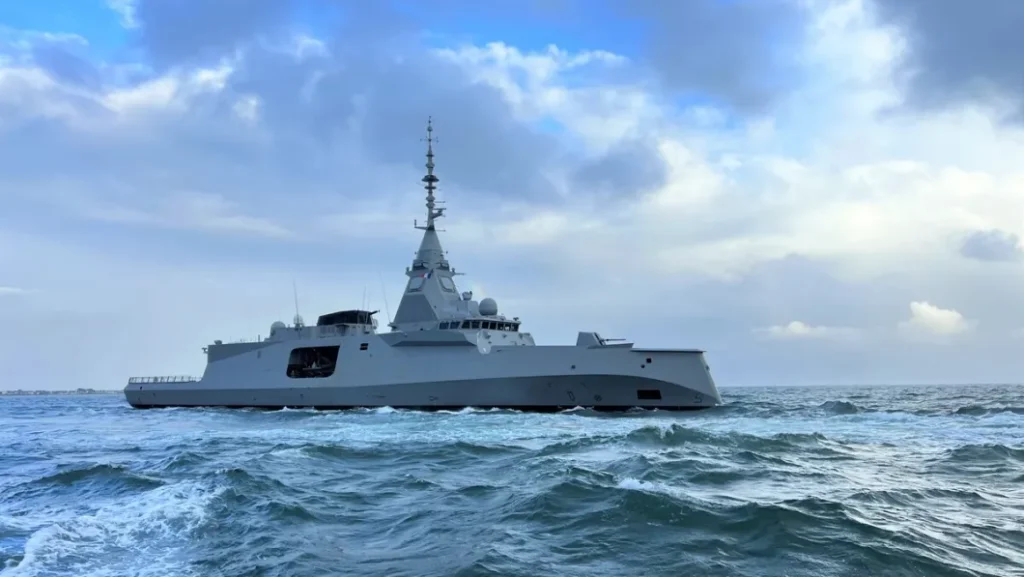
STOCKHOLM — Sweden will order four FDI frigates from the French manufacturer Naval Group, backing away from the joint British-Swedish Babcock and Saab bid as well as the proposal from Spain’s Navantia.
The purchase will be Sweden’s largest defense acquisition since the early 1980s and constitutes a major step forward in building its naval capabilities.
Aboard the Visby-class corvette, HMS Härnösand, moored here near the Royal Palace, the Swedish prime minister and defense chiefs announced their intention today to negotiate for the construction of four new Luleå-class frigates, much larger than the current five corvettes the Swedish Navy currently has in service.
“The ships that best meet the Swedish requirements are therefore the French alternative. … This is the decision that the government has now taken this morning,” Prime Minister Ulf Kristersson said.
The political decision follows recommendations submitted by the Swedish Navy and the Defense Materiel Administration (FMV), which identified the preferred international partner to deliver the Navy’s most significant surface combatant programme in nearly half a century.
RELATED: Sweden to pick next frigate by ‘early 2026,’ working on GlobalEye sale to France
France’s Naval Group is offering its 4,600-ton, 122-meter (400-feet) FDI (Frégate de Défense et d’Intervention) multi-mission frigate. The lead ship, the Amiral Ronarc’h, was delivered to the French Navy in October 2025, following successful sea trials that validated its digital architecture and combat systems.


European-made Black Hawk gets an armed upgrade
New kits turn Black Hawks into attack Hawks in just three hours.
In baseline French service, the class carries 16 Sylver A50 vertical-launch system (VLS) cells for Aster 15/30 missiles. The French Navy has decided to double this to 32 cells, aligning its ships with the enhanced export versions already in production. The Swedish FDI frigates will also be equipped with the European (French-Italian) MBDA Aster 30 long-range air defense system, which has the capability to intercept ballistic missiles, the Swedish government said today.
“We have seen that Russia has increased its production of ballistic missiles over the past year. Our capability in this area [air defence] will triple with this acquisition,” Defense Minister Pål Jonson said at the press conference aboard the navy corvette today.
The new frigates will also be fitted with the medium-range MBDA CAMM-ER air defense system for protection against combat aircraft, cruise missiles and drones.
The government said there are three main reasons for selecting the French FDI frigates instead of the British-Swedish and Spanish bids. On the one hand, the authorities noted that the FDI can be delivered quickly, which is important given Sweden’s current security situation. On the other hand, they are a design already in production, which provides a high degree of delivery reliability.
In addition, the vessels feature an integrated, combat-proven air defense system, the government stressed.
The defense minister said that the cost of a new frigate is usually around 10 billion Swedish kronor (approximately $1 billion). However, the final price tag will depend on the outfit and the negotiations about to begin. Sweden’s military chief, Gen. Michael Claesson, declined to give any specific numbers when asked by Breaking Defense.
“Let me be clear: This is the end of the beginning. Negotiations are now starting, and it would be foolish to throw around specific figures at this stage. We will put hard pressure on the company, set clear requirements, and then see where we land in terms of both price and the balance between timeline and capability,” he stressed.
The first of the four frigates is expected to be delivered in 2030, with one frigate supplied per year thereafter.
Additional Swedish systems on the FDI will include Saab’s RBS 15 anti-ship missiles, Torpedo 47, the GIX radars, Trackfire remote weapon stations (Trackfire RWS), and BAE Systems’ Bofors 57 mm and 40 mm naval guns.
Related: https://breakingdefense.com/2025/11/with-sweden-baltic-sea-now-a-lake-full-of-nato-submarines/
“We are extremely honoured by the choice of the Swedish Ministry of Defence to provide the Royal Swedish Navy with 4 FDI, a latest-generation frigate, thereby strengthening our strategic partnership with Sweden and demonstrating the strength of industrial cooperation in Europe,” Naval Group’s spokesperson Bénédicte Mano said in a statement to Breaking Defense.
Troublesome Journey
The Luleå-class program has had a turbulent history. In 2021, FMV awarded Saab Kockums a contract to define the next-generation of the Visby Gen 2 corvettes. This new 72-metre stealth class, based on the existing Visby design, is optimized for the shallow waters of the Baltic Sea, which average about 55 metres in depth.
In 2023, that program was cancelled in the wake of Russia’s invasion of Ukraine and Sweden’s accelerated NATO accession, which was finalized in 2024. Saab then partnered with Britain’s Babcock to develop the significantly larger Luleå-class frigates, which will be approximately 50 metres longer than the current Visby vessels.
The increased size on the Luleå frigates to 122 meters was driven primarily by the need to accommodate advanced air defense systems, including vertical launch silos, as well as provisions for unmanned systems and greater endurance.
This expanded capability was envisioned as better supporting Sweden’s new NATO role, shifting from purely coastal defense as a previously officially military non-aligned state to contributing to collective NATO security across the Baltic region, Finnish waters, and the High North.
But selecting a foreign or adapted off-the-shelf design marks a major departure from Sweden’s centuries-long tradition of domestic warship development. Kockums and Saab have long been the Navy’s domestic prime contractor, delivering the five stealthy Visby-class corvettes in the early 2000s. Those ships are currently undergoing mid-life upgrades, including MBDA’s Sea Ceptor air defense system, which has a range of over 25 km, to keep them operational into the 2040s.
Geopolitical ties could have favored the joint British-Swedish Babcock and Saab Arrowhead 120 bid, especially given Saab’s involvement and Stockholm’s membership in the UK-led Joint Expeditionary Force (JEF) — of which France is not a part. However, the choice of the French frigates will not affect the cooperation in JEF, Claesson said.
“I assess that this does not affect the JEF cooperation at all. The foundation of the JEF partnership is to remain fully compatible with NATO, and our choices have primarily been based on what best suits the Swedish Navy in that context. Within that framework, the JEF cooperation exists as a complement to NATO,” he said.
Breaking Defense Video