
WASHINGTON ― China has been abandoning used launcher rocket stages in low Earth orbit (LEO) at an ever-increasing pace, putting both military and commercial satellites in that crowded orbital regime at greater risk of serious debris-creating collisions, according to a new report.
Used rocket bodies are among the most dangerous kinds of space junk because they carry residual amounts of fuel that often causes them to explode, thus creating even more on-orbit debris.
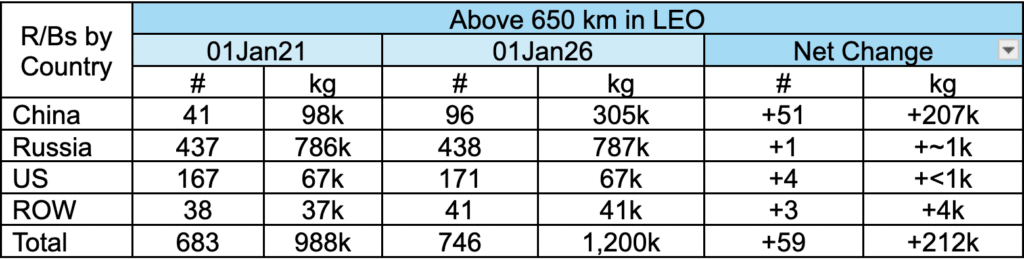
The analysis from space monitoring firm LeoLabs, provided to Breaking Defense, found that from January 2021 to January 2025 China has abandoned 51 spent rocket bodies in LEO above 650 kilometers (about 404 miles) in altitude, more than doubling the number for the previous five years to bring the total to 96.
During that period, Beijing accounted for 86 percent of the global number of rocket bodies left in LEO, nearly seven times more than the rest of the world combined, it adds. By contrast, the US left four, and Russia, only one.
Even more importantly for calculations of potential debris creation, the analysis shows that the “amount of R/B mass abandoned above 650 km from China has more than tripled,” rising from 98,000 kilograms to 305,000 kilograms. This accounts for “98 [percent] of the global increase in abandoned R/B mass is from China meaning China has left over 40x the amount of abandoned R/B mass in long-lived orbits in LEO than rest of the world combined.”
Darren McKnight, author of the LeoLabs study, said a major reason for the large jump in mass is because China uses bigger rockets than most other nations for launching its LEO satellites. The more massive a space object, the more debris it will create if it breaks up of its own accord or it smashes into another space object.
“This growing reservoir of massive derelict objects that have already shown a propensity to explode (i.e., three Chinese rocket body explosions over the last four years: two CZ-6A and recent Zhuque-2) and will linger for decades to centuries, potentially colliding with other space objects, adds an unnecessary level of uncertainty for military space actors,” McKnight told Breaking Defense in an email.
The Chinese embassy in Washington did not immediately respond to a request for comment for this report.
Victoria Samson, chief director of space security and stability at the Secure World Foundation, said the jump of Chinese “derelicts” above 650 km was “eye-opening.”
The development “should concern anyone who wants to operate in space, as that massive amount of uncontrolled mass will be a hazard for the decades it will remain in orbit,” she said. “This can have serious consequences for US national security.
“For example, many of the rocket bodies are at 800-820 km; the United States’ PWSA [Proliferated Warfighter Space Architecture] is intended to operate at at an altitude of 1000 km, which means that those satellites could be at risk from these rocket bodies as they approach their operating orbits,” she said.
Samson noted that the problem is even “more alarming” when considering the fact that “a large chunk of that increase” in Chinese abandoned R/Bs due to the launch of China’s rival to SpaceX’s Starlink, called Qianfan. The Qianfan constellation, which is being stationed on-orbit between 800 km and 1,160 km, just hit 200 satellites, and Beijing plans to put up a total of 15,000 birds, she said.
“[T]his has the very real possibility that the situation will get much worse if China does not change its approach,” she said.
International best-practice guidelines signed by more than 60 nations including China, well as licensing laws in many nations including the United States, mandate a number of mitigation measures to reduce the risks of on-orbit explosions.
China’s abandonment of its rocket bodies, LeoLabs data suggests, is not abiding by those international best practices.
These include, among other technical measures, using left-over fuel to maneuver spent rocket stages to altitudes low enough that they fall back to Earth within 25 years either naturally or, more preferably, in a controlled manner.
Another measure, one used by a number of operators in the higher regions of LEO, is to jettison spent launcher stages in a lower orbit on the way up to ensure they de-orbit in less than 25 years and then rely on electric or other propulsion units to more slowly push the satellites themselves up to their operational altitude.
Beijing, for its part, in its June 11 statement to the Scientific and Technical Subcommittee of the UN Committee on the Peaceful Uses of Outer Space, contends that it follows the 25-year debris mitigation rule as required by its own national space-use laws.