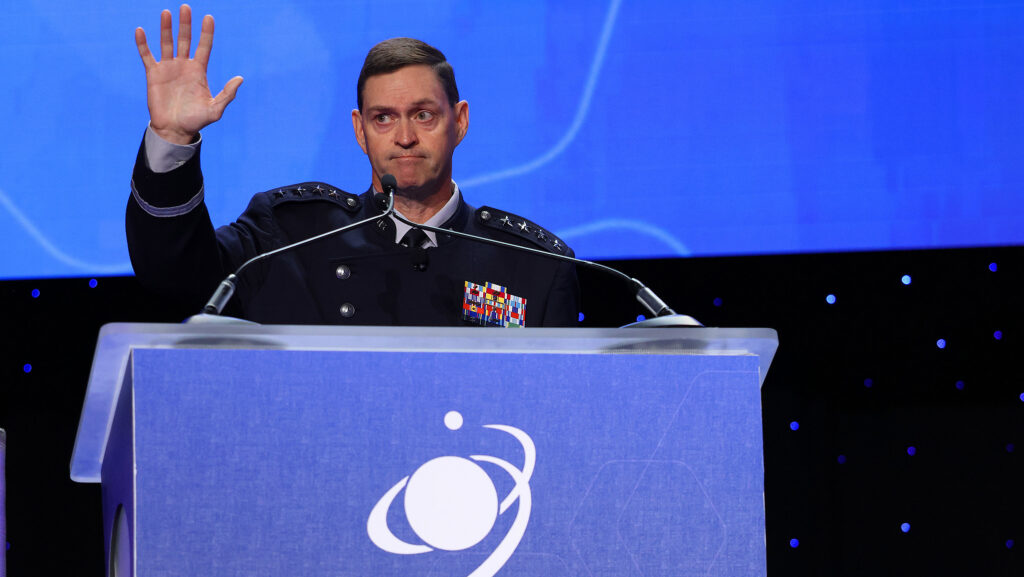
LONDON — Delivering a swan song as the US Chief of Space Operations, a reflective and somewhat philosophical Gen. Chance Saltzman today capped his 35-year career in uniform by championing the strength of alliances, noting that a key role for military officials is to act as a stabilizing force for democracy.
“In the hyper-political environment we find ourselves, with partisan politics creating divisions between a multitude of stakeholders, I remind myself that military institutions in our democracies, particularly military leadership, serves as the ballast in the ship,” Saltzman said during the Global Air and Space Chiefs conference here.
“While it may feel like the ballast slows progress as the ship of state attempts to quickly move towards its goals, the ballast creates stability when the inevitable storms arise,” the general continued. Military leaders, he added, “must remember our roles, think long term, offer our military experience to decision makers, and do what we can to provide the stability and be a calming presence.”
In a later roundtable with reporters, Saltzman was pressed on those remarks against the backdrop of trans-Atlantic tensions between the Trump administration and European allies, most recently represented by the abrupt exit of Gen. Christopher Donahue, the Army’s former top general in Europe.
“[I]f one rock is replaced with another rock, you still have the ballast on the ship,” Saltzman said during the roundtable. “Alliances are as much a political animal as they are a military animal, and so as we pursue our objectives inside that alliance, we have to make sure from a military perspective that I attend to the military functions that are a part of that alliance.”
Nevertheless, many European leaders were likely able to breathe a sigh of relief following a relatively drama-free NATO summit in Ankara last week, though one not devoid of some pointed remarks from US President Donald Trump. Those alliances, Saltzman said during his keynote remarks, have demonstrated unassailable value.
“We are stronger as a team of nations than any one of us is individually. There is far too much evidence over the last 80 years or so to argue otherwise,” he said today.
After decades in uniform, the general also said he’s witnessed a far greater integration of space power, which used to be somewhat of a passing thought for military planners.
“We really used to be considered icing on the cake,” he said during the roundtable. Now, “I think we are more the eggs in the cake batter. We are fully integrated. You can’t extract us any more and still have a joint force that functions the same way.”
Saltzman is only the second chief of space operations in the service’s relatively short history. In the years since its founding by the first Trump administration, the Space Force has rapidly taken on high-profile missions like the ability to track airborne targets from space, known as airborne moving target indication (AMTI).
After awarding a multi-billion dollar AMTI deal in May to SpaceX, the Space Force said it expected a constellation to be fielded by 2028. Today, Saltzman confirmed he expected an initial capability to be available in “the next couple of years.”
Reasoning that “most of the technical problems” with the orbital sensor network have been solved, Saltzman said the challenge now is proper resourcing over the next three or four years. An initial constellation will have “some demonstratable capability, even if it’s a bit more regional than I’d like,” which could subsequently be expanded.
Lt. Gen. Doug Schiess, the Space Force’s deputy chief of operations who oversees development and implementation of service policy, has been tapped as Saltzman’s successor. Schiess is scheduled to appear before the Senate Armed Services Committee for a confirmation hearing Thursday.