ANKARA, Turkey — In the lead-up to the NATO Summit, uncertainty over US engagement in the alliance, delivery of increased defense spending, Ukraine’s right to membership, and disagreement over Europe’s approach to the Iran war threatened to derail the annual get-together.
Yet the relative lack of drama — aside from some pointed remarks from US President Donald Trump — will have largely pleased all 32 allies, even if resolutions on other big-picture matters, such as the future of Greenland, were kicked down the road.
Check out Breaking Defense’s full coverage from the summit here, including the major developments, after reading some other key highlights here:
1. Ukraine’s air defense win, but membership status quo
One of the convention’s most anticipated guests was Ukrainian President Volodymyr Zelenskyy, who delivered a poignant 10-minute address and received a standing ovation on the opening day of the event. Later, he also made notable headway on some of the country’s most urgent priorities, including air defense. During his meeting with Trump, the US president floated the idea of granting Kyiv a “license” to manufacture Patriot air defense systems, a capability Zelenskyy has long sought.
Another win for Ukraine was securing a €70 billion ($80 billion) commitment from allies to deliver more military equipment and training. NATO also pledged to sustain this level of assistance to at least equivalent levels in 2027. The final declaration of the Summit also featured somewhat stronger supportive language than last year’s statement, referring to Kyiv as a contributor to “transatlantic security” and one that “allies stand united in unwavering support in defending its freedom, sovereignty, and territorial integrity.”
However, the war-torn country left with little visible progress for its long-standing 18-year quest to become a NATO member, despite NATO’s official position since 2008 that it would happen sometime in the future. Zelensky made an appeal for this in his remarks, asking allies if it is “right” to leave a country like Ukraine, with such advanced defensive capabilities, outside of NATO.
When asked whether some member states are still undecided about letting it join, the Swedish Defense Minister Pal Jonson told Breaking Defence that a shift has occurred toward increasingly viewing Kyiv as a “security provider.” He added that “the sooner” Ukraine becomes a member, “the better it is,” as it belongs both inside NATO and the EU.
2. A new multi-national bank for defense
On the second day of the summit, Canadian Prime Minister Mark Carney announced the creation of the Canada-led Defense, Security and Resilience Bank (DSRB), backed by Canada as well as Albania, Belgium, Ukraine, Greece, Latvia, Luxembourg, Romania and Turkey. The new financial institution aims to provide low-interest loans to countries to finance defense projects.
The ambition is to mobilize $134 billion of capital and have the DSRB up and running by 2027. While no G7 nations have yet joined, UK finance minister Rachel Reeves said in parliament last month that the country is working closely with Canada on this initiative. In a press release this week, Ottawa hailed the bank’s ability to help “governments and small to medium-sized enterprises address critical financing gaps.”
3. No F-35 breakthrough for Turkey
Despite positive signals from Trump that US sanctions would be lifted, Turkey did not secure formal re-entry into the F-35 program. Ankara has sought readmittance since being kicked out of the multinational fighter jet program in 2019 following Turkey’s purchase of Russian air defense systems.
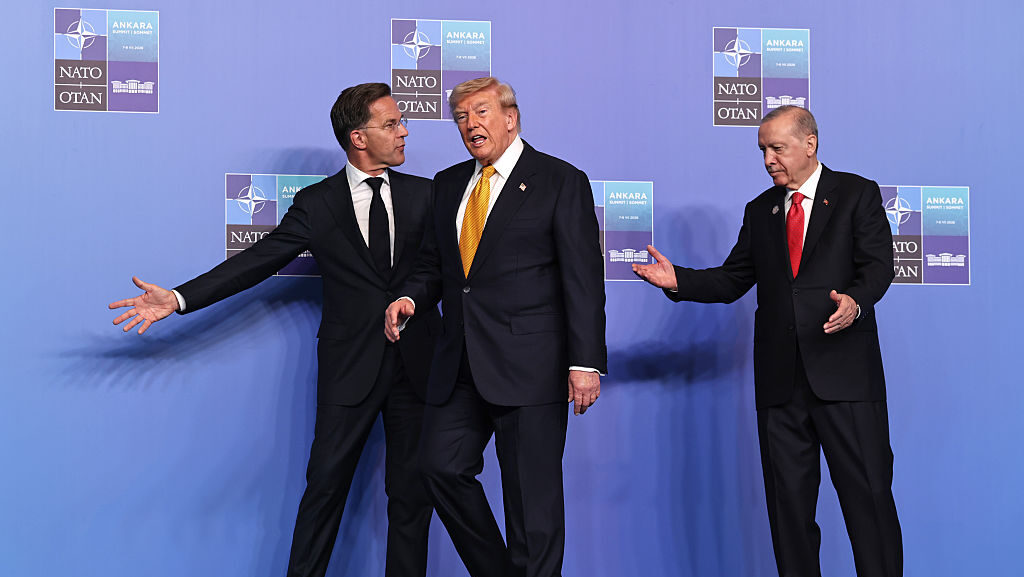
Sitting next to Turkish leader Recep Tayyip Erdogan on the first day of the summit, Trump said that bringing Turkey back into the fifth-generation fighter program is “something certainly we’d consider” and said it’s “a decision we’re going to make.” But nothing was formalized.
Ahead of the summit, one Turkish defense expert told Breaking Defense that they no longer viewed Ankara’s primary objective today as simply returning to the fighter program, but rather as increasingly developing its own domestic fighter, the KAAN.
4. Flurry of defense industry announcements
NATO wasted little time in signing off on big-ticket acquisitions, kicking off a first wave of announcements at a defense industry forum on the sidelines of the event.
After months of speculation, the alliance announced the planned procurement of up to 10 Swedish GlobalEye surveillance aircraft to replace a fleet of aging E-3 planes. It also marks a distinct shift toward investing in a European solution after initially deciding to acquire Boeing’s E-7 Wedgetail, as originally envisioned. Next steps will see the alliance’s procurement agency and Saab open negotiations for the aircraft, ahead of the signature of a production contract.
Separately, a commitment to multirole aircraft “in support of national requirements” was also made by a coalition of partner nations. To that end, Denmark, Finland, France, Germany, Poland, Spain, Sweden and Turkey signed letters of intent for the Crewed Airborne Early Warning High Visibility Project.
5. Deep-strike capabilities
Looking beyond developments in crewed and uncrewed aircraft, NATO also focused heavily on advancing deep precision strike capabilities, chiefly through a new $50 billion coalition funding pledge over the next decade.
In all, 12 European nations, led by the UK, have signed on to the initiative, which aims to support a “range” of future long-range weapon programs. In a statement, the British MoD summed up the ambition of the program by stating it will deliver “the most advanced weapons NATO will have at its disposal in the future — with the ability to strike targets no less than 300km [186 miles] away and in some cases beyond 2000km, with pinpoint accuracy.”
As part of a separate but related move, Denmark, France, Italy, Norway, Turkey and the UK launched the allied Ground-Based Precision Strike Capabilities High Visibility Project, introduced to explore “development of novel deep precision strike capabilities, including new launchers and missiles,” according to an alliance release.
6. Trump’s ‘tremendous love’
Trump may have started the Summit with harsh words for America’s allies, but by the end, the US President spoke of his “tremendous love” for Western leaders. That message will likely have brought a smile to the face of NATO Secretary General Mark Rutte, as the Dutch diplomat again rolled out a charm offensive aimed at toeing the line with Trump no matter Trump’s barbs.
“It was a great meeting; there was a lot of love in that room, a lot of unity,” Trump said of his allied counterparts following a bilateral meeting with Zelenskyy.
The conciliatory approach stood in direct contrast to Trump’s renewed call to take control of Greenland, drawing opposition from Denmark’s Prime Minister Mette Frederiksen, who reiterated that the semi-autonomous island is “not for sale.”
Lastly, the Summit’s declaration renewed allies’ Article 5 commitment to collective defense, a move that should go some way to allaying fears in Europe and Canada that the US will not forsake them if Russia attempts to seize allied territory.
Breaking Defense Video