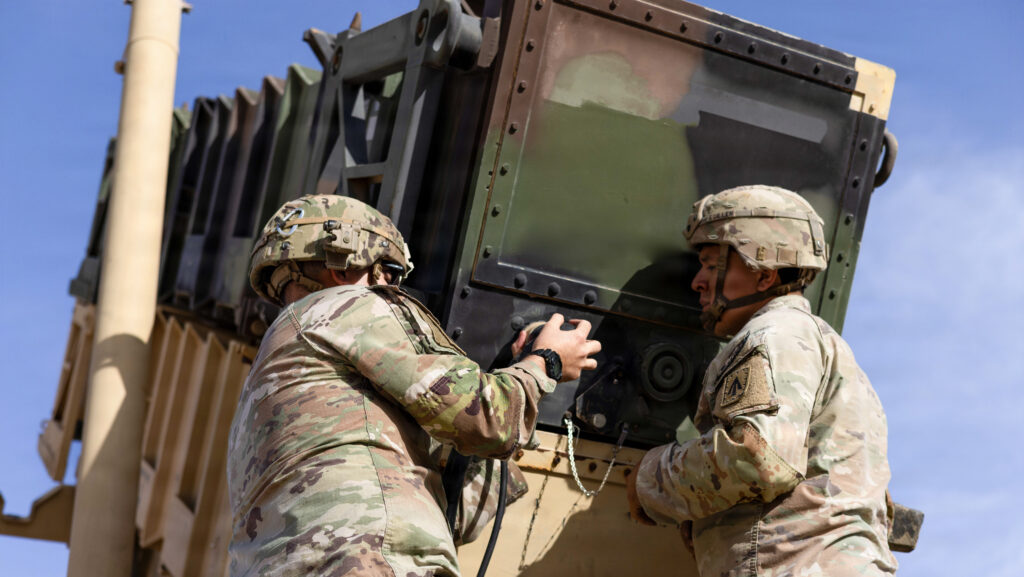
The conflict in Iran has revealed two truths about US air-and-missile-defense (AMD) systems: they are effective, but replenishing their munitions stockpiles is a critical challenge.
Their effectiveness has been proven repeatedly, as the damage done by missiles and drone swarms has been relatively minimal compared to the sheer number of attacks. Critically, however, multiple AN/TPY-2 radars – the backbone of AMD detection and tracking as part of the Terminal High Altitude Area Defense (THAAD) missile system – have been damaged or destroyed. The US has scrambled to relocate the costly, hard to replace radars from other regions such as the Indo-Pacific, potentially weakening AMD efforts in those regions.
“You can’t operate a THAAD battery without a TPY-2 radar,” said Tom Karako, director of the Missile Defense Project at the Center for Strategic and International Studies (CSIS). “Those are scarce strategic national assets and the country is already scrambling to piece together some replacements and we want to get them out there in the field.
“The broader strategic context here is that the United States has been pulling stuff out of the Pacific and out of Europe to go to the Middle East. That’s an undeniable reality. It’s hard to argue that is not going to have some potential detrimental impact to our deterrence quotient. Capability is a fundamental component of deterrence. It’s not lost on our adversaries either: the number of interceptors, the number of strike missiles, and yes, the number of radars that have been expended or adversely impacted here.”
In addition to the radars, AMD efforts in the Middle East face several other challenges, including the complexities of manufacturing solid rocket motors (SRMs) for interceptors, ramping up industrial base capacity for all aspects of AMD systems, and adapting next-gen munitions to meet future challenges from ever-evolving threats.
The critical role of solid rocket motors
When AMD systems intercept missiles or other threats, they are generally doing so with interceptors that require SRMs. Each interceptor fired is an SRM that has to be replaced, and manufacturing them is a complex process.
In a recent report, CSIS explored the challenges of ramping up production of SRMs and identified three key challenges:
- Highly cyclical demand;
- A government approach to industry that prioritizes cost and efficiency over capacity building; and
- An existing contracting and procurement structure leading to supply chain opacity and risk.
These challenges are shaping how industry is approaching the need for more SRM production and AMD production overall, said Ursa Major CEO Chris Spagnoletti.
“How can we get more capability into the existing volume set?” he said. “When we think about how to innovate, we think along those lines using different techniques and trying to move as fast as possible without sacrificing rigor. When it comes to innovating on the manufacturing side, we’re taking a look at a very modular approach. We’re looking at additive manufacturing and how we can leverage taking very complicated designs and honing them into something much more simple, less parts, less cost.”
As Karako pointed out, one of the complications in SRM manufacturing is that the demand signals have been inconsistent over the years, making it difficult to build capacity when manufacturers have to deal with constantly shifting production targets to meet what the US government wants in a given year.
“The defense industrial base for SRMs is the defense industrial base that we paid for,” he said. “We also have the defense industrial base that the government has created and curated and shaped and incentivized and disincentivized in 17 different ways. We have the industrial base that was asked for and that was manufactured by the monopsony customer over several decades. When the customer decides on a dime that they want something completely different and now they’re wagging their finger at the defense industrial base that it created, it is not surprising that it creates some difficulty.”
When demand signals do increase, it takes time to ramp up production of SRMs. SRM manufacturing is a multi-step process involving highly volatile ingredients, and the process cannot easily be sped up due to the need for curing before assembly and inspections after assembly to identify any potential flaws that would prevent SRMs from being able to meet demanding performance characteristics.
Another challenge in the SRM manufacturing process is supply chains. The government usually only buys completed systems, and is not involved in the supply chain needed to build SRMs. Given the highly specialized components and ingredients needed for SRMs, there is a limited number of suppliers, which can lead to shortages or delays.
There is one other aspect of SMR production complexities that is often overlooked: the decision to end the space shuttle program in 2011. According to the CSIS report, that led to a decrease in annual demand for SRM propellant from 20 million pounds to 5 million pounds, leading to facilities that had been producing propellant to be idled.
Karako also pointed out that there are regulatory challenges to SRM production. The Department of Defense (DoD) has its own regulations, but there are also ingredients that are regulated by the Bureau of Alcohol, Tobacco and Firearms (ATF).
“That’s interesting and this creates dilemmas where you’ve got various objects that are regulated by two different agencies, very different agencies with different rules, which is not necessarily productive,” said Karako. “Perhaps that’s something that a future NDAA or other legislative mechanism takes up. Aren’t the DoD’s regulations good enough? Do we really need a second regulatory organization for solid rocket motor things?”
Ramping up production for the entire AMD package
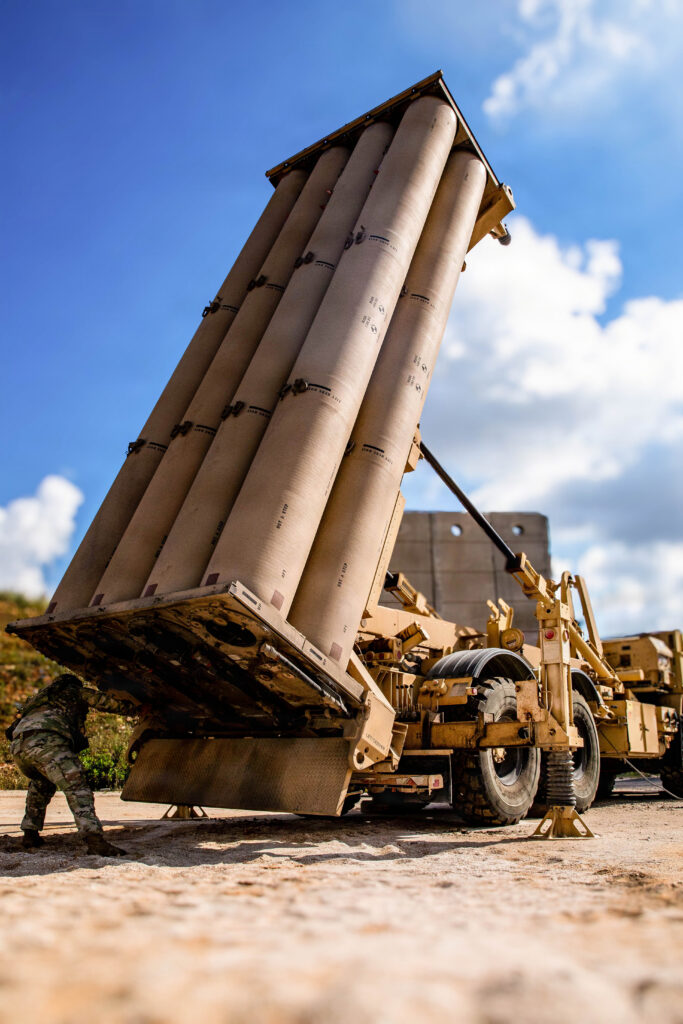
While SRM manufacturing is a specific concern, concerns about dwindling munitions stockpiles overall have existed for years. In addition to expenditures in the Iran conflict, support for Ukraine since it was invaded by Russia has increased the amount of materiel that must be replaced to ensure readiness for US forces. But it’s not as simple as flipping a switch and increasing production of everything that is needed to meet the challenges of AMD, as was just described.
Demand signals have been inconsistent, not just for SRMs, but for AMD systems and their components overall. While the DoD has started to invest more in AMD – including starting to invest directly in component manufacturers outside the traditional prime contractors – much funding over recent years went to maintenance and operations as opposed to procuring more materiel.
New and non-prime suppliers are working to fill the gaps, Spagnoletti said.
“The existing supply base has quite a lot of inertial mass,” he said. “Although they can produce very high quality parts that are very predictable, being able to adapt and innovate quickly is where new entrants have an advantage.”
Advantages in next-gen munitions
One area where new entrants have an advantage is in developing next-generation munitions to help meet future AMD needs. Among those technologies is liquid rocket motors, which Ursa Major recently demonstrated as part of the Air Force’s Affordable Rapid Missile Demonstrator (ARMD) program.
Liquid rocket motors are not new technology, but traditionally they require cryogenic storage of fuel and fueling right before launch. Ursa Major’s Draper engine doesn’t and uses storable liquid fuel to power hypersonic missiles.
“Storable liquid rocket engines, particularly the one that Ursa Major is developing, utilize non-toxic propellants that can be stored in a wide range of temperatures – unlike cryogenic systems typically used for launch,” said Katrina Hornstein, program manager, Ursa Major. “We’ve gone the storable route; it is a closed-cycle engine, meaning it is highly efficient and it’s easy to carry a lot of propellant with you.”
The company extensively uses additive manufacturing to streamline the design and manufacturing process, and is also able to source materials from outside the defense industrial base, such as auto manufacturing. That mitigates supply chain concerns and allows for faster increases in production.
Shoring up the AMD infrastructure
Ultimately, US AMD systems have performed well in recent conflicts. But restocking for ongoing conflicts such as Iran or potential conflicts in the future such as the Indo-Pacific will be critical, because shortages of interceptors or radars can be disastrous.
“The good news is that few ballistic missiles have been hitting,” said Karako. “Some have, to be sure, been getting through, but we’ve been engaging a lot. It used to be that certain folks would crow that you can’t hit a bullet with a bullet. That cottage industry has gone silent. Now the complaint is that we aren’t hitting bullets with bullets cheaply enough, and that we are running out of anti-bullet bullets.”
To meet future needs, the DoD needs to send consistent demand signals to the industrial base, which needs to ramp up capacity as quickly as possible while still meeting highly technical capability demands. New manufacturing technologies such as 3D printing and additive manufacturing can help streamline processes, while new weapons such as liquid-fueled hypersonics can respond to evolving threats.
Ultimately, it is a solvable problem, but will require a joint effort from the Pentagon, manufacturers and suppliers to effectively provide troops in the field with the tools they need for effective AMD.
“We need to consider being able to have critical munitions that can perform the way we want them to, but we need to be able to produce them at scale,” said Spagnoletti. “We need to think about innovation when it comes to actual performance characteristics. We need to be providing capabilities that put our adversaries at a disadvantage all the time, constantly. And then we need to think about how we produce those munitions at scale affordably so that we can provide the warfighter what they need when they need it.”