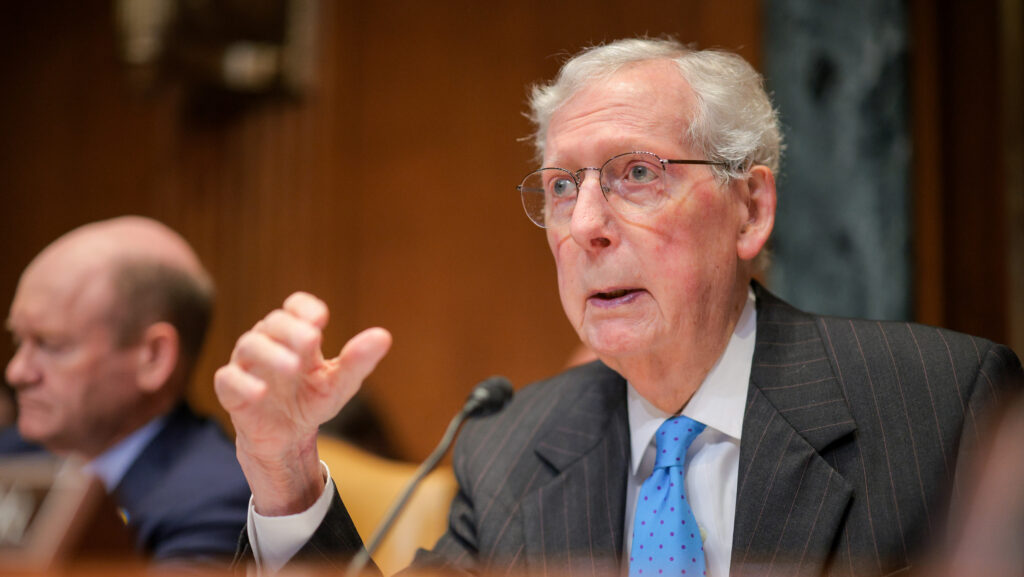
WASHINGTON — Another reconciliation bill with funding for defense is “really not an option,” the head of the Senate Appropriations defense subcommittee said today, casting further doubt on the Pentagon’s plans to use $350 billion in reconciliation money to fund a $1.5 trillion defense budget.
“I think it’s safe to conclude there will not be another reconciliation bill,” Sen. Mitch McConnell, R-Ky, said during a hearing today.
McConnell’s remarks came in response to an exchange between Air Force Secretary Troy Meink and Senate Appropriations Chairman Susan Collins, R-Maine, who asked Air Force leaders what would happen if funding for the F-35 included in the reconciliation request never materializes.
After McConnell stated that the reconciliation bill is “really not an option,” Collins added, “I agree with that assessment.”
Appropriators like McConnell and Collins do not own the reconciliation process, which will be directed by Republican leadership and the budget committees. However, their concerns echo those from analysts and other members of Congress, who have warned that the chances of passing reconciliation are dimming as Congress approaches midterm elections and could result in key defense priorities getting squeezed out of the budget.
At issue is Republican leaders’ decision to focus the second reconciliation bill, following last year’s One Big Beautiful Bill, on funding immigration enforcement, leaving out defense and other key priorities. The House is set to vote today on that $70 billion agreement, which passed the Senate last week.
The Republican Study Committee convened a meeting Monday to discuss a third reconciliation bill, Politico reported Monday. That measure could include defense funding but will face a ticking clock as midterms approach this fall — and, as evidenced by today’s hearing, is a growing concern among pro-defense Senators, who on a bipartisan basis expressed concern about the current approach.
Sen. Tammy Baldwin, D-Wisc. said she was “very concerned” that a large part of the Air Force’s request is relegated to the “partisan reconciliation measure.”
Sen. John Kennedy, R-La., noted that Congress is unlikely to pass a budget before the new fiscal year starts on Oct. 1, and asked Air Force leaders how that would affect the department.
Meink responded that a CR would have “significant” impacts on readiness, leaving the Air Force unable to make key investments in areas like drone defense, F-35 sustainment and munitions procurement.
“Well, I think you should prepare for it,” Kennedy said. “Again, I hope I’m wrong, but I doubt it.”
One way to ease some of the pain if reconciliation doesn’t happen would be in the form of a supplemental funding bill with money to replenish equipment expended or destroyed in Iran, or even to fund new systems, as laid out by acting Pentagon Comptroller Jules Hurst in March. But while a supplemental has been teased almost from the first week of the conflict, defense officials have not made clear when a request will be made to Capitol Hill, much to the consternation of lawmakers.
Sen. John Hoeven, R-N.D., asked whether passing a supplemental funding request would become more important if Congress fails to pass additional defense reconciliation funds.
“If we’re not able to do a reconciliation and we continue to work to get the regular funding through in terms of the budgetary process, isn’t it vital that we have a supplemental right now to make sure that we have provided funding for our global military operations?” Hoeven said.
Meink said that getting the full amount requested in the FY27 budget was “vital” but added that the supplemental will come from the Office of Management and Budget.
“The DoW [Department of War] is working with OMB on options,” he said, using a secondary name for the Defense Department.
Breaking Defense Video