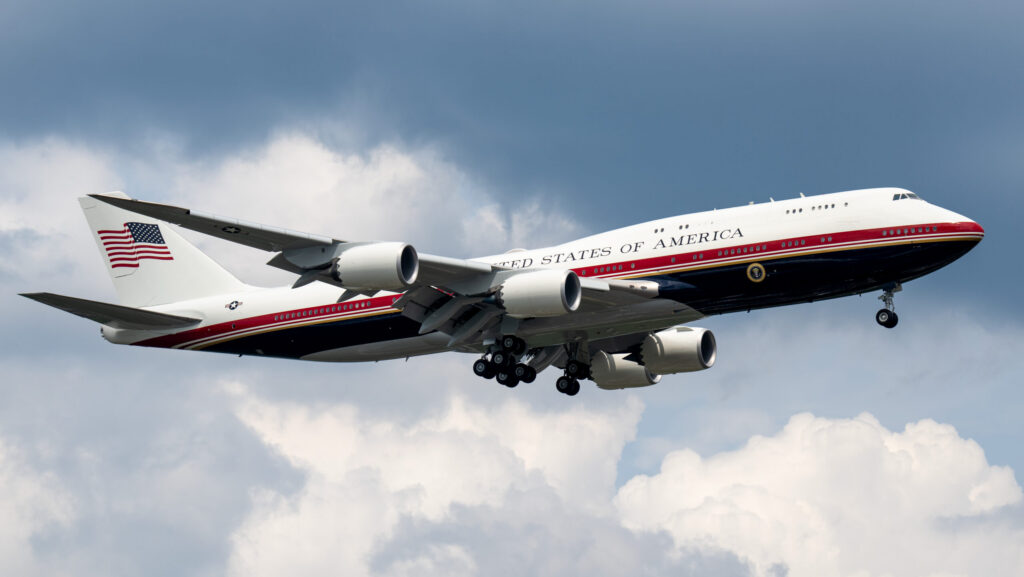
FARNBOROUGH — A Boeing 747 donated by Qatar and modified to serve as a new flying White House will be taken out of service for additional upgrades, just weeks after an international debut, according to President Donald Trump.
“It has a lot of capability,” Trump told reporters on Sunday in New Jersey while departing from the FIFA World Cup final, according to Reuters. “But as I understand it, in about a month or so, they’re gonna send it to have it be maxed out.”
Trump said the modification will “take about a month,” but did not elaborate on what the process will entail.
On July 9, the New York Times reported the aircraft — gifted last year by the Qatari royal family — lacks anti-missile countermeasures standard for flying the president and an extensive entourage of security personnel and other passengers. The story prompted an aggressive reaction from the Trump administration, including subpoenas hand-delivered to Times journalists demanding they testify about the sources for their reporting.
The Qatari jet, dubbed the “VC-25 Bridge Aircraft” by the Trump administration, was accepted by the US government last year. Its security upgrades were spearheaded by L3Harris in a 10-month sprint, a timeline that invited skepticism by lawmakers and experts over concerns that certain security measures were being sacrificed for the sake of schedule.
“We knew there were some issues around security with the plane. We’ve known that from the very beginning. Obviously, there was an effort to address that,” Sen. Jeanne Shaheen, D-N.H., said during a media roundtable at Farnborough Airshow this morning.
“I have, I think, in the past, called for a hearing on to make sure that this is a plane that’s safe, that [it] provides protection for our president, and I would hope that we would continue to move in that direction so that the public is reassured that the protection is going to be there,” added Shaheen, who is a defense appropriator and member of the Senate Armed Services Committee.
But Sen. Jerry Moran, R-Kan., who also serves on the defense appropriations subcommittee, said that the decision to take the plane out of service was actually “a positive,” because it shows that that stakeholders are ensuring the plane is secure.
“If there … was an examination and a problem apparently was determined to exist, the good news is that it’s apparently going to be addressed,” he said. “And I think it’s important for all of us to determine what that problem is and to be supportive of corrective measures.”
The Air Force and L3Harris did not immediately respond to a request for comment on the additional upgrades. When the aircraft entered service earlier this month, just in time for the celebration of America’s 250-year anniversary, L3Harris executive Jason Lambert told Breaking Defense that he has “the utmost confidence that the aircraft is ready to perform the mission as Air Force One.”
Nevertheless, after flying on the aircraft to the NATO summit in the Turkish capital of Ankara, Trump opted to leave the region on an older Air Force One model as tensions climbed with Iran. On board that aircraft, journalists were instructed to close their window blinds.
Trump denied that security concerns drove the aircraft swap, but seemingly alluded to threats from Iran when asked about closing the window blinds, reportedly referring to “sleazebags over here.” The president then reunited with the Bridge jet in the United Kingdom and returned back to the US aboard the aircraft.
Air Force Secretary Troy Meink testified before Congress last year that the modifications for the Qatari jet would cost taxpayers “less than $400 million.” The service has said the fresh jet will “relieve pressure” on the aging fleet of VC-25A aircraft that currently alternate as Air Force One.
Boeing is separately upgrading two additional 747 jumbo jets for the Air Force One mission under a contract signed during the first Trump administration, but technical and workforce challenges have pushed back delivery of the first aircraft by roughly four years — earning the president’s ire. Steve Parker, the chief of Boeing’s defense division, told reporters Sunday that the company expected to take further cash hits on the aircraft’s fixed-price deal that has already driven about $2.8 billion in charges to date.
After personal signoff from Trump, the Qatari aircraft was painted with a red, white and blue livery — eschewing the iconic baby blue scheme used since the Kennedy administration.
PHOTOS: Farnborough 2026
 Gallery