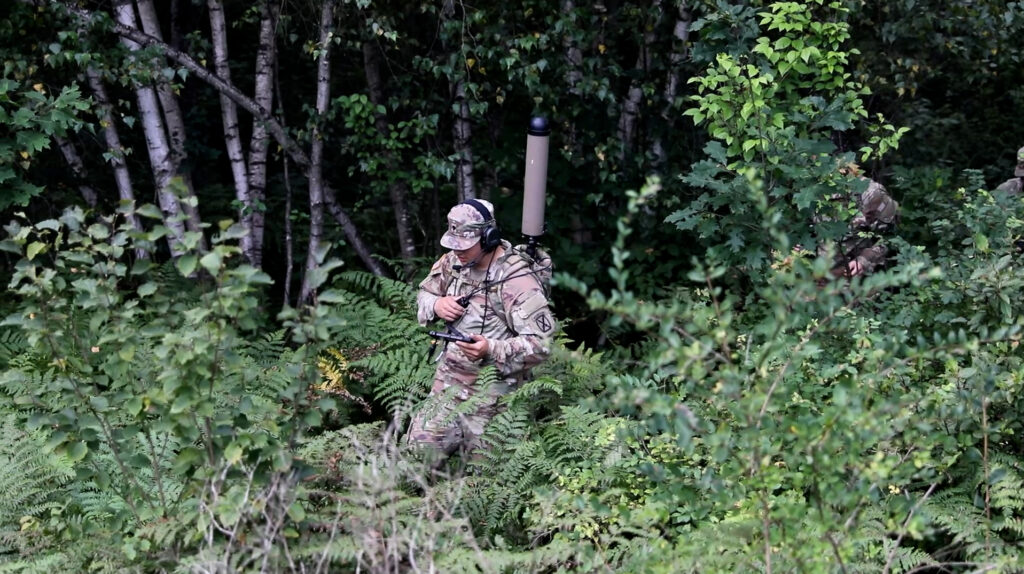
AUGUSTA, Ga. — With no new starts for electromagnetic spectrum operations (EMSO) capabilities budgeted for fiscal 2027, the Army is looking to leverage prototypes and broad requirements from other programs to get new kit in the hands of soldiers, officials said this week.
Earlier this year, the Army published two documents — a Characteristics of Need (CoN) for EMSO systems, which is a guiding document that outlines broad based needs as opposed to hyper-specific requirements, and the Rapid Electromagnetic Warfare & Signals Intelligence Commercial Solutions Offering (REWSI) Commercial Solutions Opening (CSO), which is a library of capabilities to choose from — all in the name of getting new kit to soldiers faster.
No new starts means the Army isn’t creating any new programs or receiving money to fund brand new efforts as part of the FY27 budget. But with the desire to leverage commercial systems and soliciting industry ideas to continue to continue to get after gaps through the CoN, “there’s two ways to skin that cat,” Mark Saxon, deputy project manager for Electromagnetic Warfare & Collection, told Breaking Defense in an interview.
First, his office is looking at experimentation in small quantities working with the Army’s V Corps, taking advantage of research and development funds. V Corps, which is based in Kentucky but has forward deployed troops in eastern Europe, will also help serve as a pilot for the REWSI, he said. The REWSI will allow the Army to pick and choose capabilities from a library of commercial systems creating constant competition and ensuring they don’t have the same thing that might not work for every formation in every theater.
Second, is the Army is looking to piggyback on requirements of other existing programs, both EW specific and non-EW. Other programs have EW requirements, Col. John Harrell, director of the EW directorate in Army Futures and Concepts Command, said in an interview, and the Army can use some of that funding to provide more EW gear.
“Fires, Aviation, Maneuver even, they do have some requirement documents as well and money towards key capabilities that need EW to enable,” he told Breaking Defense. “I think that’s something that we’re exploring as well as we start talking about that taxonomy and that understanding of a governance process. It’s their money to spend, but why isn’t it also our capability to use as well?”
Other existing EW programs of record have some wide requirements in the way of electronic attack, electronic support and electronic protection.
“There’s a lot we can fit under there. It’s really about defining the right capability for the unit and then making sure it aligns to the requirement,” Saxon said.
This follows years of trying to play catch up after the Army divested much of its EW systems at the conclusion of the Cold War. The Army had, in many ways, over engineered or over prescribed systems leading to delays in getting soldiers equipped with modern gear.
“Before we were looking [for] very specific things. I was looking for this range for this specific type target, which is within this range field of frequencies because that’s what the threat told me I needed to go find. The team was doing a great job of buying exactly that tech or trying to buy that exact tech,” Harrell said.
With the CoN and CSO approach now, however, it provides the team more flexibility to get new capabilities to units if technology advances or if there are formation changes within the Army.
“What the CoN has allowed us to do is be even more flexible within that framework. As [Intelligence and Electronic Warfare] battalions are getting ready to stand up, we’re changing the force structure. We’re defining exactly what they’re going to be doing. It allows us to flex the kit,” Saxon said. “If you’re an [electronic attack]-focused unit, maybe you’re going to get more EA kit with the [Terrestrial Layer System Electronic Warfare] And if you’re an ES focused — it allows us to flex and say, we’re not going to give you the baseline. Everybody’s not going to get the exact same baseline. You might need more processing power for a SIGINT unit, so we’re looking at a more expensive system there.”
Moreover, ongoing experimentation with the Army’s Next Generation Command and Control has allowed the EW team to workshop capabilities and tailor them to units in ways that weren’t possible before. While EW kit was given to experimental units in the past — as part of the Army’s Transformation in Contact initiative — the serialized NGC2 experiments provided a better venue to iterate.
“Things like Ivy Sting series, as we were going, was defining where these things should be at what echelon. Should it be in a targeting cell to affect fires? Should it be in an intel cell to actually do effects on the back end and prioritize sensors for intelligence gathering? Or should it be with a maneuver and plans of maneuver scheme,” Harrell said. “Each commander decided to do that differently. 25th is doing it one way, and then 4th ID did it completely different way. They’re both effective. I think that was something that was key for us to learn.”