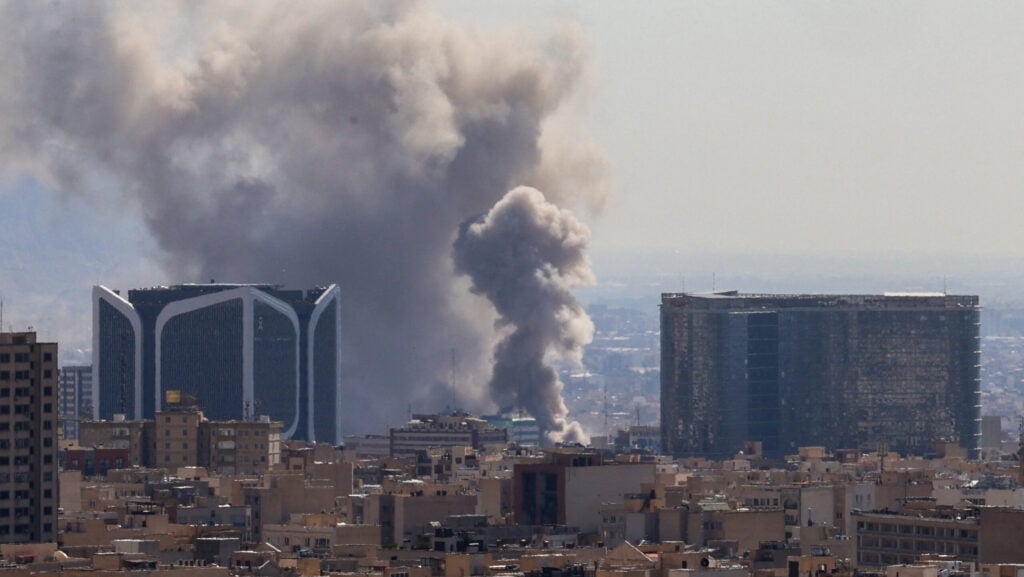
China’s People’s Liberation Army (PLA) has not fought a major war in nearly five decades, leaving many of the concepts driving its modernization efforts untested in combat. So it’s no surprise that Chinese military researchers are soaking in everything they can from the conflict in Iran in order to measure those concepts against battlefield reality.
The takeaway seems clear: For the PLA, Iran has reinforced many of the ideas already driving China’s modernization around “intelligentized” and systems-oriented warfare. The conflict, PLA scholars are saying, shows China is already on the right track with developing a military capable of challenging other large militaries.
Chinese military commentary since the opening of hostilities echoed a familiar theme: future advantage depends less on any single platform than on the speed, resilience and cost efficiency of the overall system connecting sensors, decision-makers, weapons, logistics and data. In an April 12 analysis, PLA Academy of Military Science (AMS) War Research Institute academics Tian Kaiyuan and Wang Jianfei described the conflict as a transition from “force-on-force confrontation” toward “systems competition.” Their discussion focused on distributed command, attacks on enabling nodes and the low-cost attrition of what they call “systems guerrilla warfare.” Rather than match an opponent platform for platform, they prioritize the disruption of the networks that allow advanced platforms to generate combat power.
In an April 13 PLA Daily article, Xu Fangming of the AMS War Research Institute argued that the US-Iran conflict accelerated a shift from “human-led linear killing” toward AI enabled, networked kill webs. Other AMS theorists have treated the Iran conflict as evidence supporting ideas they had advanced before the war: that intelligence networks built in advance, the integration of sensors, command systems, weapons and unmanned platforms, and the pressure that large numbers of relatively inexpensive weapons can defeat sophisticated defenses. They also highlight the vulnerabilities behind those advantages, noting that stale or deceptive data undermine AI-assisted targeting, attacks on critical nodes can disrupt otherwise capable forces and concentrated bases or command facilities can present lucrative targets.
Artificial intelligence occupies the center of that network, but Chinese military analysts have not treated algorithms as substitutes for preparation. Kuang Lasheng, an AMS researcher, argues that years of human intelligence, technical collection, pattern-of-life mapping and prewar rehearsal supplied US AI systems with the data needed to accelerate targeting during the Iran campaign. His formulation places “pre-positioned intelligence preparation” at the foundation of military action and warns that even powerful algorithms produce little value when fed unreliable or outdated information.
Military theorists at China’s National University of Defense Technology explicitly focused on the US use of the Maven Smart System in Iran to extend that argument to intelligence fusion, target prioritization, route planning, autonomous attacks and manned-unmanned teaming. Their account places AI throughout the whole kill web rather than inside a single decision point. Prewar studies from the PLA’s Rocket Force University of Engineering described a similar architecture that combines UAV video, signals intelligence, satellite imagery, open-source reporting and electronic-warfare data to generate plans and sensor-to-shooter actions. Much of this work predates the current war, giving the PLA a chance to see concepts already driving its modernization tested in the fires of actual combat.
The conflict has also sharpened Chinese attention to the economics of air and missile defense.
Tian and Wang highlighted Iran’s use of inexpensive unmanned systems to consume far more costly interceptors. Chinese researchers had studied the same imbalance before the current campaign. A 2025 study modeled Isreal’s Iron Dome under increasingly dense rocket attacks, while a 2026 article by PLA researchers drew lessons from earlier US-Iran and Iran-Israel fighting and identified limited defensive coverage, weak battle-damage resilience, high production costs and interceptor shortages as key focus areas. The authors of that study also examined how US missile defenses could use AI to identify multiple incoming threats and launch interceptors from dispersed locations.
PLA Air Force-affiliated authors have described the Iran conflict as representing a new type of large-scale unmanned offensive-defensive attrition. Drawing on Iran alongside the wars in Ukraine and Gaza, they identified three main themes: distributed cross-domain operations, a mix of advanced systems and low-cost weapons and greater autonomous collaboration. A companion article also advocated pairing sophisticated systems with cheaper sensors and interceptors while distributing critical nodes across the defensive network. China’s defense industry had already advertised a similar approach through counter-UAV systems combining missiles, guns, electronic warfare, lasers and high-power microwave systems. The objective goes beyond destroying incoming weapons by improving the exchange ratio and preserving defensive capacity during prolonged saturation attacks.
Chinese analysts have also drawn a parallel lesson about survivability. Earlier PLA commentary and analysis criticized linear kill chains vulnerable to communications disruption or node destruction and instead proposed dynamic kill webs that can reroute information and continue operating after local losses. The Iran war has provided a practical example of that problem. Tian and Wang emphasize distributed command and backup decision nodes, while technical studies examined how local nodes can maintain command and control after losing contact with a central command post. The common objective centers on preserving the wider combat system when individual nodes fail.
That logic expands the target set far beyond aircraft, missiles or command posts. In an April 12 Guanming Daily article, Zhao Lei and Liu Ning of China’s National Defense University argued that modern conflict increasingly links the kill chain with the supply chain. They identified airfields, ports, warehouses, pipelines, power infrastructure and data centers as operationally significant targets whose loss can degrade the wider combat system. A second report in May 2026, from a think tank affiliated with China’s Ministry of State Security, applied a similar framework to “infrastructure warfare”, highlighting attacks on energy, transportation, financial and digital infrastructure. They paid particular attention to commercial cloud and data centers, arguing that AI’s growing role in intelligence collection, target identification and precision strike increasingly makes the infrastructure supporting those functions a physical target.
Broader commentary from China’s national security research community echoes these themes. In an April 2026 symposium in Modern International Relations, Tang Zhichao, director of the Political Research Office at the Chinese Academy of Social Sciences’ Institute of West Asian and African Studies, highlighted standoff warfare centered on missiles and UAVs, asymmetric operations and large-scale military use of AI, while predicting greater interest in missiles, drones and A2/AD. Chen Wenxin, director of Ministry of State Security-linked think tank CICIR’s Institute of American Studies, focused on the cost imbalance between cheap drones and missiles and expensive Patriot and THAAD interceptors, while Chen Qinghong, deputy director of CICIR’s Institute of World Politics, emphasized ammunition stocks, defense-industrial capacity and the vulnerability of US forward bases. Though none speaks for formal PLA doctrine, their analyses show these questions circulating across China’s national-security community.
These publications do not prove that the PLA has formally converted Iran’s lessons into doctrine, force structure, or procurement decisions. Instead, they show Chinese researchers comparing combat experience against concepts already embedded in PLA modernization efforts, then using the results to identify weaknesses and development priorities.
For US planners, that pattern deserves attention. Chinese analysts do not need to conclude that every Iranian tactic succeeded before drawing value from the conflict. Failed strikes can expose sensor limitations, successful penetrations can reveal defensive seams, interceptor consumption can illuminate ammunition requirements and attacks on bases or logistics centers can test assumptions about system resilience. Each episode supplies data against problems the PLA already studies.
The most consequential Chinese lesson from Iran may therefore come not from any single weapon or tactic, but from the interaction among intelligence preparation, AI-enabled decision speed, distributed unmanned systems, cost-imposing salvos and the networks that connect them.
Chinese researchers approached the conflict with an established framework for how future high-end warfare could unfold. Their assessments of Iran have largely reinforced that approach, strengthening their case for continued investment in the capabilities that support faster, more distributed, resilient and cost-effective combat systems.
Tye Graham is a Senior Researcher with BluePath Labs and a retired US Army Foreign Area Officer.
Breaking Defense Video