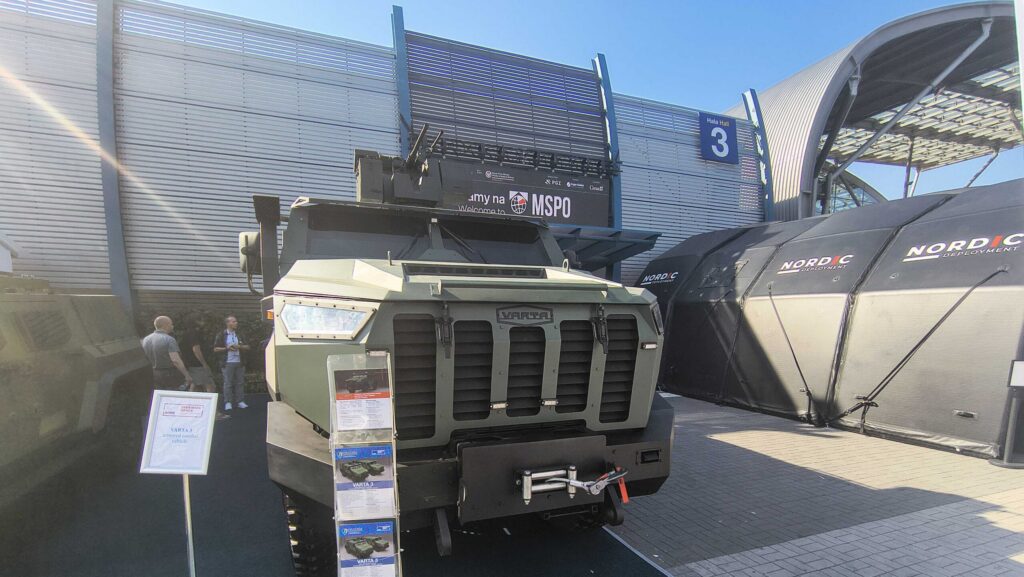
KIELCE, Poland — The CEO of Ukrainian Armor says that the Eastern European firm is looking to German industry, potentially like Mercedes-Benz’s defense arm, in a bid to forge an industry partnership to support manufacturing of two new land vehicles unveiled at the MSPO trade show.
Speaking about plans for the Saigak Armored Personnel Carrier (APC) and Varta 3 Mine Resistant Ambush Protected (MRAP) vehicle, unveiled here, Vladyslav Belbas told Breaking Defense, “We are trying to pay attention to the German market, in terms of [securing] cooperation with German companies such as Mercedes-Benz.”
Saigak, he said, represented the firm’s first foray into light armored vehicles, while the Varta 3 is “based on” the Mercedez-Benz Unimog chassis. Saigak features an active protection system that the company says can defeat up to 20 First Person View (FPV) drones, amid a proliferation of the aircraft dominating the war in Ukraine.
Belbas said that the vehicle is “dedicated” to transforming unarmored civilian pick-up vehicles and protecting them from drone threats, adding that the conflict’s “kill zone” currently stretches between 20 to 30 kilometers (12.4 to 18.6 miles), while longer-range drones can attack as far out as 100 kilometers.
Separately, he said that the Varta 3 can protect passengers from an eight kilogram TNT explosion and is equipped with ballistic protection.
“We hope the new products will find interest on the market, [and] we also look forward to cooperating with German industry … because Germany is one of the biggest donors now to Ukraine, but they want also to involve their industry in these donations,” Balbas added.
He explained that no discussions with the German government have been held, however, regarding future vehicle orders.
On Iran, Ukraine And Air Defenses
During the discussion with Breaking Defense, Belbas also offered his view on the status of the war against Russia, and how it had been affected by another conflict thousands of miles away: Iran. He stressed that the high expenditure of US weapons used against Tehran and for air defense in the Middle East has had a profound impact.
“We cannot judge or make conclusions on what America is trying to do with their own weapons. … But definitely, it [Iran war usage rates] gives significant damage to supplies of air defense missiles in Ukraine, and now you see that unfortunately [over] the last few weeks in Kyiv,” he said.
Looking at how Ukraine can counter Russian attacks without desperately needed weapon systems like the US Patriot, Balbas focused on a two-fold solution: local production of air defense missiles and jet-powered interceptors, in parallel with attacking Russian production sites.
He said he believed that a peace settlement is “very far away” because Ukraine’s position has been weakened as a result of expending interceptors to counter Moscow’s ubiquitous use of Shahed-style drones.
“So on the battlefield, Ukraine is progressing a little, not Russia. But in the rear, cities are destroyed. … All of this because [of] a lack of Patriots, interceptors.”
He was also critical of some European firms willingness to pursue industrial partnerships. “When we come to some European companies for discussing some cooperation, they evaluate … [their] return on investment,” he said. “All this in Ukraine we invest because we want to survive. We are not investing to get the money back.”
Breaking Defense Video