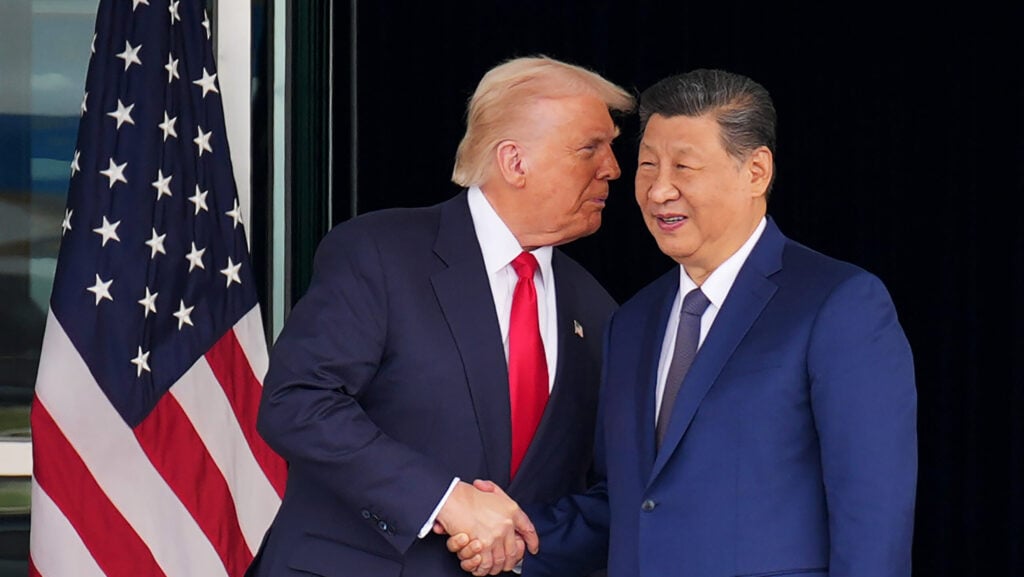
When President Donald Trump descended the stairs from Air Force One in Shenzhen, China, he was greeted with a hug from China’s Xi Jinping. And why not? It’s easy to imagine Xi is in a pretty good mood these days, thanks to the early conclusions Chinese planners are likely drawing from the 2026 American midterm elections.
Determining American political vulnerabilities is an essential part of preparing the political terrain for exploitation in any future crisis. For Xi, understanding what American voters will and won’t tolerate will provide direct insights into how China should act during any potential conflicts in the near and long term. And when it comes to takeaways from the election, there are two that Beijing is likely to focus on: the American public’s appetite for conflict, and the American public’s apprehension around artificial intelligence.
Both could have major impacts on Chinese planners when thinking about the short term, such as a potential Taiwan conflict, and the long-term with its great power competition with Washington.
Past Chinese analyses have highlighted the apparent reluctance of the American electorate to sustain wars in the face of casualties. Chinese military analysts have pointed to the American withdrawal from Somalia in 1993 after the “Blackhawk Down” fiasco. They have also suggested that the reason the US bombed Serbia while refraining from committing ground forces was a similar fear of suffering casualties. No doubt April’s massive US effort in Iran to rescue a downed F-15E crew reinforces this view. The implication is that the prospect of suffering significant casualties is likely to deter, or at least slow down, American leaders and make them reconsider their commitments.
But interestingly, the current conflict with Iran has not seen significant American casualties. The US has suffered several dozen killed and several hundred wounded, for which it has inflicted massive losses on the Iranian armed forces and decapitated much of the Iranian leadership. Nonetheless, as even Vice President JD Vance observed, the war with Iran was a huge factor in the Republican loss of the House and Senate.
In this election year, the impact was not from human casualties, but economic losses. The closure of the Straits of Hormuz, as much because of the maritime insurance industry’s fears of losses as actual damage to shipping inflicted by Tehran, led to rising oil prices, which in turn affected pricing of all other goods and services. And the costs persist, as the conflict continues to extract a toll on domestic economics.
It is therefore likely that a key takeaway that Beijing will factor into its preparations for any conflict over Taiwan is ensuring that the war will impact the American voters. Given the heavy Chinese presence in various supply chains, especially of consumer goods, it is likely that the Chinese will restrict the flow of goods to Walmart and Amazon, as well as rare earth minerals, while at the same time boycotting American goods in China. The goal would be to cause disruptions in the American economy that would directly affect the voting public.
But as students of history, the Chinese also likely expected the Republicans to lose at least one of the houses of Congress, as is typical of mid-term elections. They likely did not anticipate the electorate’s mass disdain for data centers and, by association, artificial intelligence. In 41 ballot initiatives in 10 states, all but one resulted in measures to limit future data center development. Nationwide, data centers were not only a major part of debates, but the American electorate has broadly rejected their unfettered expansion.
For Beijing, this is an enormously important development.
From the Chinese Communist Party’s (CCP) perspective, with the massive growth and expansion of information and communications technologies (ICT), humanity transitioned from the Industrial Age to the Information Age in the 1990s. The currency of power shifted to the ability to generate, move, analyze and exploit information more rapidly and more accurately than your competitor or adversary. The shift to the Information Age altered the underpinnings of everything from military security to economic development to genetic engineering and medical research. Developments such as cell phones, the internet and the proliferation of computers and tablets led to a massive expansion of person-to-person and organization-to-organization information sharing. The Chinese termed this “informationization” (alternately translated as “informatization” and “informationalization”).
The transition is ongoing, with continuing advances in ICT. The result has been “intelligence-ization” (alternately translated as “intelligentization”). Where previous information sharing and exploitation continued to have a heavy human component, this is now evolving to machine-to-machine information movement, without human intervention. This is the key to such developments as the Internet of Things, networks of self-driving cars, “smart cities,” and drone swarms. Whether it is future cities or future battlefields, the ability of machines to interact with other machines, at the speed of algorithmic “thought,” will be a key determinant of winners — and losers.
In a 2025 session with the CCP’s top leadership, Xi emphasized that Chinese AI development must not only involve developing technical AI capabilities, but its incorporation into a broad range of economic activities. That is, AI is not just about advancing R&D, but applying it to existing industries and services — including the military.
In this environment, the gap between Chinese and American views of AI is striking. According to the Stanford AI index, over 80 percent of Chinese are excited by the prospects of artificial intelligence, over double that of American respondents. As important, only one-third of those Americans surveyed said they would trust AI, against 72 percent of Chinese. It seems clear that Americans view AI with deep skepticism if not outright animosity, a view reflected in the mid-term election results.
Much as the Soviets tried to exploit the West’s anti-nuclear movements, it is likely the Chinese are similarly trying to capitalize on American and other Western anti-data center and anti-AI feelings. Regardless, there is clearly an anti-AI wave in the American public, which Beijing will no doubt be thrilled by.
In the competition between the US and PRC, the mid-terms suggest that Americans are not prepared to engage in the all-out competition the Chinese expect and are preparing for.
Dean Cheng is a non-resident fellow with the Potomac Institute for Policy Studies and with the George Washington University’s Space Policy Institute. When not translating Chinese articles, he can often be found feeding quarters into pinball machines.