
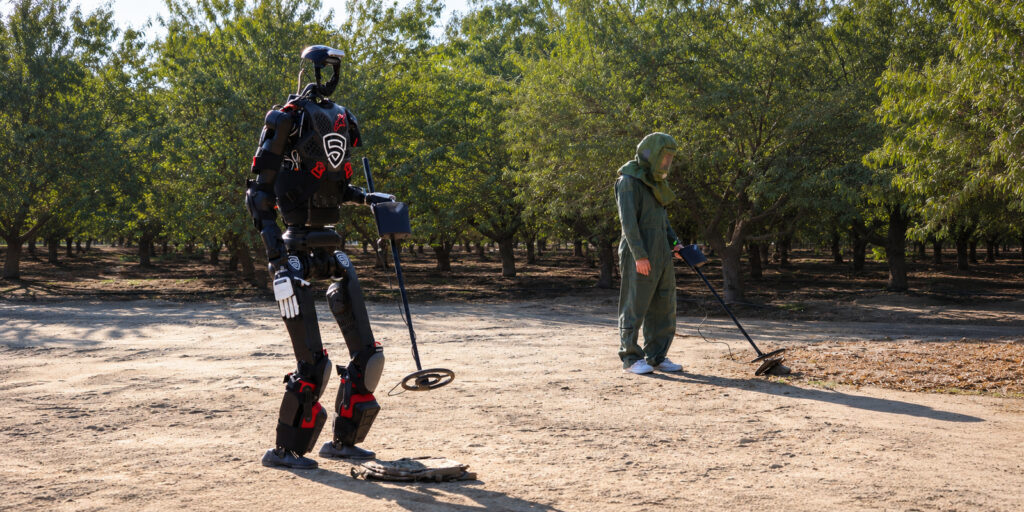
Searching suspected explosive ground puts people in danger. Skylark Labs has demonstrated a humanoid that can take on that search with a standard handheld metal detector—sweeping the ground and responding to its alert under human supervision. The aim is to keep explosive ordnance disposal (EOD) specialists farther from suspected hazards while they direct and assess the search.
In an experiment conducted for an EOD supplier, the robot picked up the detector, swept a designated search area and stopped and backed off when it sounded. It carried out the sequence without a separate command for each step.
Skylark says visual and audio feedback guided the robot through the task. The detector’s beep became an input to its next action, connecting what the machine sensed with what it did. Company footage shows the humanoid sweeping outdoors alongside a person performing the same search. The demo footage can be seen here.
“Our customers already own and trust their detectors. A robot that learns the search from the specialists who do it, and then runs it with that same equipment, takes people out of the most dangerous moments without handing them more work.”
EOD supplier representative
The threat is persistent. Action on Armed Violence recorded 10,376 IED incidents across 94 countries between 2015 and 2024, causing 83,529 civilian deaths and injuries. Suspected devices can also halt movement, restrict access and divert personnel.
EOD teams already rely on robots. In 2022, the U.S. Air Force began fielding 170 L3Harris T7 systems: tracked machines controlled by an operator. Skylark is pursuing a humanoid that carries out an assigned search without requiring a person to direct each movement.
The humanoid form is central to that approach. Its hands, reach and posture let it work with equipment designed for people, including the detectors EOD teams already carry. Learning to use those tools reduces the need to redesign equipment around a robot. The intended payoff is practical: less time spent directing a machine, and less human exposure at the front of the search.
Skylark’s Continual Field-Adaptive Models, or CFAMs, provide the learning capability. Specialists demonstrate how to handle familiar equipment and carry out a search. Skylark says the detector-search skill was taught through a few minutes of human demonstration. The models are designed to keep adapting on the device as the robot works, without a separate retraining cycle.
CFAM delivered about 30% higher task success than a standard model in a real-world manipulation test. In a separate evaluation, it matched a standard model’s performance using just 40% of the training data. It also learned new skills with little loss of earlier capabilities. Performance in new search conditions is still being tested.
“The first footsteps onto unswept ground carry the greatest risk. If a machine can reduce human risk while discerning the unknown, specialized judgment is reserved for the most complex challenges. That only works if we can readily summon machine sensing and human judgment for combined understanding that neither system can achieve alone.”
Retired U.S. Marine Corps Lt. Gen. Michael S. Groen, former director of the Pentagon’s Joint Artificial Intelligence Center and a member of Skylark Labs’ Defense Advisory Board
The demonstrated work is detection support. Physical handling and disposal remain development goals. The humanoid’s value will depend on carrying out a defined search reliably enough that a specialist can supervise from greater separation, instead of being the first person onto unswept ground.
“Our mission is to enable machines—including humanoids—to independently carry out explosive ordnance disposal tasks, keeping people away from potentially lethal threats. We’re building the AI brain that allows these machines to learn efficiently and adapt to unfamiliar objects, terrain, and changing conditions, with the goal of making them reliable and effective in complex EOD operations,” said Amarjot Singh, Founder and CEO of Skylark Labs.
Skylark’s longer-term goal is a team of humanoids working together. Hive, its framework for coordinating multiple machines, is already deployed in oil and gas operations in the United States, India and the Middle East. Applied to EOD, it could let robots divide a search area, share findings and hand off work as conditions change, with one specialist overseeing the team.
The goal is to send the machine first, while keeping the specialist in charge.