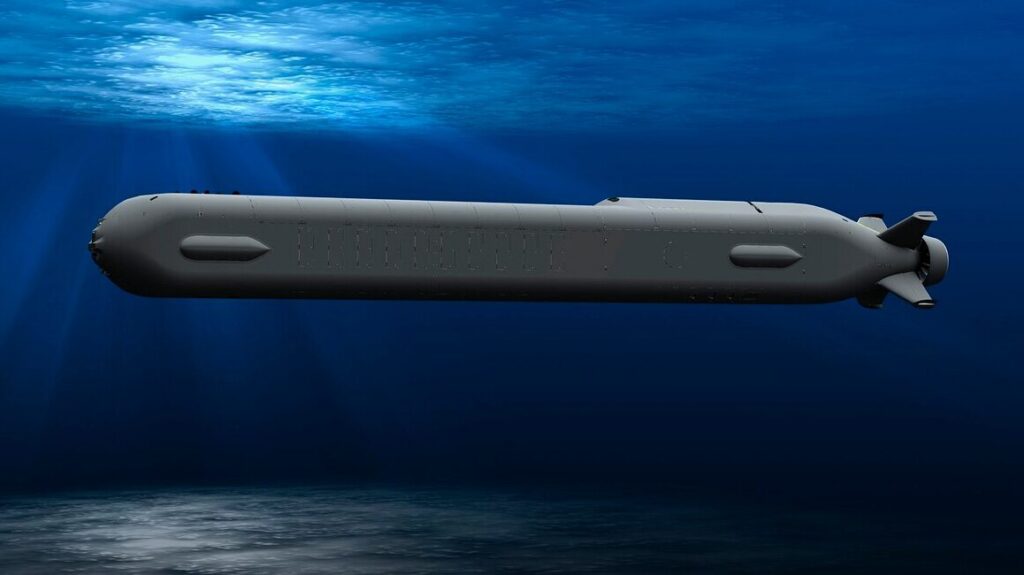
WASHINGTON — The Navy is getting closer to operationally using several unmanned underwater vehicles (UUVs) — specifically the Orca, with the service set to receive its third “soon,” according to the commander of Submarine Forces for the US Pacific Fleet.
Additionally, the Navy is making progress on the Combat Autonomous Maritime Platform (CAMP) XLUUV, which is the Navy and the Department of Innovation Unit’s initiative to quickly prototype and field XLUUVs, as well as the Dragonfish large displacement UUV (LDUUV), which replaced the Navy’s nixed Snakehead LDUUV program.
“Those are all progressing toward meaningful operational employment,” Rear Adm. Chris Cavanaugh said Thursday. “Those systems complement our crewed platforms, expand our reach, increase our operational flexibility, and allow us to accept risks that we wouldn’t take with manned submarines.”
The Orca program is the Navy’s first XLUUV initiative, launched in 2017, and aimed at laying undersea mines. The first test vehicle was delivered in 2023 and the first prototype vehicle was delivered in 2025, according to the Government Accountability Office. The vessel has a range of up to 6,500 nautical miles to support “monthslong, long-range missions” and can accommodate a host of mission payloads, according to Boeing, which makes the vehicle.
Capt. Michael Linn, the program manager for the Undersea Warfare Program Management Office, said that the service is nearing the end of production plans for Orca, and that two of the three prototype vessels have already been delivered. Ultimately, the program will lay the groundwork for other UUV programs like CAMP, he said.
“We’re going to get our third one delivered soon, and that is going to wrap up a long and arduous process of getting Orca over the finish line,” Linn said on Friday. “Once we get it in our hands, we’re going to continue to characterize it. We’re going to put it through its paces and figure out what it really does well and what it doesn’t do well. But the point is I’m fully intent on getting it employed and characterized. CAMP, we’re going to build on what we learned from Orca.”
Breaking Defense Video