Air Warfare, Land Warfare

Boeing drawing up new tiltrotor helo wingman

The planemaker is developing a “conceptual design” of a potential Group 4 or 5 size tiltrotor drone that could team with aircraft like the AH-64 Apache or CH-47 Chinook, according to a company engineer.

Boeing's Collaborative Combat Rotorcraft (CCR) is one adaptation of Boeing’s Collaborative Transformational Rotorcraft (CxR) - a modular, unmanned, multi-mission autonomous tiltrotor concept. (Boeing image).

AUSA 2025 — Aerospace giant Boeing is in the “conceptual stages” of a new tiltrotor drone wingman, according to a company executive, who said the unmanned system could join platforms like US Army Apache attack helicopters or Chinook transport aircraft in battle.

“It’ll be a tiltrotor with two proprotors” and a gas turbine engine, Chris Speights, chief engineer of Boeing’s vertical lift portfolio for its defense division, said in a briefing with reporters on Oct. 7 ahead of the AUSA conference in Washington. “We believe that that’s going to provide the most mature, rapid ability to field.” 

The modular, unmanned wingman “is a conceptual design that’s being developed,” Speights said, adding that Boeing is seeking feedback from the Army. “But all of our analysis shows that this is absolutely meeting the needs” for a “family of systems” setup where various platforms are connected together and working in tandem. 

The drone, dubbed CxR, is being designed to “carry the payloads that are relevant for Apache types of missions,” Speights said, whereas a potential variant, dubbed ClR, would provide logistics support for aircraft like the Chinook. The drone would be in the Group 4 or 5 category, the upper end of how the Pentagon describes sizes of drones. He deferred questions about its development timeline. 

The Army in a shakeup of its aviation portfolio last year canceled a next-gen reconnaissance aircraft dubbed FARA, redirecting its dollars into unmanned systems, though officials did commit to continuing a futuristic assault aircraft dubbed the MV-75. Other military services like the Air Force and Navy are pursuing their own unmanned wingman, but with varying designs. 

Estimating the drone’s max gross weight could be between 5,000 to 7,000 lbs, Speights said it would likely be capable of carrying payloads as heavy as 1,000 to 2,000 lbs. Boeing engineers are targeting a speed for the platform at somewhere between 200 to 250 knots, according to Speights, which he said would potentially enable it to be a wingman for the MV-75.   

“We want to have technologies that are proven,” Speights said, pointing to the company’s experience with the troubled V-22 Osprey that is currently expected to fly with restrictions until next year. Specifically, Speights said Boeing learned important lessons concerning features like tiltrotor control mode transitions — essentially, what systems and flight controls are needed for an aircraft to take off like a helicopter and then shift its rotors in flight to fly like a plane.

“We really want to leverage and lean on that, because there’s a lot of maturity and capability there, and that’s what we see adding value to this collaborative requirement,” he said.

PHOTOS: AUSA 2025

PHOTOS: AUSA 2025

A view of a show floor at the 2025 Association of the US Army's Annual Meeting & Exposition in Washington, DC, Oct. 13, 2025. (Rachel Cohen/Breaking Defense)
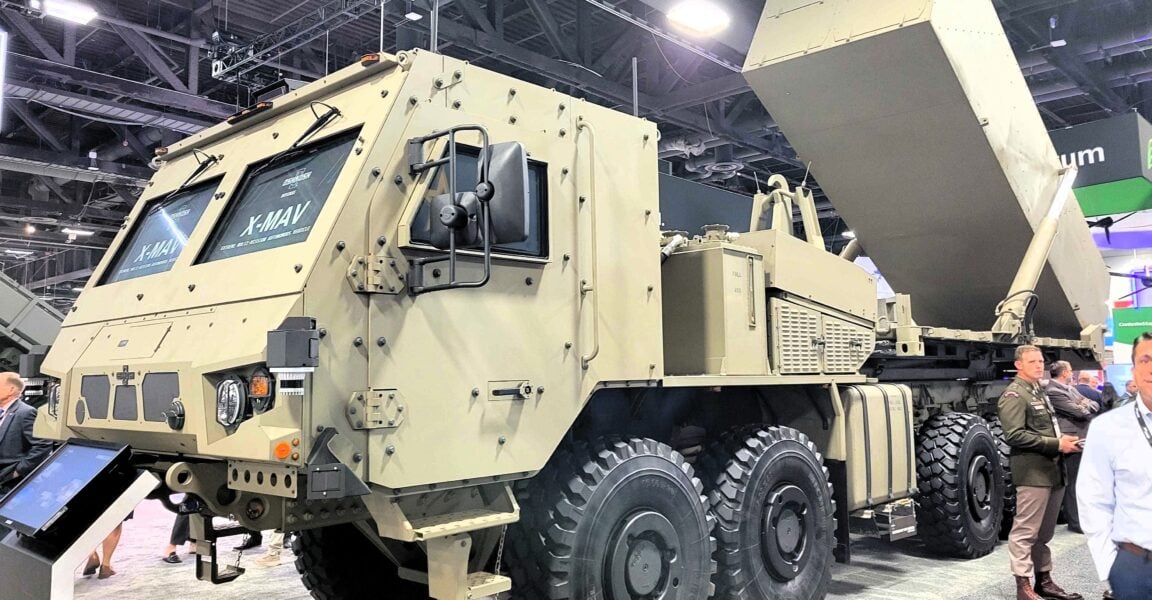
Oshkosh Defense debuts its Extreme Multi-Mission Autonomous Vehicle (X-MAV), an "autonomous-capable launcher solution that is engineered to support the future of long-range munitions," Oct. 13, 2025, at the Association of the US Army's Annual Meeting & Exposition in Washington, DC. (Rachel Cohen/Breaking Defense)
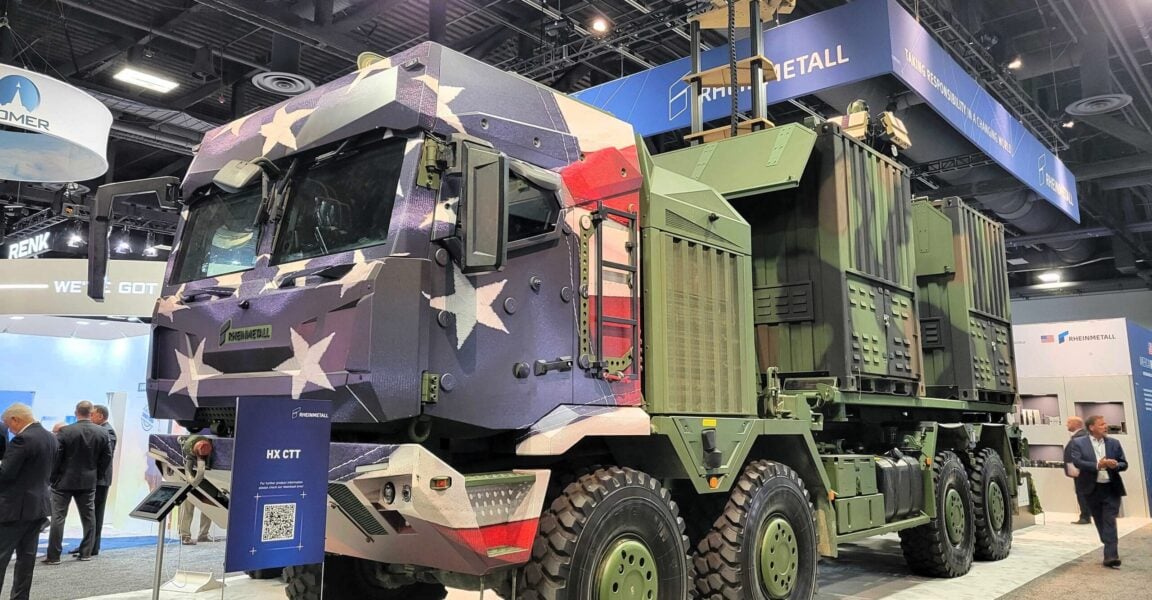
Rheinmetall brought its HX Common Tactical Truck, built in partnership with GM Defense, to the Association of the US Army's Annual Meeting & Exposition, Oct. 13, 2025. (Rachel Cohen/Breaking Defense)
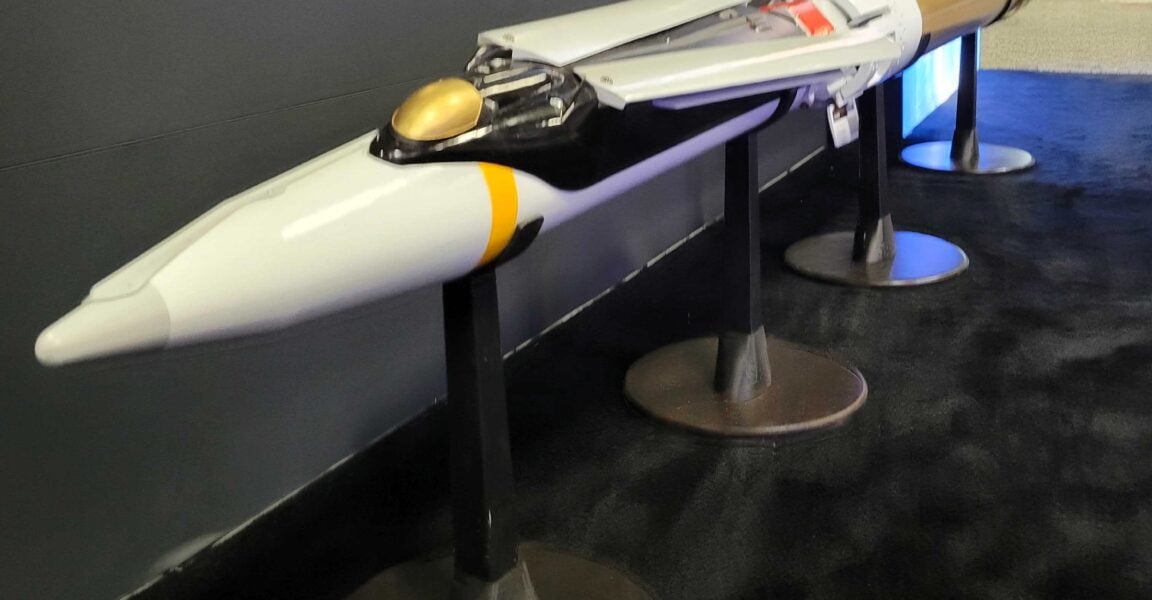
Saab's Ground-Launched Small Diameter Bomb is based on Boeing's SDB and Lockheed Martin's Multiple Launch Rocket System. (Rachel Cohen/Breaking Defense)
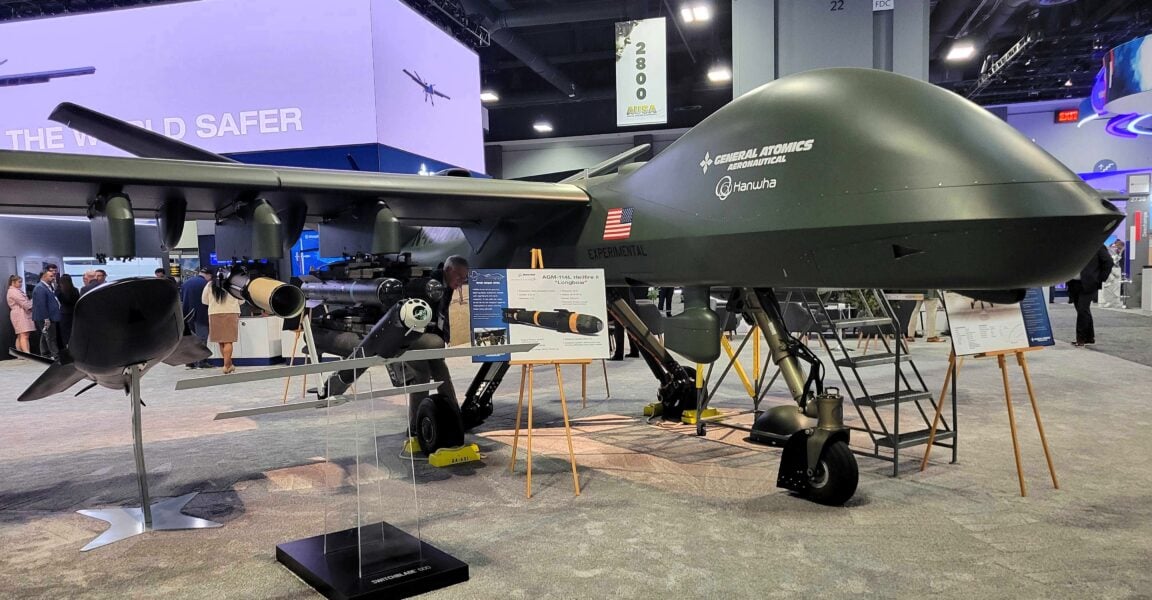
General Atomics Aeronautical Systems and Hanwha Aerospace are collaborating on a short takeoff-and-landing version of the MQ-1C Gray Eagle drone. (Rachel Cohen/Breaking Defense)
Rafael's Iron Beam is a 100kW-class laser weapon on track for operational use this year. (Aaron Mehta/Breaking Defense)
Honeywell's SAMURAI anti-drone system is one of myriad counter-drone technologies on display at AUSA 2025. (Daniel Woolfolk/Breaking Defense)
Hanwha Defense USA pitches its 155 mm, 52-caliber K9 Thunder self-propelled howitzer at the Association of the US Army's Annual Meeting & Exposition in Washington, DC. (Rachel Cohen/Breaking Defense)
Conference attendees try out Trijicon's firearm sights and scopes. (Aaron Mehta/Breaking Defense)
Attendees roam the halls of the Walter E. Washington Convention Center in downtown Washington, DC, Oct. 13, 2025. (Daniel Woolfolk/Breaking Defense)
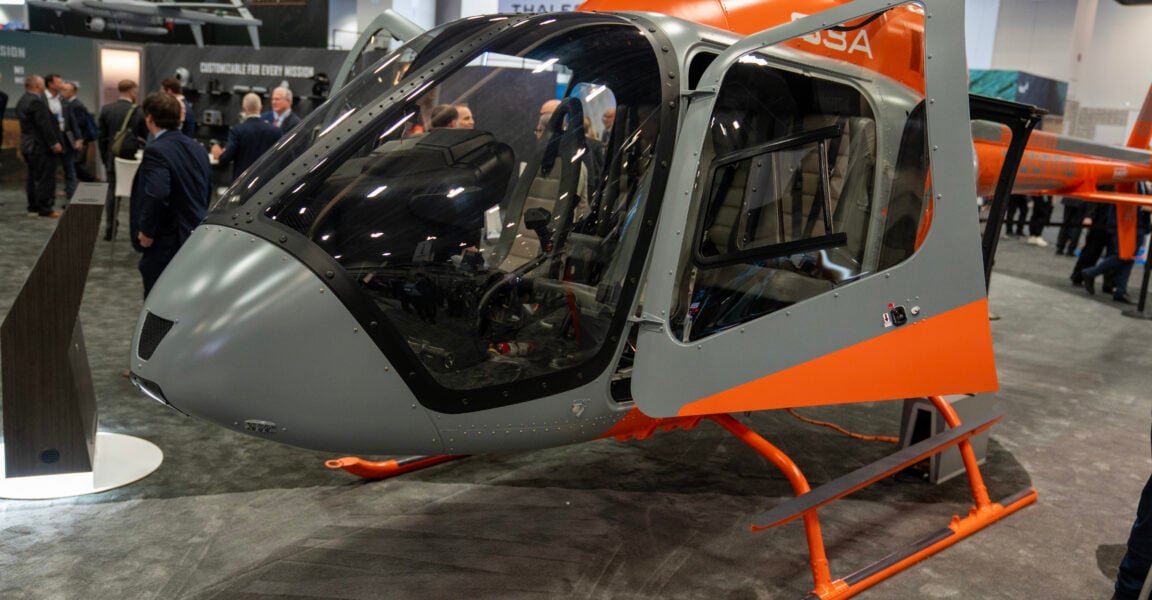
The Bell 505 Jet Ranger X is a contender for the Army's Flight School Next program. (Daniel Woolfolk/Breaking Defense)
GM Defense's Infantry Squad Vehicle-Utility is based on the Chevrolet Colorado ZR2 and can be adapted to carry mortars, counter-drone equipment and more. (Aaron Mehta/Breaking Defense)
Name a more iconic duo. I'll wait. (Aaron Mehta/Breaking Defense)
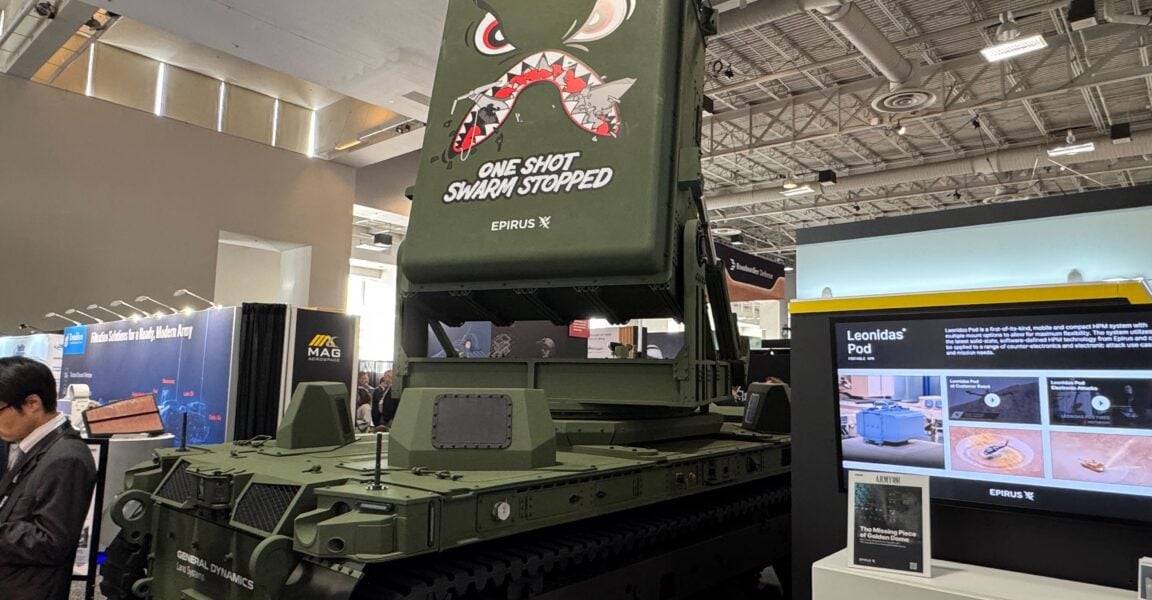
Epirus’s Leonidas high-powered microwave system is mounted on top of a General Dynamics land vehicle. (Michael Marrow/Breaking Defense)
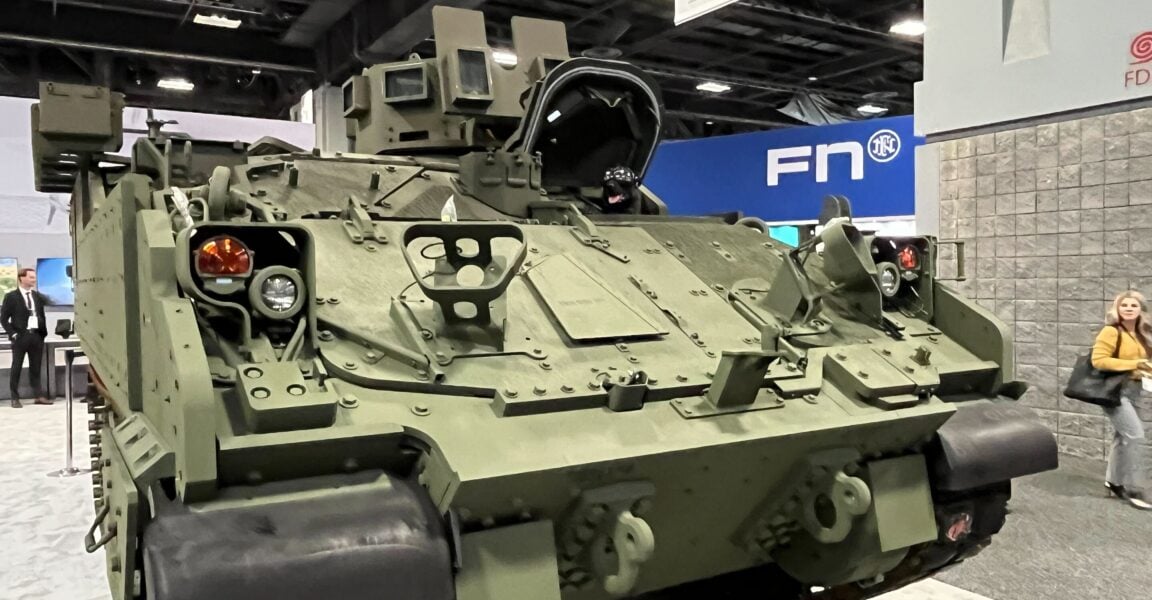
A four-legged attendee checks whether the infantry carrier variant of BAE Systems' Armored Multi-Purpose Vehicle can also carry canines. (Sydney Freedberg/Breaking Defense)
It wouldn't be a defense trade show in 2025 without a robot dog on hand. (Aaron Mehta/Breaking Defense)
Honeywell showcases a hybrid quadcopter/fixed-wing drone on the show floor. (Aaron Mehta/Breaking Defense)
RTX displays its missiles and a Lower Tier Air and Missile Defense Sensor. (Aaron Mehta/Breaking Defense)