WEST 2026 — The Marine Corps recently unveiled new details about its ongoing Dynamis Series, what a senior official called a new “technology accelerator sprint project” aimed at more quickly modernizing the Corps’ command and control architecture to play nicely with those of other services.
The series involves multiple “events of increasing complexity, and we’ve overlaid them with events that have already taken place to take advantage of that opportunity,” Col. Arlon Smith, director of Project Dynamis, said in an interview on the sidelines of the annual WEST conference.
“What we don’t want to do is what we’ve always done in the past: siloed programs, by silo services. You build them, and then we all try in combat to figure out how they connect,” Smith said. “What we want to do is take advantage of the peace time we’re in, take advantage of the momentum we have … and build something that’s inherently joint, that’s going to ultimately prepare Marines for the battlefield we’re going to face.”
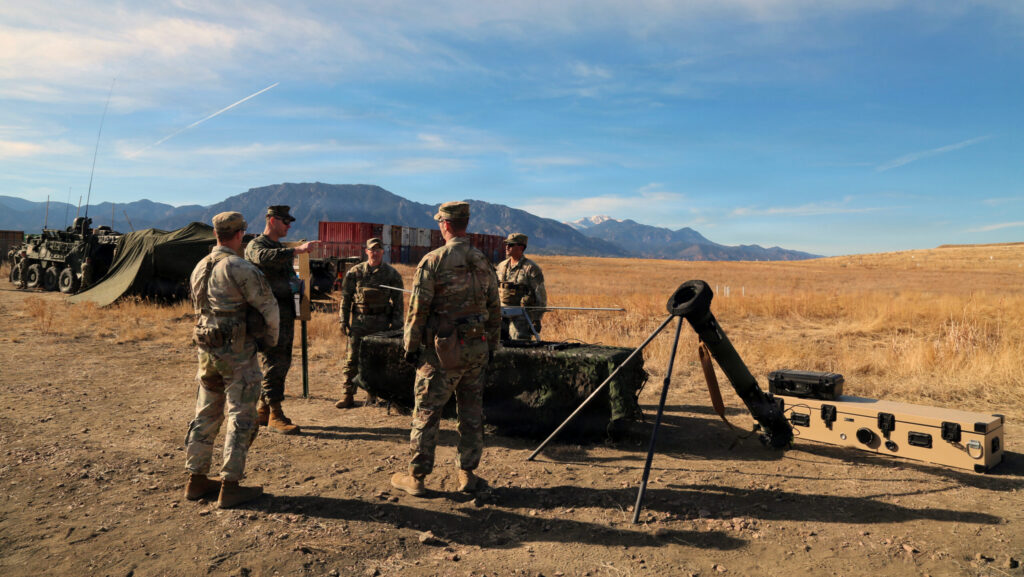
Each event is dubbed a “serial,” with Serial 001 kicking off in December. That one demonstrated a large-scale common data transport, according to a February release. Serial 002 in January focused on a technical engineering baseline for integrating additional software and hardware capabilities. And the Corps just finished Serial 003, joining on with the Army’s 4th Infantry Division’s Ivy Sting 4 event that sought to incrementally add capability to scale the service’s Next Generation Command and Control to an entire division.
“What we’re looking to do is build on the momentum the Army has with an incredible program to build something from the ground up that’s inherently joint. What we’re looking to do is adopt and integrate some of the things they’re [Ivy Sting] working on as well, to be a fast follower, and to take our little dollars and partner with some of the bigger dollars that are out there,” Smith said.
The Dynamis Series stems from Project Dynamis, the Marine Corps’ contribution to the Pentagon-wide Combined Joint All-Domain Command and Control effort to connect “sensors to shooters” across the entire battlespace, from all the services and key international partners.
RELATED: Pentagon’s CJADC2 dreams ‘very aspirational’ right now, Marine Corps general says
Dynamis initiated from a paper authored by now Col. Jason Quinter, who is currently serving as chief of staff of I Marine Expeditionary Force. He wrote the paper roughly three years ago as a result of working joint requirements and noticing that the Marine Corps wasn’t moving fast enough relative to the other services in building dedicated efforts, such as the Navy’s Project Overmatch, the Army’s Project Convergence and the Air Force’s Advanced Battle Management System, he said in a 2024 interview, describing it as helping the Corps supercharge their efforts.
While parts of Dynamis have been in the works for several years, it was nestled underneath the secretive Overmatch, given the Corps sits organizationally under the Navy. A September memo from the assistant commandant formally established Dynamis, naming a director and a cross functional team along with unique acquisition authorities.
“The Assistant Commandant of the Marine Corps published a memo that basically said he was concerned that our ability to C2 in contested environments was at risk, and we need to accelerate what we’re doing,” Smith said last week.
Smith noted that while there has been a lot of senior-level attention, support and momentum, it won’t last without progress.
“The metric for success is delivering real capabilities that work … because if we’re not delivering capabilities that matter to warfighters, the honeymoon will end very rapidly,” he said. “At the end of the day, this is a serious business with serious requirements.”
Officials said they’re looking to scale some of the capabilities that have been built by the Marine Corps Warfighting Lab, Special Operations Command and other services such as the sensitive but unclassified-encrypted capabilities.
“Some of the work that we’ve been doing at [Marine Corps Tactical Systems Support Activity] under this Dynamis umbrella, has been taking existing programs of record and moving that software out of the monolithic programs and putting them in on a small form factor server so that we can use those. Many of those are already joint and interoperable to some degree today,” Col. Craig Clarkson, commander of MCTSSA, said in an interview.
“Moving the data around the battlespace gets a little bit complicated depending on how the network architectures are put together and all the different services have different rules with how they do their firewalls and all that kind of stuff,” he said. “But as we’re like doing that evolutionary improvement on systems that we have now, we’re looking towards revolutionary improvement with some stuff that’s coming from industry that may be able to replace some things that we have now and do it more efficiently.”
One of the early tools is the Marine Air-Ground Task Force C2 prototype. This MCTSSA built capability is a small form factor, high-compute hardware stack that can operate anywhere, including in degraded communication environments, according to a Marine Corps release. The release noted that while the system has been deployed, it is being improved upon through the Dynamis Series.
Smith said his team is working with I MEF along with its subordinate units.
“We’re looking at the Army’s model of picking one division, but I think the way we’re going to end up tackling it is in partnership with the I MEF leadership, who’s all in on this, is pulling together a MAGTF of elements like an MACG, etc., and pulling together a cross functional team to get after this,” he said.