WASHINGTON — The Department of the Air Force needs more juice.
Or, more accurately, the missions the DAF envisions in the future are going to need far more energy storage than current batteries allow, or will need greater bursts of energy or high-powered advanced weapons, or will need lighter alternatives for a host of unmanned systems, or will just need them to work for longer.
Looking to the next generation of air and space missions, current batteries can amount to, a spokesperson for Eglin Air Force Base told Breaking Defense, “key limitations for Air Force applications” where military systems often demand exquisite performance.
So the DAF, which includes the Air Force and Space Force, is looking for help achieving breakthroughs for energy generation and storage. Later this month Eglin Air Force Base, in particular, is inviting industry and academia to “identify promising technologies that can enhance system performance through improved electrical power capabilities,” according to a notice published Jan. 28. The meeting is slated to take place at the Doolittle Institute in Niceville, Fla.
The DAF expects that new solutions could have several applications, spanning ground installations to systems on the edge like “air vehicles, weapons and space,” the spokesperson said.
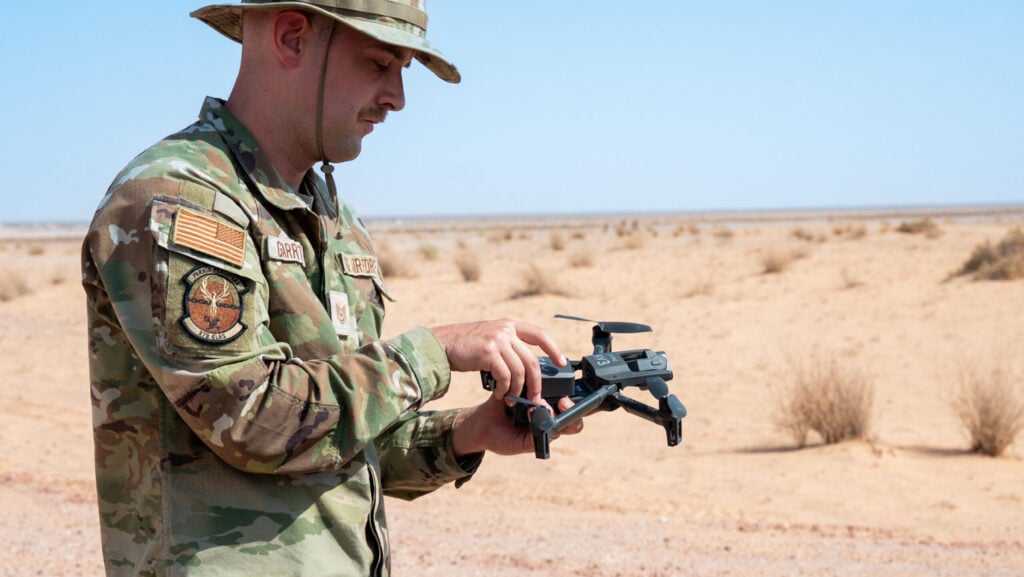
The industry day later this month will identify any promising ideas, which could inform a potential “broad reaching battery and energy storage research program” and subsequent contracts as early as fiscal 2027 if funding permits, according to the spokesperson. Key objectives include improving battery energy density by as much as two or three times current capacity, “particularly for” drone-based ISR, “resilient space assets,” as well as “optimizing pulsed and continuous power output to satisfy weapon system demands.”
As they are, commercial batteries “are typically designed for everyday commercial use and cannot withstand the extreme environmental conditions of Air Force operations, such as intense heat, cold, powerful mechanical shocks, or extreme vibrations,” the spokesperson said.
They also “suffer from self-discharge, leading to a short storage shelf life that makes them unreliable for long-term materiel storage,” they continued. “Using batteries in the unique operating environments of the Air Force introduces unknown safety risks for operators, platforms, munitions, and infrastructure, which need thorough understanding.”
The DAF is also interested in improvements for more bespoke, energy dense batteries typical in military systems. For example, missiles typically use power sources known as thermal batteries, which power in-flight functions like guidance systems. Extending the amount of power these batteries provide could “dramatically increase the range and time-on-station” of munitions and the platforms meant to carry them, the spokesperson said.
The effort also aims to shore up the domestic supply chain — whose minerals and components often have foreign sources, particularly from China — along with codifying new safety and certification processes. Research will additionally try to foster “standardization and modularity” to “improve interoperability and reduce costs” among various systems.
Research could redound to the private sector as well, since the spokesperson said that dual-use applications “where appropriate, are in the government’s best interest” and can help bolster supply chains. Still, the spokesperson said, “The DAF needs to implement safeguards to ensure continued investment in S&T and procurement from industrial partners, preventing over-reliance on market whims.”
Department Of Energy’s JOULES-1K
The Air Force is far from the only government entity pursuing research in better battery technology.
According to the DAF spokesperson, the department is regularly consulting with organizations like the Defense Advanced Battery Working Group and the Federal Consortium for Advanced Batteries to “maximize the impact of battery and power technology advancements.” The Air Force also recently participated in a “Federal Battery Investment Strategy Discussion” hosted by the Office of the Secretary of Defense, “where all Government Departments discussed current and planned programs with the explicit intent of preventing duplication and identifying opportunities for synergistic collaboration.”
One of those efforts is a program underway with the Department of Energy’s Advanced Research Projects Agency, or ARPA-E. Through the JOULES-1K program, ARPA-E is working toward an ambitious “step-change”: boosting battery energy density by as much as four times beyond prevailing lithium-ion designs, Program Director James Seaba told Breaking Defense in January. (An ARPA-E spokesperson said the organization is similarly coordinating with government agencies to “ensure our battery programs fill critical innovation gaps rather than duplicate existing efforts.”)
If successful, the program could unlock new capabilities for vehicles, ships and aircraft. For example, all-electric aircraft have recently hit stumbling blocks due to limits of current power generation technology, leading the Air Force to turn to hybrid-electric designs for some of its own projects. With more powerful batteries, all-electric solutions could be in reach for some air vehicles, and even smaller systems like drones could see substantial performance gains.
Under JOULES-1K, “we believe the performance of these battery systems” — where some, Seaba clarified, are technically fuel cells — “will be able to go in and provide that performance where current technology lacks.”
After a first phase that lasted roughly 18 months, ARPA-E recently launched the second phase of JOULES-1K, which Seaba said should also last another 18 months or so. With awards ranging from around $1.5 million to $4 million, a mix of six academic and industry teams [PDF] will proceed with the expectation to demonstrate working prototypes by the end of the second phase.
Beyond capability, Seaba emphasized new battery chemistries unlocked through JOULES-1K will have to be price competitive with commercial technology while drawing from US supply chains. “We have to beat lithium ion battery for cost, or at least be at that level on a per-unit energy basis,” Seaba said. “And we believe we have the chemistries and the materials to enable that to happen.”
Seaba said that different systems could come with their own tradeoffs relative to considerations like weight and volume, ultimately acknowledging that the program’s goals will be difficult to achieve.
“I do expect [JOULES-1K systems] to be definitely above two times. Four times is challenging,” he said.
Still, he underscored that work since the first phase, where 13 teams were originally selected, has yielded promising results.
“If we had all 13 of them, and they really couldn’t come up with anything — you know, if they hit like two times at the bench scale, we would just end the program,” he said. “So we only continue on if we have viable technology. We have the money. That’s not the question.”