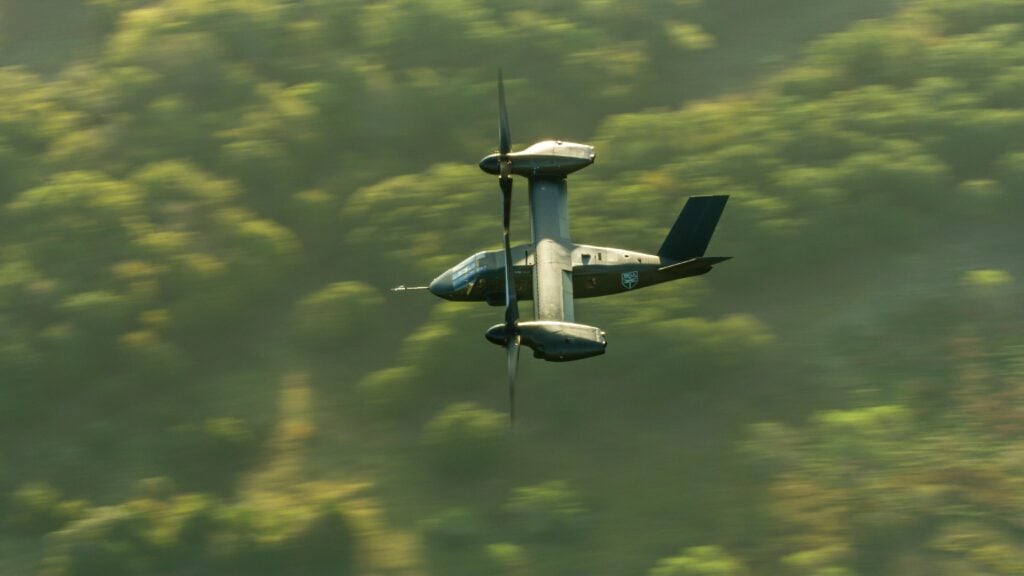
NASHVILLE — The Army has officially given a new name for its MV-75 tiltrotor, calling it the Cheyenne II, though the service is closely holding additional details about the rotorcraft’s timeline, including its expected first flight.
“It’s going to happen when it’s going to happen. So we are moving as fast as we can,” Maj. Gen. Clair Gill, Program Acquisition Executive for Maneuver Air, told reporters last week. “If I was king, and I had all the money in the world and all the engineers, and there were no limits, we probably would be able to do it in a matter of months.”
The Cheyenne II MV-75 is the result of Bell-Textron‘s victory in the Army’s high-profile Future Long Range Assault Aircraft competition, designed to in part replace some of the mission sets of the service’s aging Black Hawk fleet.
Announcing the chopper’s new designation today, Under Secretary of the Army Mike Obadal called the MV-75 a “foundational system of this modern combined arms force.”
“Its modular open design digital backbone allows us to keep pace with emerging technology through innovation in the field that closes the gap in commercial development,” he told the audience here at the Army Aviation Association of America conference.
As recently as January then-Army Chief of Staff Gen. Randy George was bullish on the Cheyenne II’s timeline, saying it could be flying with formations by the end of this year or beginning of next. Production could begin as early as 2028, he said.
Speaking to reporters on Friday both Gill and Brent Ingraham, the service’s acquisition czar, declined to say if they were holding onto either timeline.
“I don’t want to be overly optimistic and commit to something that two years from now, I would potentially look back and say there were so many factors in there that I didn’t control and we didn’t understand till we got to that point,” Gill said.
One of those prominent variables is the complexity of the program, involving about 300 tier one and almost 2,000 tier three and four suppliers. (Gill didn’t discuss numbers related to tier two.)
“There are certain raw materials that help us make certain metals that we want to have in this aircraft to ensure that we don’t have any failure of components, and we’re competing with the entire world for these same raw materials. And the vendors you know, the sub-tier suppliers, […] they are trying to develop components as fast as they can. They’re looking to us for guidance,” said Gill, who is dual-hatted as the commanding general for the Army Aviation Center of Excellence.
Brig. Gen. David Phillips, Gill’s deputy PAE, added that the Army has been working closely with the Air Force and Navy who fly the V-22 tiltrotor, along with industry on how to get hold of the right raw materials for the job.
“We worked with industry to really use better tools to scrub all of those build materials to really see where the pinch points are. Where are we competing with commercial industry? Where are we making sure that we’re not getting materials from the wrong parts of the world?” Phillips said.
Gill emphasized that though there are supply chain lessons the Army can take from the V-22, ultimately, there are “fundamental differences” between how the two aircraft are designed and will perform.
Apart from supply chain pressure, there are also budgetary constraints that could hinder the production and prototyping timelines, Gill said. The absence of predictable funding ultimately “kills any momentum” made in moving up timelines for the Cheyenne II especially with government shut downs or continuous resolutions. Oftentimes the primes, Bell-Textron in this case, have to step up to try to keep that momentum going, he added.
“Every one of [Bell’s] sub-tier suppliers cannot weather that storm every year. And so what happens is, if we have no money, and we either have to stretch the program, slow down the program, stop the program, then it puts tremendous strain on the rest of it. And that’s why I know you all want dates, because it makes a story, but that’s why I can’t give you dates, because I don’t control those variables.” Gill said. “So we need to know that this program is going to be funded every year, that we’re going to have the right appropriation coming to us.”
In the president’s recent budget request, the Army saw a bump of nearly $600 million for research, test, development and engineering funds for the MV-75 compared to FY26, signaling the service is in a good position to move the program to the left.
Though the Cheyenne II is slated to replace some of the missions of the Black Hawk, and the recent budget documents drastically cut funding for Black Hawk procurement, Ingraham said Friday that the Army is not “getting rid” of any of the existing fleet.
“We are not getting rid of any of those platforms. A lot of the existing platforms will be in the fleet for years to come. We have worked to ensure that that is laid into the budget appropriately,” he said. “I think you’ll see as the full budget rolls out, you’ll see where we’re focused on, not only introducing this new aircraft, but ensuring that we maintain and keep the operational fleet we’ve got today.”
Breaking Defense Video