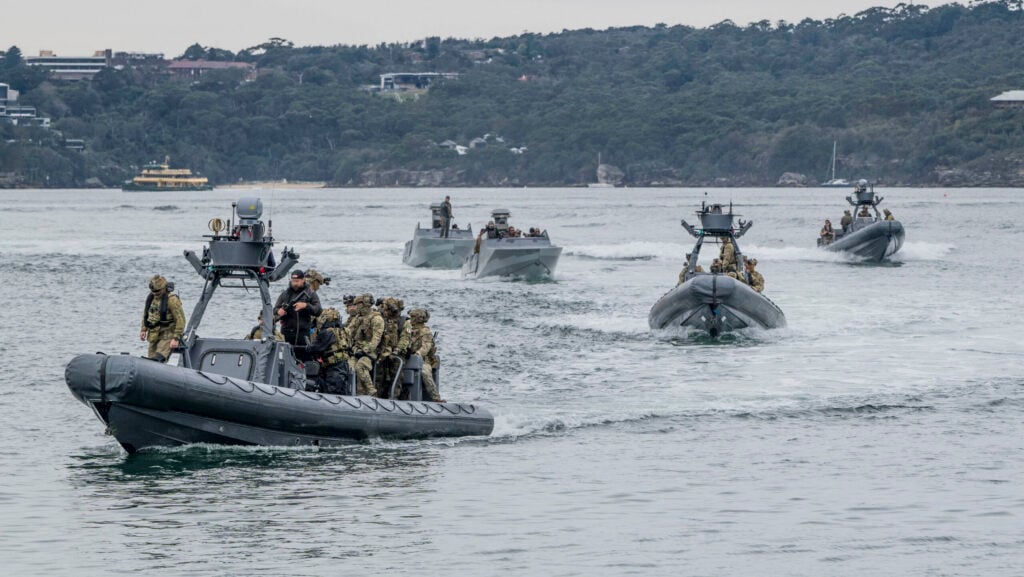
TAMPA, Fla. — The US special operations family of combatant craft is set to receive a significant number of improvements as they are upgraded to “hyper-enable Naval Special Warfare operators,” service officials disclosed.
Representatives from the Program Executive Office-Maritime, led by Capt. Jared Wyrick, listed multiple efforts to enhance combatant craft assault (CCA), combatant craft medium (CCM) and combatant craft heavy (CCH) as well as initial designs for next-generation vessels.
Combatant craft are used to enable the insertion and extraction of small teams, as well as maritime assault, interdiction and resupply, even in contested environments.
Naval Special Warfare currently operates 42 CCAs, but Wyrick said it will task the US Special Operations Command’s innovation office, SOFWERX, to launch a solicitation later in the year to identify a mission management solution for the in-service craft. This will include the addition of an open system architecture to facilitate the “integration and aggregation of sensors,” functioning as a single “pane of glass to reduce cognitive overload” on operators, Wyrick said.
A second effort to upgrade the assault variant of the vessels is to increase shock mitigation, Wyrick continued. “These are small, fast, agile craft exposed to sea conditions and required to do boarding operations with physical wear and tear to operators in the long term,” he explained.
Meanwhile, the command’s fleet of three CCHs is also set to receive upgrades in terms of hybrid electric propulsion to extend range and the operational envelope of the craft, Wyrick stated.
Wyrick also disclosed NSW has started the process of considering what a next-generation combatant craft assault — dubbed CC-X— might look like. Wyrick said it could feature hydrofoil technology as used on certain boats, surfboards, and watercraft to lift the hull above the water to reduce drag. A design could be completed within the next couple of years, he added.
Before that, PEO-Maritime also said the design process for the “next-legacy CCM,” also as known as CCM MkII, will start this year.
The CCM MkII will feature an expanded and “comprehensive C6ISR capability,” leveraging lessons learned from its predecessor, the MkI, Wyrick said.
“There are no more ECPs [engineering change proposals] left in [the MkI]. So we are translating that into the design of the MkII and increasing its operational effectiveness in payload, power and bandwidth,” he said.
Similar to the combatant craft assault upgrade, the MkII will also include an open systems architecture and mission management system with Wyrick describing consideration of “innovative ways to aggregate information to reduce cognitive load.”
“WARCOM [Naval Special Warfare Command] is looking at potentially automating functions of the craft to reduce size of crew,” he added.
Generally, Wyrick is considering additional capability injections to combatant craft which include 360-degree situation awareness; passive ranging; and machine learning/artificial intelligence integration to aid “target detection, recognition and identification” of threats.
Other themes for the upgrades included ruggedizing equipment to meet IP 66/67 standards for shock, saltwater and vibrations — described as a “persistent challenge for the fleet.”