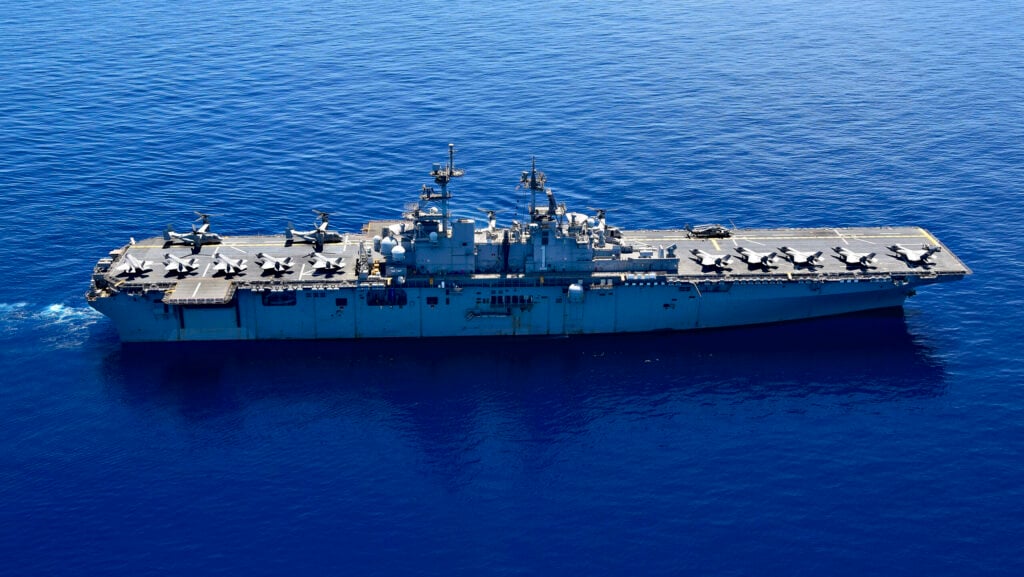
WASHINGTON — The Department of the Navy is recommending a modification to the force generation model it uses for amphibious ships, following a report from the new Amphibious Force Readiness Board (AFRB) that aims to improve the ships’ readiness.
The Navy currently utilizes a 36-month Optimized Fleet Response Plan (OFRP) for maintenance, training, and seven-month long deployments for amphibious vessels, but today Acting Secretary of the Navy Hung Cao said that he’s on board with a new 56-month model.
“The course of action that we would like to pursue would be able to extend the OFRP to 56-months, allowing us to have two workup cycles, two integrated training cycles, as well as two deployments for every ship,” Cao told lawmakers on the Senate Armed Services Committee today.
Cao said that he sent the recommendation to the Secretary of Defense Pete Hegseth, and that the proposal also includes increasing the number of amphibious ships to 40 — up from the congressionally mandated 31 ships.
RELATED: Short on amphibs for Turkey, Sudan, the Marines grapple with crisis response ethos
Cao’s comments come after Chief of Naval Operations Adm. Daryl Caudle and other Marine Corps leaders signaled in April at the Modern Day Marine Exposition that the services were weighing revamping the force generation cycle for amphibious ships.
At the time, Caudle said that altering the 36-month model could “kill the overhead of the phases of the force generation cycle that don’t add significantly to getting it ready for its next deployment.”

Why Bigger Fences Aren’t Enough in the Age of Drones
Traditional thinking about how to protect facilities must adapt to new threats such as drones or downstream attacks.
Amphibious ships generally deploy in Amphibious Ready Group (ARG) formations that usually include an assault ship, a transport dock, and a support vessel outfitted with an embarked Marine Expeditionary Unit (MEU) of at least 2,200 Marines. These forces ultimately create what the services call an “ARG-MEU,” and the Corps aims to maintain a 3.0 ARG-MEU presence globally.
The AFRB, which kicked off in March, has been evaluating multiple avenues to tackle amphibious readiness issues and determine how many amphibious ships are necessary. Marine Corps leaders and Caudle have said recently that 40 amphibious ships is likely the right number.
“Forty just makes a lot of sense that it’s going to take that to give me the friction in there necessary to have a persistent 3.0, sir,” Caudle told Sen. Dan Sullivan, R-Alaska, at the same hearing today. “So I think it’s a solid number, but we’ll refine that as we look hard at it. But it’s a correct number.”
Although three ARG/MEUs are currently deployed, Commandant of the Marine Corps Gen. Eric Smith has repeatedly said in recent weeks that presence isn’t sustainable. Likewise, he said at the Modern Day Marine Exposition that combatant commanders are requesting even more ARG/MEUs, but that there aren’t enough ships to meet the demand.
Smith also said then that the services were considering several ways to increase the size and availability of the amphibious force, such as optimizing maintenance schedules and force generation models, procuring new ships, and extending the service lives of existing ships.
Amphibious ship readiness has faced heightened oversight in recent years, and the Government Accountability Office concluded that half of the vessels were in “poor condition” in a report released in December 2024. The report cited challenges from the Navy maintaining these ships, stemming from issues with spare parts and canceled maintenance.
Breaking Defense Video