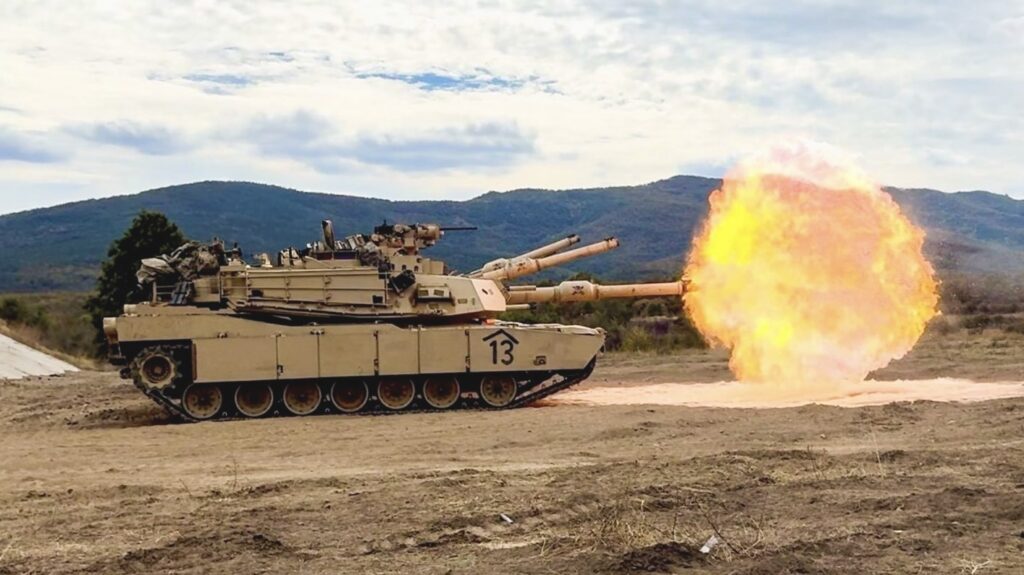
WASHINGTON — General Dynamics Land Systems has partnered with Primordial Labs to bring AI voice-control to its combat vehicles, ranging from the iconic M1 tank to the next-gen XM30, the companies plan to announce later this morning.
Coming just days ahead of the massive annual AUSA trade shadow in DC, this odd couple combines a classic heavy-metal military manufacturer, which has built the M1 for over 40 years, with a young AI startup best known for demonstrations with small drones.
But Primordial built its Anura voice-control system to be platform-agnostic — it’s also working on AI assistance for Army helicopter crews — and adaptable to any kind of vehicle, co-founder Lee Ritholz told Breaking Defense. “We’re [used to] doing everything on a really tiny processor,” he said. “As we get to these larger platforms, it becomes almost a luxury” by comparison.
GDLS, for its part, sees tremendous potential for voice control to help increasingly overburdened human soldiers manage an ever-growing array of complex systems, from tactical data networks to AI target recognition, company officials said in interviews.
“There’s a bunch of technology being thrown at soldiers,” explained Salem Auclair, a 20-year Army veteran who helped write the official requirements for the XM30 before joining Primordial. The XM30 program, for which GDLS is competing with American Rheinmetall, actually calls for shrinking the crew from three soldiers on today’s M2 Bradley to two on XM30, while adding more technology.
“These are the same 18- to 22-year-old soldiers that that are driving these vehicles now, and we’re giving them more complex system,” Auclair said. “Well, how can we help them use those systems? Give them a mechanism that they’re used to, their voice.”
Geoff Norman, GDLS’s director of strategy and a retired Army general who worked on the next-gen vehicle program, said, “having to flip switches and push buttons and type on keyboards and do the manual tasks in a combat vehicle, on the move, in the dark, in bad weather … will be a challenge in the future, especially given that those tasks are going to be done by a smaller crew.”
With AI voice control, by contrast, a soldier just needs to give a verbal order, and the software should be smart enough to take care of the rest, the two companies’ experts explained. In many ways, Anura is designed to act as an additional, virtual crew member, to which the human soldiers can delegate a wide range of tasks — especially time-consuming or technically complex ones — so they can stay focused on the fight. Company officials said it can even help manage other automated systems, for example by telling an AI threat-detection system to scan for flank attacks while the humans focus a target up ahead.
However, Anura won’t be able to fire a vehicle’s weapons, the companies emphasized.
“We’re not talking to the fire control system and doing … lethality tasks,” Norman said. “What we’ve chosen are things like doing communications, adjusting which radio net you’re on, sending reports that otherwise you would have to type in, adjusting the camera view that you’re looking out of the vehicle on. Those things are easy to verify and validate for a safety case.”
Anura isn’t using generative AI, the kind of superpowered but unpredictable chatbot that has roiled the world since the launch of ChatGPT.
“We can’t hallucinate because we don’t generate things,” Ritholtz said. “We’re not using generative AI.”
Instead, he explained, Anura uses more narrowly focused and predictable forms of machine learning, which in turn serve as translators between the human soldier’s voice commands and the complex, often user-unfriendly interfaces of military systems.
Anura isn’t installed on the current XM30 prototypes now in testing by the Army, Norman said, but GDLS aims to offer it on future upgrades, both to XM30 and to legacy vehicles like the M1 tank and Stryker troop carrier.
Breaking Defense Video