SINGAPORE — Despite Australia’s recent moves to strengthen its land- and sea-based air defenses, more needs to be done to protect the country in times of conflict, an expert told Breaking Defense.
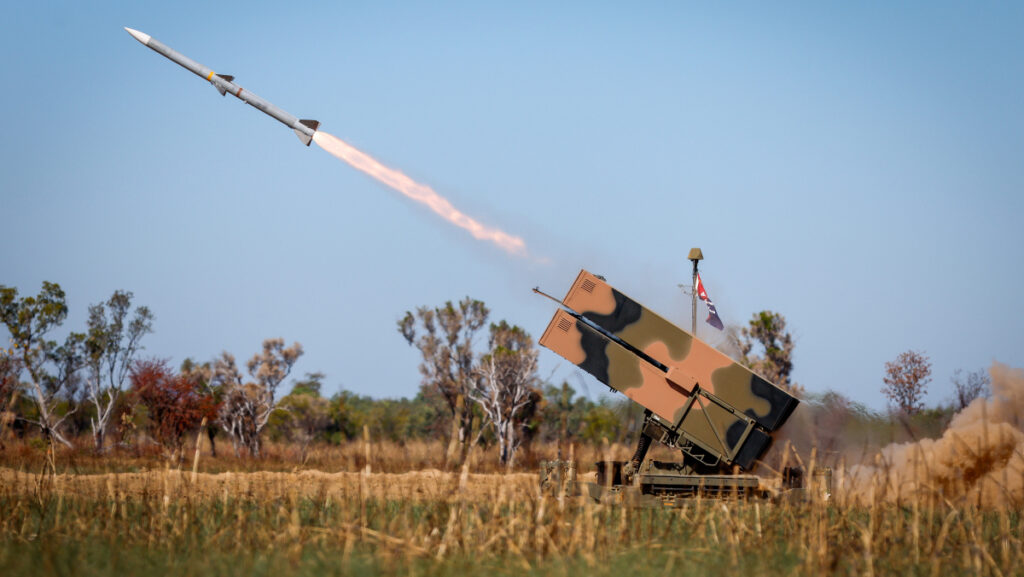
Canberra on Oct. 13 announced it is seeking Expressions of Interest from interested vendors for a land-based system under Project LAND 6504 – Medium Range Ground Based Air Defence.
Slides from an industry briefing for LAND 6504 at the recent Land Forces defense show in western Australia indicate that the country is running an “acceleration project” seeking a medium-range air defense system “focused on rapid capability delivery,” prioritizing “proven Military-Off-The-Shelf (MOTS) solutions” and a “clearly defined and achievable Concept of Employment.”
Further, according to the briefing the system must be mobile, deployable, and integrated with Australia’s CEA Technologies’ radars and existing IAMD infrastructure.
It must also be able to intercept ballistic missiles in their terminal phase along with subsonic air-breathing missiles. Capabilities listed as “highly desirable” for the system include being able to intercept maneuvering hypersonic and high-speed cruise missile targets.
Australia expects to select the winning platform for LAND 6504 in late 2027 following a RFP that is expected in the early part of the year. The system is expected to conduct a live firing at the biennial Talisman Sabre multinational exercise, typically held in July or August, in 2029.
Meanwhile, for sea-based air defenses, the Very Short Range Air and Surface Defence (VSRASD) program is looking for a system to protect the Royal Australian Navy’s upcoming Hunter-class frigates from air- and sea-borne drone threats.
An RFP posted Sept. 29 on the Australian government’s tenders website called for a system that “should be able to identify multiple threats at a distance of up to 5,000 metres” and can function as a standalone system but also able “to be integrated into the ship systems.”
The RFP added that each Hunter-class frigate will be equipped with one or two of the systems, with a possibility that the system could be fitted on other classes of Australian naval vessels.
Australia also awarded a contract to Lockheed Martin in September to expand Australia’s joint air battle management system. The country’s military also test-fired a naval SM-2 air defense missile from an adapted ground launcher in July, utilizing a CEA Technologies radar and a virtual Aegis combat system.
Despite these recent efforts, Euan Graham, an expert associate at Australia’s National Security College, told Breaking Defense that recent events in the Middle East and elsewhere show that Integrated Air and Missile Defense (IAMD) capabilities need to go hand in hand with efforts to harden bases and other military targets.
“Iran has revealed the limitations of US IAMD in the Middle East, as well as depleting its defensive arsenal,” Graham said. “China’s capabilities are orders of magnitude greater.”
The accelerated timeline for the LAND 6504 program is welcome, Graham said, given that “it is well known that Australia’s Ground Based Air Defense (GBAD) capabilities lags behind its air and sea-based systems.”
However he warned that the acquisition will “still be unlikely to fill the gap, given Australia’s parallel need to protect expeditionary forces and military bases and critical infrastructure in Australia.”
Australia must thus harden its military targets in addition to building up its IAMD capabilities, noting that its geographic isolation was no longer the defensive advantage it once was in a contemporary conflict.
“Distance does give Australia defensive advantages over, for example, Japan,” Graham explained. “But China’s development of cruise missile submarines would give it the ability to mount surprise attacks on targets in Australia such as its submarine base HMAS Stirling, Naval Communications Station Harold Holt (a joint Australian and US naval communication station), and the Jindalee Over-the-Horizon Radar Network infrastructure.”
Breaking Defense Video