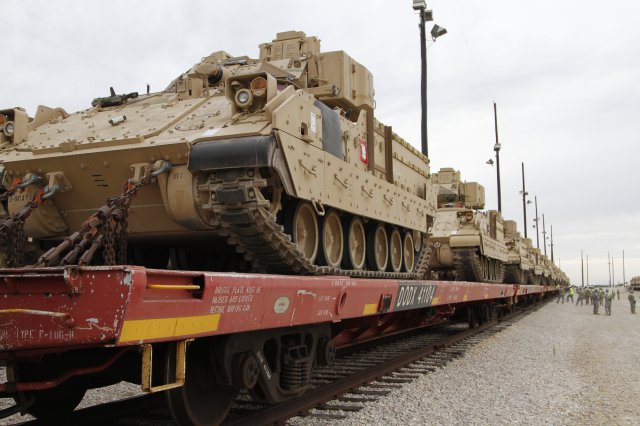
Bradley armored vehicles from the 1st Cavalry Division shipped out in August for a deployment to Eastern Europe.

Bradley armored vehicles from the 1st Cavalry Division shipped out in August for Eastern Europe.

WASHINGTON: The Mideast may have the spotlight right now, but it’s not the only area that has the Army of Chief of Staff worried. In an uncanny parallel to the 1990s, the end of a large-scale ground deployment — in Europe then, in Iraq and Afghanistan now — has led to steep Army budget cuts even as multiple new missions, smaller but demanding, pop up all around the world. With new threats arising and complexity increasing as funding declines, Gen. Ray Odierno said, a new “Army Operating Concept” will help reorient the service for the post-Afghanistan era.

Not that we’re in the post-Afghanistan era yet, given the continuing advisor mission there. The stress of the accumulated stresses, old and new, is already starting to show. “I have two division headquarters in Afghanistan. I have a division headquarters in Korea, [and] I’m going to send another division headquarters to Iraq,” Odierno ticked off this morning at a Defense Writers Group breakfast. “I’m going to send a division headquarters to Africa to work the response to the Ebola virus. I might end up sending a division headquarters to Europe.”

That’s a broad and curious mix of missions, from old-school Cold War deterrence, to post-9/11 counterterrorism, to what sounds unnervingly like the first chapter of an apocalyptic science fiction novel. “It’s very clear the disease is accelerating faster than we initially thought,” Odierno said of Ebola. But diverse, far-flung, and simultaneous missions is what the new Army doctrine expects to characterize the future, rather than the traditional focus on one or two all-consuming “major theater wars.”

“Where in the past we focused on maybe one big fight somewhere, the new Army Operating Concept [says] we have to be able to do multiple small-scale things simultaneously,” Odierno said, “so for example we might have to operate with smaller capability on four different continents at the same time.”

“You’ve got to be a bit more flexible, a bit more adaptable,” Odierno continued, summing up the new concept. “You have to be able to get there quickly. You have to develop new capabilities in understanding the economic, cultural, and political environments simultaneously.”

Odierno said such these complex missions require extensive high-level interaction with local and international partners, so they need high-level leadership cadres drawn from divisional headquarters, which have become “one of the real stress points on our Army.” But no one’s deploying full divisions of 20,000-plus soldiers. The Ebola mission, for example, will grow in the thousands within 30 days, Odierno said, topping out at a target (for now) of 3,000 troops.


The new headquarters being considered for Europe would provide high-ranking oversight and international coordination for what are likely to be ongoing rotations of brigade-sized forces to Eastern Europe. Currently, the light infantry of the Italy-based 173rd Airborne Brigade is about to be replaced by heavy armored forces from Fort Hood’s 1st Cavalry. Tanks deploying from the US to Europe is a faint echo of the Cold War, but it’s a far cry from the massive REFORGER exercises of the 1980s: The “reassurance” deployment will stay at only 600 soldiers.

The Iraq mission is now at 1,600 personnel from all the services — not just the Army — and “I don’t think there’s a rush to have lots of people in there,” Odierno said. This is a marathon, not a sprint, and requires deliberation, he said, citing the President’s remark that “degrading and destroying” the self-proclaimed Islamic State could easily be a three-year effort.

That effort will require someone‘s ground forces to retake Iraqi cities, but “I did not say we need US divisions and brigades on the ground to do this,” Odierno said, clarifying his recent comments to the Senate Armed Services Committee. “Iraqi security forces are capable of doing this. We’ve watched them do it” in the past — with US assistance — and they can do it again if the new, more inclusive Iraqi government  can convince them it’s worth fighting for, he said.

But will the Iraqis need American forward observers and special forces on the frontline with them once more, if only to call in airstrikes? “We’ll have to see….The worst thing that can happen for us if we start killing innocent Iraqis, innocent civilians,” Odierno said. “So far, it is so good, but to be honest with you the targets we’ve gone after have been targets that are very clearly identifiable: they have military equipment, they’ve been out in the open, [but] they are going to start infiltrating back into the population.”

To man all these missions, the Army currently has 510,000 troops, down from its wartime peak of 570,000 and on track to 450,000 by the end of 2017. If the automatic budget cuts known as sequestration return in fiscal 2016 — as is currently the law — then the Army will diminish to 420,000. But Odierno’s greatest concern is less about the total number of troops than keeping what he has well-trained.

“I’m taking endstrength out as fast as I possibly can, 20,000 a year,” Odierno said. “I’ve already cut our modernization budget by 46 percent. So it’s going to come out of readiness.”

During sequester’s first bite back in 2013, the Army went down to three brigades fully trained, ready, and available for unexpected crises. (Odierno tends to say two brigades, but he isn’t counting the 82nd Airborne’s Global Response Force for various arcane reasons of great interest to some people). “There are about 14 brigades [ready] now,” Odierno said. “We’ll be able to sustain that in ’15, but in ’16 we’re going to go right back to where we were.”

Total numbers still matter, of course. “I testified last year [that] if we have to go to 450,000 in the active component it is significant risk. and if we go down to 420 we cannot execute our current strategy,” Odierno said. “That was before ISIL expanded itself [and] before we had the Russian incursion in Ukraine….The risk actually has increased.”

Updated 4:15 with precise number of soldiers (600) on “reassurance” deployments in Eastern Europe.

Comments

  • Don Bacon

    Currently the Army is an answer in search of a question, with the current president more unlikely to commit troops irresponsibly than any past, and perhaps any future, president.

    Actually all the service chiefs are in a quandary about what forces to sustain because there has been no definitive basis for forces from the administration, from the commander-in-chief.

    The National Security Strategy is a document prepared periodically by the executive branch of the government of the United States for Congress which outlines the major national security concerns of the United States and how the administration plans to deal with them. The legal foundation for the document is spelled out in the Goldwater-Nichols Act.

    On May 26, 2010, the latest National Security Strategy was issued by President Barack Obama. What did it say about threats, upon which forces would be required?

    “Terrorism is one of many threats that are more consequential in a global age. The gravest danger to the American people and global security continues to come from weapons of mass destruction, particularly nuclear weapons. The space and cyberspace capabilities that power our daily lives and military operations are vulnerable to disruption and attack. Dependence upon fossil fuels constrains our options and pollutes our environment. Climate change and pandemic disease threaten the security of regions and the health and safety of the American people. Failing states breed conflict and endanger regional and global security. Global criminal networks foment insecurity abroad and bring people and goods across our own borders that threaten our people.”

    That’s about it. Terrorism, WMD, space, cyber, climate, disease and criminal networks.

    On November 29, 2013 it was announced:
    President Obama will formally present a new national security strategy early next year, identifying his foreign policy priorities for the remainder of his time in office, the White House said Friday.

    But it wasn’t done. So how ought the Army respond to the threats in the NSS? They don’t know. So the Army responds with the anachronistic mish-mash of tired Army doctrine.

    “The newly published & revised TRADOC Pam 525-3-1, The U.S. Army Operating Concept (AOC), 2016-2028, is a key document in the Army Concept Framework that details how future Army forces will conduct operations as part of the joint force to deter conflict, prevail in war, and succeed in a wide range of contingencies in the future operational environment.”

    “Threats to the Nation will originate among diverse populations where the advantages of dispersion, concealment, and terrain provide the best chance for success. Beyond Afghanistan and Iraq lies an environment that will require active engagement by ground forces. . . .”

    The Army has to justify retention of its heavy weapons, for one thing, its SP howitzers, tanks and armored fighting vehicles, plus its half-million person force. So it does.

    • Gary Church

      Thanks Don,
      “Beyond Afghanistan and Iraq”?
      I should run for president on an isolationist platform. The best thing we could do is just back out of international affairs as quickly as possible and clean up our own back yard.

      As for retaining Infantry, Armor, and Artillery assets; these are what wars are fought with. This is not what people generally believe but it is true. Fancy attack helicopters and jet fighters are billions of dollars that could be spent on……retaining Infantry, Armor, and Artillery assets. It is the 20 something soldiers and the 2 to 3 years of hard training they have to have to be effective that is critical. Since they generate the least profit they are the first low hanging fruit and this is an incredible mistake. The forces and programs that need to be done away with are to be found elsewhere.

      • Gary Church

        That comment sounds like I am defending the Army keeping a massive conventional force. But I am not. I am defending keeping an Army and not a money machine for corporations. Unfortunately the Officer Corps is, despite being bloated and over-strength like no other time in history, an organization more dedicated to it’s own members furthering their careers than defending their country. Yes….I am bitter.

        • Don Bacon

          I’m not necessarily agreeing with you, but you are describing The Iron Law of Institutions.

          The Iron Law of Institutions is: the people who control institutions care first and foremost about their power within the institution rather than the power of the institution itself. Thus, they would rather the institution “fail” while they remain in power within the institution than for the institution to “succeed” if that requires them to lose power within the institution.– Jonathan Schwarz

          • Gary Church

            Thanks for the info.

  • Craig

    The Army’s budget is at near record levels. Why is he sending division headquarters to lead brigade size deployments? So he can pretend that he needs more divisions? Meanwhile our Army is clinging to its outdated senseless mission to defend South Korea. The South’s military is five times more powerful than the North, and is even cutting its size!. Read about wasteful games our Generals play in Korea http://www.g2mil.com/casey.htm

    The news today proved that author correct. Our Generals are fighting to keep our troops near the DMZ, even after both South Korean and American leaders agreed to pull them back.
    http://www.stripes.com/news/us-seeks-to-keep-artillery-brigade-near-korean-dmz-1.303927

    • Gary Church

      We have bases all over the world but South Korea is picked out as an example of someplace we should leave?

      No. I am throwing the bullshit flag on this one. If there is any place we need to keep bases open it is South Korea. Why? North Korea!
      g2mil needs to tone done their high pitched screaming.

      • Craig

        North Korea!

        It is obvious that you didn’t bother to read that article, or are unable to update your decades old thinking. Doesn’t it bother you that South Korea is slashing the size of its own Army? And if North Koreans might do something crazy, we need to get out GIs and their families out of North Korean artillery range.

        • Gary Church

          Well, something I said got this reply removed; let’s try again.

          We are there as a guarantee North Korea will not invade. But you want to just pack up and leave. That sends a great message to the maniac with atomic bombs.

          • shloime

            is there no option between “stay in full force” and “just pack up and leave”? would half as many troops, backed up by the rest of uncle sam’s army including the fleet of strategic bombers, not be an equally effective deterrent to the north koreans?

            what is the “magic number” of americans that guarantees south korea against invasion?

          • Gary Church

            The number that is there.

    • madskills

      Did you ever think we are there to keep the South from attacking the North….. When Dad is around usually the kids behave better….

    • J. C. Smith

      “The South’s military is five times more powerful than the North”
      I be curious to see the metrics on this. Such things are nearly impossible to quantify.

  • Joseph White

    All these troops overseas, and our own borders left wide open for terrorists and illegals to cross at will.

  • madskills

    We can’t get the Army to give the troops a better rifle to use or proper camouflage for the uniforms, even if we have known it for years. Even if we continue to forget the air force needs to support the army, how can we be spending $200 million plus to build the pig f-35, or the new Ford aircraft carriers for $17 billion a copy. We can’t afford the gold plated arms the services keep dreaming up.

  • H. H. GAFFNEY

    The greatest mystery for the U.S. military has always been what crazy places an Administration may, or has, sent them. In the absence of anybody’s knowledge of the future, the Services end up planning to be everywhere in the world. And that ends up with the Services trying to scare everybody in Washington (Administration and Congress) that they need more money — anything new comes up, and they want “more money.” So it ends up being all about Washington budget politics (currently hopeless because of the GOTP). One of the big troubles in U.S. defense consciousness was that the Cold War was entirely static — hopeless in face of the massive Soviet forces, but there was never any war. As for the 2MTWs of the 1990s, that was a complete farce. Nothing I ever saw in watching defense programs carefully from 1990 to 2013 seemed to have any basis in “2MTWs” (or “2MCOs.”)

  • http://www.thecontract.us Tom Scott Hudson

    We need to get back to following the Constitution when it comes to defense and warfare. Everyone who is concerned with the future of this nation needs to read The Contract On The Government. It is the book the politicians and bureaucrats DO NOT want you to read. Find our more here: http://www.thecontract.us

  • Walter

    One can thank our feckless president who declared a peace dividend in the midst of a war. One must ask if President Obama intends to protect America given his cuts to our armed forces.

    The man is an abject failure as a commander in chief garnering little if any respect from uniformed personnel.

    • Gary Church

      Tell it to UBL

  • Dr__P

    The Marine Corps has had a system of rotating units and of forming HQ units based on task forces for years.

    • J. C. Smith

      And it’s falling apart. MEBs — once standing organizations — were disassembled. Now they’re being rebuilt but the manpower is coming out of MEF staffs hard pressed to do what they need to do from day to day. 4 MARDIV is helping, but that’s a stopgap that will ultimately fail as personnel numbers plummet (and they are dropping rapidly in the USMC, too).

      • Dr__P

        You correctly note that the authorized strength level of the Marine Corps is directly hurting the ability to respond. That will hurt regardless of the structure.

        Yet the major point was the nature of assigning headquarters and subordinate ground, air and logistics units to a MAGTF. The specific MAF/MAB/MAU [MEF/MEB/MEU depending on the time frame in question] is always in flux. Indeed the smallest ground component is now often a reinforced company instead of a battalion.

        The whole point of the MAGTF is that the structure is fluid and can be shaped as the situation requires. Then, the operating forces are drawn from existing forces as needed. The MAGTF staffs are separate from the existing forces until needed and can be sent forward quickly and form fighting units. That we have ongoing responsibilities have made the MAGTF structures seem more permanent.

        Reducing end strength is cutting into that ability to reconstitute new organizations. Indeed the striking of 1/9 from the active roster of battalions is a way to keep the other battalions at closer to full strength. Yet that also means one less battalion to rotate.

  • daniel

    Military is being gutted…..

    • Gary Church

      The most non-profitable part of the military- the 20 something infantry, armor, and artillery enlisted soldiers. This is the worst possible mistake. It takes two or three years of hard training to make them effective. The majority of our support troops (I was one) will not be able to take up the slack for understrength combat arms. We will be screwed but we will have a few useless stealth fighters.

      • J. C. Smith

        Not to mention the enormous number of captains and majors being forced out. They were to have been our Army’s future leadership.

        • Gary Church

          Actually, the military is so top heavy on zeros I cannot agree with you on that. Last I checked there is one officer for every 5 enlisted. While the officers suck up everything and the enlisted get the crumbs falling off the table like dogs there are also the senior enlisted E-7 through E-9 that have many “retired on active duty” parasites.

          I submit an almost 30 year old E-5 in charge of six or seven 20-somethings is the Army. Ike said so;
          The Sergeant is the Army.

          Right now it is that officer getting his masters degree gratis that is the army.

          • Gary Church

            Looking at your past comments I see you were an officer. I served with some excellent officers- but I am sorry to say not as many as you would think considering how many there are now and the tremendous amount of payroll they require all the way up to the general staff and their six figure retirements.

  • Jim Aldridge

    I have an idea, why don’t nations just come together say one week each year and have one big O gigantic orgy. Solve a lot of problems. The monies spent on toys can be spent on toys of pleasure vs toys of death.

  • J. C. Smith

    OK, so he sends divisions all over the world. What happens when they need to be replaced? There aren’t enough remaining divisions to do that. We’re breaking every division in the Army to manage small-scale crises, with no bench to back them up.

    • Gary Church

      We hire mercenaries. That is the solution most often pursued when a nation turns into a bunch of……

      • Gary Church

        Sorry, I was looking out the window earlier admiring the pierced tattooed young men shambling and limping down the street holding their pants up in the front while their brightly colored underwear is displayed behind. The future of America