gcv

CAPITOL HILL: There’s a new chairman in town on the HASC’s powerful tactical air and land forces subcommittee, the sometimes fiery Michael Turner of Ohio, and he’s got his sights set on right on the Army and the Defense Department’s industrial base practices.

Turner, best known as a vigorous advocate for missile defense and his attention to detail on national systems governed by the strategic forces subcommittee he ran until this last election, made clear to reporters this afternoon that he’s closely watching the Army’s oft-botched acquisition efforts — especially the controversial Ground Combat Vehicle. Keep reading →

BAE Systems and General Dynamics, the companies developing the Army’s new Ground Combat Vehicle, struck back at the Congressional Budget Office over a CBO report arguing the GCV would be inferior to the German Puma troop carrier. The contractors’ essential argument: CBO based its scoring on an out-of-date concept for what GCV would be, and the prototypes now in development are a lot better.

“CBO stated they are using ‘GCV Concept after Trades’ from the original Army AoA (Analysis of Alternatives) delivered in March, 2011. This might account for the poor qualities given the GCV in the study,” General Dynamics Land Systems spokesman Pete Keating told Breaking Defense this morning. “The GCV requirements today and the two contractor offers are significantly different vehicles from the Army conceptual vehicles in the 2011 AoA.” Keep reading →

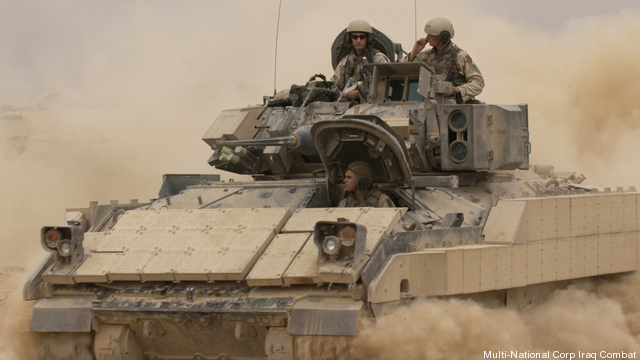
[updated] WASHINGTON: The Army’s proposed Ground Combat Vehicle would offer less combat power, at a higher cost, than buying the German-made Puma already in production or even just upgrading the Army’s existing M2 Bradley, according to the Congressional Budget Office. CBO issued a report today assessing different alternatives to upgrade Army heavy brigades‘ infantry fighting vehicles (IFVs), tank-like war machines with tracks and turrets designed to carry troops into combat.

[Click here for the GCV contractors BAE and General Dynamics critiquing the CBO report] Keep reading →

WASHINGTON: A $140 million congressional plus-up to the Army’s Bradley fighting vehicle program has made it past every legislative hurdle into the spending bill now headed for the Senate floor. But with amendments and House-Senate conference still to go, and with the Army still (at least officially) unenthused about the unrequested funds, Bradley manufacturer BAE is leaving nothing to chance and has launched a major campaign online, in the media, and on the Hill to ensure all goes well.

Looking ahead, the total 2013 Bradley bill of $248 million — half from the Pentagon’s initial request, half added by Congress — is just the down payment to keep BAE’s York, Penn. plant running until the Army starts building new armored vehicles circa 2017. While a quarter-billion a year is relatively modest in a Pentagon context, it’s scarce funds that the Army is reluctant to spend in the current budget crisis — even though it may cost more in the long term to shut York down only to reopen it three years later. Keep reading →

WASHINGTON: The current fiscal crisis slams the entire military, keeping aircraft carriers in port and fighter pilots on the ground for lack of funds, but of all the services, said Pentagon comptroller Robert Hale today, “the Army has by far the worst problem.”

That’s because the Army faces a unique triple-barreled budget problem, known with grim humor as “6-6-6″ because each part takes $6 billion out of Army readiness accounts: the automatic cuts known as the sequester, which began March 1st; the Continuing Resolution now funding the government, which continues spending at 2012 levels without any flexibility to start new programs or even adjust existing ones; and the shortfall in wartime supplemental funding (called OCO, for Overseas Contingency Operations) caused by unexpectedly high costs in Afghanistan. Keep reading →

America’s Army has developed a bit of a split personality of late. On the one hand, the top brass has very publicly embraced the administration’s January 2012 strategic guidance that emphasizes “innovative, low-cost, and small-footprint approaches” and “building partner capacity” in lieu of large ground force deployments. Leaders from Chief of Staff Gen. Ray Odierno on down talk up the Army’s capabilities in cyberspace, missile defense, seaborne operations, and small advisor teams.

At the same time, the service’s biggest new weapons program remains the controversial Ground Combat Vehicle, an estimated $34 billion program to build what could be 70-ton-plus behemoths optimized for all-out land war. “Low-cost” and “small-footprint” it ain’t. (“Innovative” it may be; read on). And GCV is just the tip of the armored iceberg. Keep reading →

[CORRECTED with revised data from Army] CRYSTAL CITY: If Republicans and Democrats can’t come to terms, the combination of sequestration, a year-long Continuing Resolution, and reduced Overseas Contingency Operation (OCO) funding will slam Army readiness accounts by $17 billion to $19 billion, Chief of Staff Gen. Ray Odierno said this morning.

All told, he said, the legislative impasse puts at risk everything from military training to family support, from the civil service workforce to weapons programs like the multi-year procurement of the CH-47F Chinook helicopter. Keep reading →

WASHINGTON: Where’s the strategic beef? That’s what Andrew Krepinevich wants to know.

“When the administration came out with its strategic guidance [in] January, I thought the guidance made a lot of sense in terms of setting priorities,” the head of the influential Center for Strategic and Budgetary Assessments said this morning at the headquarters of the Air Force Association. “Western Pacific No. 1, Persian Gulf region No. 2, that certainly made a lot of sense. But what I haven’t seen since then is the strategy. If these are the objectives, how do we go about meeting those objectives?” Keep reading →

@insidedefense So GCV is being cut by 11% in FY 14 & might be cut a lot more? That’s… not actually a big surprise. http://aol.it/VEA6OQ SydneyFreedberg


[updated with quote from Army source] WASHINGTON: The battle over the Army’s Ground Combat Vehicle isn’t only about one war machine and what it may weigh (80-plus tons) or cost ($13 some million). It’s just one front in a larger war over the Army’s armored heart and its role in the nation’s strategy.

As budgets tighten and the military reorients from Afghanistan to the Pacific, the nation can get by with “substantially smaller ground forces,” said Andrew Krepinevich, the influential director of the Center for Strategic and Budget Assessments. A former Army officer himself, Krepinevich has repeatedly called for cutting the Army in favor of air and naval forces. In particular, he told Breaking Defense, out of all the Army’s various branches, “armor/mechanized infantry is certainly a bill payer.” Keep reading →

Page 1 of 3123