networks

Harris PRC-117G Kandahar Afghanistan size0-army.mil-64535-2010-02-17-150240

Part outsider, part incumbent, Harris Corp. is eagerly upsetting applecarts by taking on defense industry colossus General Dynamics and other established contractors in its bid to grab a hat trick in this year’s Army radio competitions. The largest service is expected to make awards in three of its largest communications programs this year as early… Keep reading →

Paratroopers from 3rd Brigade Combat Team, 82nd Airborne Division, use Joint Tactical Radio System radios to communicate during a field exercise at Fort Bragg, N.C., in March.

As the Army prepares to choose the new builder of its handheld digital radios, the incumbent contractors are tryiing to convince Congress to keep other companies out. The incumbents are General Dynamics, which publicly apologized to the Army over its half of the program last year, and Rockwell Collins. The Army’s own chief of acquisitions,… Keep reading →


WASHINGTON: What homemade roadside bombs could do to Army and Marine ground vehicles was the ugly surprise of the last decade. What sophisticated long-range missiles could do to Navy aircraft carriers could be the ugly surprise of the next. “I think it would almost follow like the night to the day,” Rep. Randy Forbes told me in a recent interview. “The last decade… we asked a disproportionate sacrifice from the Army and Marine Corps,” he went on. “The next decade’s going to be the decade of seapower and projection forces, [and] some of those ugly surprises we see bits and pieces of already.”

As chairman of the House Armed Services seapower and projection forces subcommittee, Forbes wants to refocus fellow legislators, the Pentagon, and, for that matter, the media from a narrow debate over the troubled F-35 Joint Strike Fighter program to a wider look at all the capabilities that a carrier can support. That includes not just traditional manned fighters like the F-35, but also unmanned drones like the X-47B and the future UCLASS (Unmanned Carrier-Launched Airborne Surveillance and Strike System), electronic warfare aircraft like the EA-18G Growler, and even cyber attacks. Keep reading →

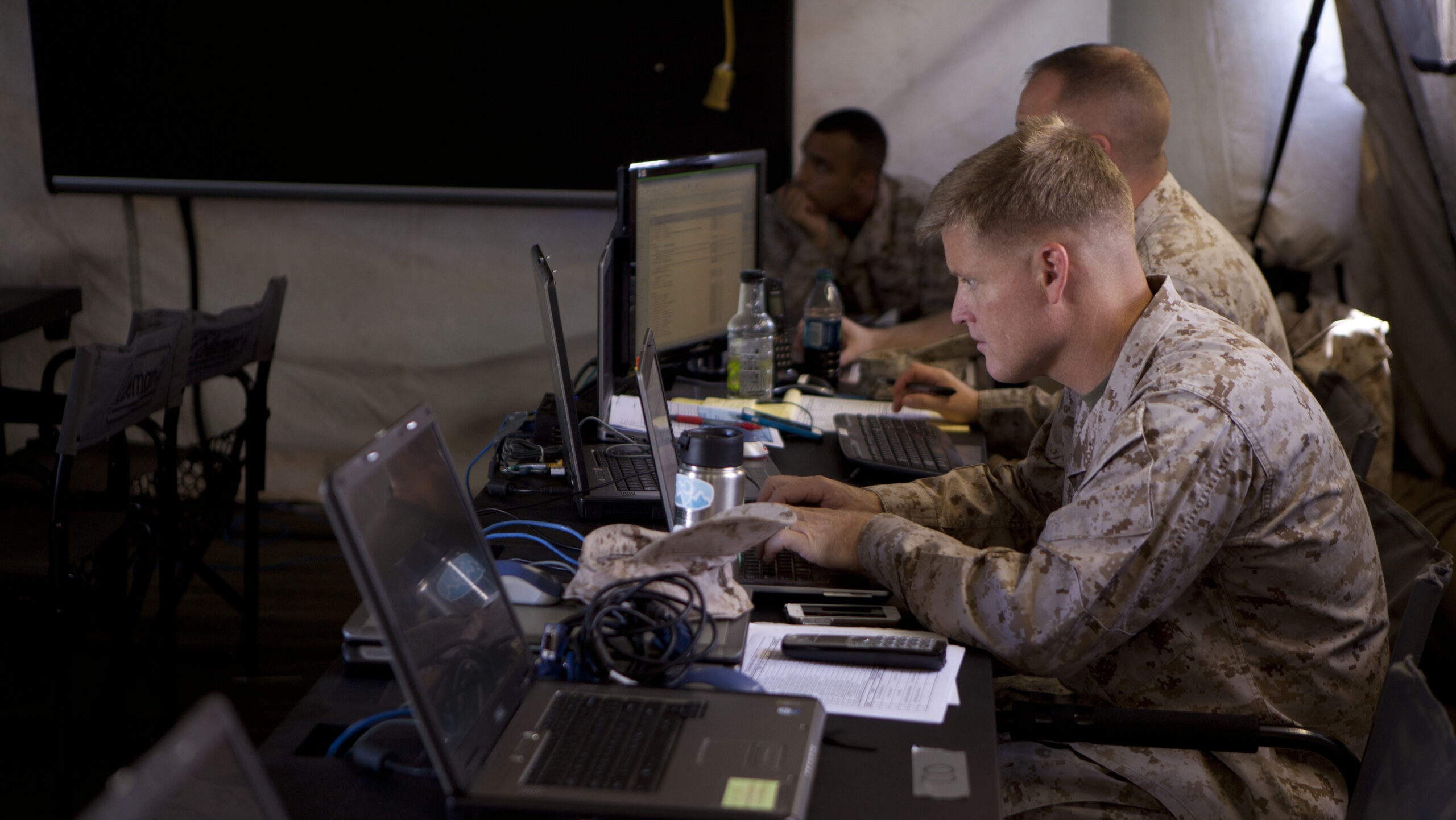
RANGE 24, FORT DRUM, NEW YORK: “That’s awesome,” said Maj. Edward Sedlock, watching another soldier call up data on his militarized Android smartphone. It was such small, unguarded moments — neither officer had noticed a reporter standing nearby — which suggest that, after more than a decade in development, the Army’s struggle to bring wireless networking to the foot soldier is finally yielding fruit, just in time to help secure the drawdown in Afghanistan.

Sedlock and his comrade weren’t part of some special group testing new equipment, like the much-publicized Network Integration Evaluations in the New Mexico desert, AOL D readers are so familiar with. Instead, they belong to an operational unit, the 3rd Brigade of the 10th Mountain Division, training to use the new gear as they get ready for an expected deployment in Afghanistan. (They haven’t yet received their formal orders to go but planning is well advanced, down to designating an assigned area of operations the Army asked us not to name). “3/10″ and its sister unit, the 10th Mountain’s 4th Brigade, are the first combat brigades to receive the technology, as part of an upgrade the Army calls “Capability Set ’13″; two more brigades, from the famed 101st Airborne, are next in line for the new network. Keep reading →

PENTAGON: Technology is a two-edged sword, and it can cut the hand that wields it in unexpected ways. For a generation, ever since the first Gulf War, the information age has been America’s big advantage, arming the US military with everything from smart bombs to remotely piloted drones to supply databases. But even low-tech Iraqi insurgents could pick up Predator video transmissions from time to time, and potential adversaries from China to Iran are far more capable in cyberspace. So as the all-consuming commitment to Afghanistan winds down, the armed services have started looking hard at the perils and potential of their dependence on computer networks — none more so than the US Navy.

The Chief of Naval Operations himself, Adm. Jonathan Greenert, has increasingly emphasized the intersection of the brave new world of cyber with the Navy’s longstanding strengths in electronic warfare, most recently in an editorial published on this website yesterday. To flesh out the CNO’s vision, I sat down with Greenert’s point man on the coming war of electrons, Rear Adm. William Leigher. A veteran cryptologist who went on to serve at Fleet Cyber Command, Leigher now bears the jaw-breaking title of “director of warfare integration for information dominance,” known in Navy shorthand as N2/N6F. It’s his job to keep up with the staggering pace at which information technology advances. Keep reading →

WASHINGTON: The current fiscal crisis slams the entire military, keeping aircraft carriers in port and fighter pilots on the ground for lack of funds, but of all the services, said Pentagon comptroller Robert Hale today, “the Army has by far the worst problem.”

That’s because the Army faces a unique triple-barreled budget problem, known with grim humor as “6-6-6″ because each part takes $6 billion out of Army readiness accounts: the automatic cuts known as the sequester, which began March 1st; the Continuing Resolution now funding the government, which continues spending at 2012 levels without any flexibility to start new programs or even adjust existing ones; and the shortfall in wartime supplemental funding (called OCO, for Overseas Contingency Operations) caused by unexpectedly high costs in Afghanistan. Keep reading →

FORT LAUDERDALE: It’s unnerving when you learn your program’s fate from the small print in a presenter’s PowerPoint slides. But that’s how difficult government-industry communications can get in the Army’s ambitious attempt to inject innovative technology into its cumbersome procurement process, the twice-yearly Network Integration Evaluations.

“A question we’ve been asked many times over: ‘Have you bought anything out of the NIE?’ Yes, we have,” said Maj. Gen. Harold Greene, deputy to the Army’s Assistant Secretary for Acquisition, on the second day of the Association of the US Army‘s annual winter conference here in Florida. Up on the screen flashed a list of 30 NIE-tested technologies that the Army was procuring, from massive programs like WIN-T (Warfighter Information Network – Tactical) from General Dynamics to “Tactical Vision” mission planning software from a 30-person firm called Ringtail Design. Keep reading →

WASHINGTON: Since 9/11, the armed services have made great strides in applying information technology to warfare — but their implementation to date has relied on costly, manpower-intensive “brute force,” said the Navy’s director for “information dominance,” Rear Adm. William Leigher. As budgets tighten, he said, the services will have no choice but to operate more efficiently and, above all, more cooperatively with one another.

“This is going to force us to take a different approach with jointness,” Leigher told the audience at an Armed Forces Communications and Electronics Association (AFCEA) luncheon yesterday. Under the growing fiscal pressure, he said, consolidation of separate networks to a single “joint information environment [JIE] becomes more possible in this downturn … than it might have been.”

It’s hard to think about the future, though, when you don’t know how much money you’ll have next month. With the automatic cuts known as sequestration set to start March 1st, and the Continuing Resolution funding the government expiring March 27th, all the services are frantically cutting back on costs. That includes conferences and speaking engagements requiring travel: “For those of you who expected a panel, I’m your panel,” said Leigher, the sole speaker left on the day’s agenda.

The real near-term damage is to military readiness, with the Navy cancelling ship maintenance and even deployments overseas — most dramatically of the aircraft carrier USS Truman. But modernization programs will feel the pain as well, said Leigher: While major procurements are often funded years in advance, smaller improvements are routinely installed during maintenance “availabilities” now being cancelled.

For example, eight warships won’t be upgraded as scheduled with a new shipboard network called CANES (Consolidated Afloat Networks and Enterprise Services). That’s a single system meant to replace the no less than five separate networks, each serving a different purpose, currently installed on the typical warship.

Five networks on one ship is just a simple example of the inefficient kludges characteristic of today’s military information technology. Information pouring back from high-tech drones, for example, hits a low-tech chokepoint at analysis centers doing the “processing, exploitation, and dissemination” (PED), Leigher said, where the chief method of sifting through that data is entire rooms full of “22-year-old sailors” sitting and staring at screens for hours, watching for the one moment of life-or-death significance in hours of data.

“We throw people at the problem,” said Leigher. “People are the most expensive thing [in the military budget]. There’s got to be different ways we can attack this.”

What the military really needs is “better artificial intelligence,” said Leigher, able to sort through the information overload, identify patterns and anomalies, and only pass what matters on to the human analysts.

The ultimate goal, said Leigher, is a single seamless network sharing intelligence, targeting data, and commands among manned and unmanned assets from every service — yet without today’s dependence on satellite communications systems that can be hacked or shot out of orbit by a high-tech adversary (translation: China).

After decades of the Navy thinking about platforms — ships, planes, satellites — “I’m seeing the change,” said Leigher: “We really are talking about network warfighting capbilities” in a way the military wasn’t just a few years ago. And that change goes across services, especially between the Navy and the Air Force under their AirSea Battle initiative. “You really can’t look at this in a vacuum with the Navy,” he said, but instead must build in links to joint air operations centers and to so-called “5th generation” fighters like the Air Force F-22 and the F-35, which the Air Force, Navy, and Marines will all fly.

One project Leigher singled out was the awkwardly named NIFC-CA (pronounced “Nifca”), short for Naval Integrated Fire Control – Counter Air. Intended to coordinate defense against incoming enemy aircraft and missiles, NIFC-CA was begun to connect Navy fighters, shipboard radars, missile launchers, and reconnaissance aircraft like the E-2C. In September, however, the Navy and Army ran a test together at White Sands Missile Range, New Mexico, where a NIFC-CA connection allowed a Navy SM-6 Standard missile to intercept a target using data from an Army radar blimp called JLENS (Joint Land Attack Elevated Netted Sensor).

That kind of connectivity, Leigher said, “is really the first time we’ve approached what AirSea battle talks about, network integrated attack.”

Ultimately, the admiral said, the cutting edge of the new combat network will be unmanned platforms that can fight, not just collect intelligence. “This is where it all comes together,” he said, showing a slide of the experimental X-47 drone: artificial intelligence, weapons, targeting, command and control, and networks with the bandwidth to tie it all together.

At the same time, Leigher acknowledged, America’s omnipresent new technology creates a vulnerability as well — one that will require constant effort to secure. “These things,” he said, holding up his smartphone, “will keep me in business forever.”

And the challenges aren’t just technological. “Where I feel a little bit uncomfortable, as a guy that grew up in the intelligence community, is about what this means for privacy,” Leigher said. “We’ve got to be very careful as we go forward to protect individual rights, because it’s very easy to cross the line.”

Edited at 9:40 am, Feb. 21 to add term “Processing, Exploitation, & Dissemination.”


Sitting in the cockpit of her A-10 Warthog somewhere over Florida’s Eglin Air Force Base on Jan. 10, Maj. Olivia Elliott flipped a switch. In an instant her blunt, twin-engine warplane with the 30-millimeter cannon in the nose was transformed. No longer just the Air Force’s most heavily-armed attack jet, now the A-10 was also a flying wireless router, providing Internet connectivity to anyone in range — and with the right password.

The final test of the Network-Tactical, or Net-T, upgrade to the Northrop Grumman LITENING and Lockheed Martin Sniper targeting pods, carried by A-10s and other warplanes, is the latest in a long chain of communications breakthroughs by the U.S. military and the defense industry. Keep reading →

This year, the Defense Information Systems Agency has ambitious plans to streamline and speed up how military personnel access applications and services on the Defense Department’s computer networks. These efforts include launching a new pan-service user environment, making enterprise services easier to use and access, increasing the offerings and capabilities of cloud based systems, and providing a mobile device infrastructure for the services to use.

But all of those efforts are being buffeted by the uncertainty of monumental Defense budget cuts, and increasing pressures on IT budgets in particular. Keep reading →

Page 1 of 512345