shipbuilding

navy-carrier-strike-group-maneuvering-090212-n-6597h-078-1366319971

[updated with Adm. Greenert comment] House Armed Services seapower chairman Randy Forbes promised a “rebirth” of oversight in my interview with him last week, and he makes a down payment on that in his subcommittee’s markup of the defense bill. It includes a host of new reporting and certification requirements. Top of the deck comes the… Keep reading →

The Canadian Coast Guard Ship Louis S. St-Laurent makes an approach to the Coast Guard Cutter Healy in the Arctic Ocean Sept. 5, 2009. The two ships are taking part in a multi-year, multi-agency Arctic survey that will help define the Arctic continental shelf. U.S. Coast Guard photo by Petty Officer Patrick Kelley.

[updated with Adm. Greenert comment] WASHINGTON: While the Navy pivots to the Pacific, the Coast Guard has got their northern flank: the once icebound but now rapidly opening waters of the Arctic Ocean, with its new opportunities for oil, gas, and trade through the fabled Northwest Passage. For the chronically underfunded and “oversubscribed” service, however, the… Keep reading →

CAPITOL HILL: Yes, the defense budget is a mess. Continued uncertainty about whether sequestration will go away or is the new norm has thrown the annual budget process into even greater disarray than usual. But, Rep. Randy Forbes believes there’s a silver lining. Precisely because the president’s budget request is largely overtaken by events, Congress… Keep reading →

LCS-1 Freedom in Guam 8600054408_7d148ae721

In a hastily convened conference call with journalists, the Navy pushed back today against recent congressional criticisms of its Littoral Combat Ship. Yesterday, the LCS program took a 1-2 blow from BreakingDefense, which got a draft of a Government Accountability Office (GAO) report questioning the Navy’s cost estimates to operate it. There was also one… Keep reading →

The $13 billion supercarrier USS Ford under construction in Newport News, Va.

CAPITOL HILL: It’s been a rough 48 hours for the US Navy. Yesterday, the Littoral Combat Ship was battered by House appropriators and questioned by a leaked report. Today it was the Senate Armed Service seapower subcommittee’s turn to grill the Navy about its aircraft carrier and submarine programs. While the automatic 10-year budget cuts known as sequestration played a major role… Keep reading →

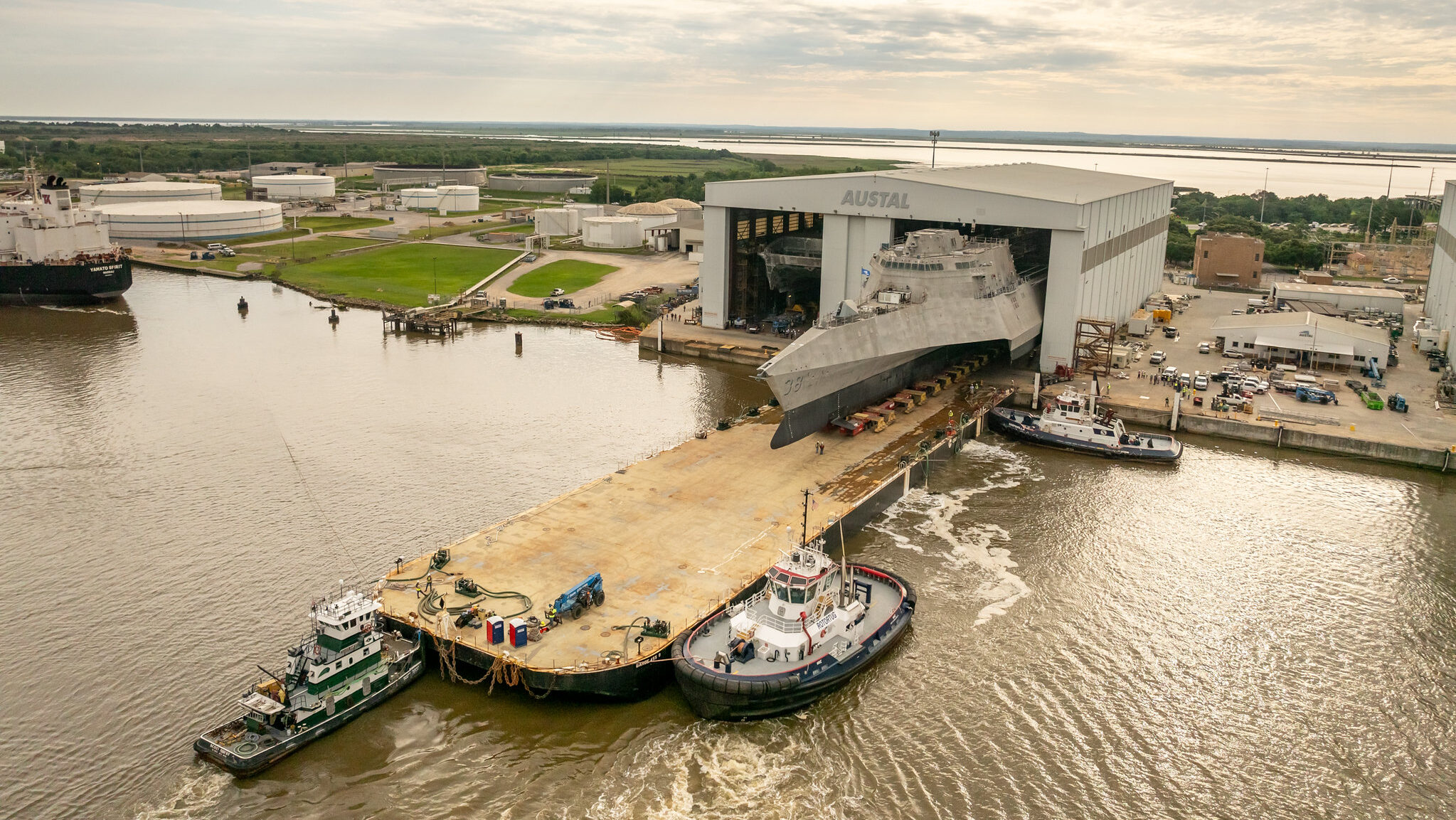
The two Littoral Combat Ship variants, LCS-1 Freedom and LCS-2 Independence.

CAPITOL HILL: The Navy is 90 percent sure its current estimated cost to operate and maintain the controversial Littoral Combat Ship is off target, according to a draft Government Accountability Office report obtained by BreakingDefense. According to the anonymous authors – whose diagnosis, we should emphasize, is not yet the official and fully vetted conclusion… Keep reading →

CAPITOL HILL: Sequestration is not the Navy’s only shipbuilding problem. In the near term, the automatic cuts to the 2013 budget are bedeviling efforts to save money by buying ships in bulk. Negotiators are racing the clock to salvage a multi-year procurement contract to buy 10 DDG-51 Aegis destroyers for the price of nine; Navy Secretary Ray Mabus told reporters today he was “optimistic.”

In the longer term, however, after the 10-year, $500 billion cut in defense spending required by sequestration, the Navy has dug a different hole for itself. The service has crafted a 30-year shipbuilding plan that requires massive increases in funding to levels that the Navy’s acquisition chief Sean Stackley admitted to Congress had not been seen since the Reagan build-up.

“Can you present… a scintilla of evidence” that the 30-year plan can be funded, an exasperated Rep. Randy Forbes, the chairman of the House Armed Services Committee’s panel on seapower, asked during a hearing this morning.  Keep Reading →

For a host of security and economic reasons, American foreign and defense policy will increasingly focus on the Asia-Pacific region in the decades ahead. With over 60% of all U.S. exports going to Asia-Pacific Economic Cooperation (APEC) countries and 40% of total global trade emanating from Asia-Pacific, the United States cannot be an impartial observer of events in the region.

That interest should be heightened by the accelerating military and particularly naval buildup that is playing out across East Asia and the Western Pacific in response to China’s rapid and opaque military modernization efforts. Countries from Vietnam to the Philippines to Japan are responding to Beijing’s recent assertiveness and growing military capabilities by investing in advanced systems of their own, fostering a potentially volatile climate in the economically-essential waters of East Asia. Keep reading →

The House passed the second Continuing Resolution of the year today, avoiding the direst scenario that had haunted many in American defense circles. But the CR’s passage does not mean anyone has avoided sequestration, as the mandatory budget cuts are known. And cutting $50 billion a year from the Pentagon budget for the next 10 years — which will happen under sequestration — will still mean serious cuts to what is, admittedly, the enormous defense bill we pay.

As many senior officials and lawmakers have pointed out, the manner in which these budget cuts must be implemented is the real problem. So far, it looks as if a program gets cut by 10 percent. Period. The Pentagon can’t make any choices about what to cut or when under sequestration and it can’t distribute the cuts across programs to lessen their effects or to ensure we can buy the weapons we really need without greatly increasing their units costs. Add to this congressional reluctance — born of fear — to cut troops’ pay and benefits and you face incredibly challenging strategic choices. I asked Loren Thompson, a member of our Board of Contributors, to detail how the military can cope with this. Read on. The Editor. Keep reading →

WASHINGTON: The Navy’s top admiral talked up cheap ships and high tech this morning, from laser weapons to a new double-decker version of the Mobile Landing Platform vessel (pictured above). Chief of Naval Operations Adm. Jonathan Greenert said precious little about the rolling budget cuts called sequestration. He clearly preferred to emphasize a bold vision of the future rather than the current budget crisis that has forced the fleet to halve its aircraft carrier presence in the volatile Persian Gulf.

Indeed, speaking at a Newseum conference sponsored by McAleese & Associates and Credit Suisse [click here for full coverage], the CNO struck a remarkably optimistic note about the current fiscal misery: “If we get a bill at the end of this month, all of the carrier woes” — delays not just to deployments but to maintenance overhauls — “all go away,” Adm. Greenert said. “The money’s in place; we [just] need the authority to spend it.” Keep reading →

Page 1 of 512345