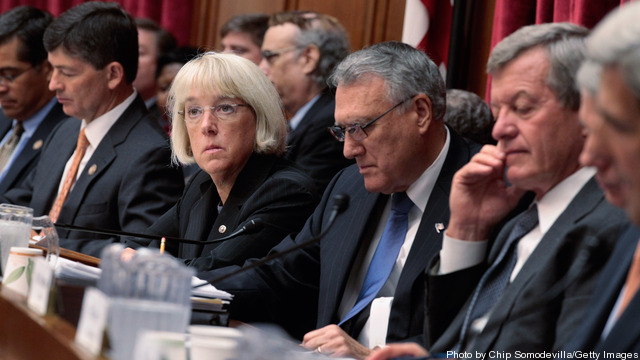
 If you are in the defense business, then you’re probably getting tired of speculation about how the so-called congressional “super-committee” is going to decide the fate of America’s military posture. That bipartisan panel of 12 lawmakers was established by the Budget Control Act to recommend $1.5 trillion in savings by November 23, and if it doesn’t succeed — or Congress fails to enact what it recommends — then automatic cuts will be imposed on domestic and defense programs.
The defense cuts triggered by “sequestration” in the absence of a political agreement could reach $600 billion over ten years, and that’s on top of the $350 billion already being implemented under the law.
They’re all wrong. Two years from now, Washington will barely remember what the super-committee was, and a whole new array of issues will occupy center-stage in the policy arena. The committee’s recommendations aren’t going to matter over the long run, for five simple reasons.
1. It’s only a law. The legislation that created the super-committee and mandated deficit reduction goals wasn’t brought down from the mountaintop by Moses. It’s just another law, and like any law it can be repealed or amended. History reveals few examples of federal laws adversely affecting millions of voters that aren’t modified soon after passage, and today’s legislators have no power to constrain the actions of future Congresses. So if you think that the mandates set forth in the Budget Control Act are going to set the level of U.S. military spending for the next ten years, guess again. America’s political system is the binary opposite of the old Soviet central-planning system. We don’t do 10-year plans in Washington. Everything is subject to change, and well-organized minorities almost always get their way in Congress. Thus, the Budget Control Act as we know it today is not long for this world, no matter what the super-committee recommends.
2. Elections are coming. The second wave of defense cuts potentially triggered by the law doesn’t begin to take effect until January of 2013, after the next presidential election. There’s a high likelihood that election will put a Republican in the White House who has no use for the spending priorities he or she has inherited. Even if President Obama manages to eke out a meager electoral victory despite high unemployment and low approval ratings, he will face a Congress dominated by Republicans (the GOP already controls the House and only needs to pick up four seats to control the Senate). The political stalemate that led to the Budget Control Act will thus be either broken or altered, and new measures will take its place. If Republicans win everything, they can satisfy the deficit-reduction aspirations of the Tea Party without cutting defense, and most of the candidates for the party’s presidential nomination are signaling resistance to any defense cuts at all. It’s exceedingly improbable that the current law would remain intact through a shift in partisan control of the government, and the most likely scenario is that mandated defense cuts will be repealed just as they are beginning to bite after inauguration day.
3. Threats trump deficits. Former joint chiefs chairman Adm. Mike Mullen was exaggerating when he said the deficit was the biggest threat the nation faces. Being out of money is nowhere near as bad as being dead. So if major new security challenges arise in the years ahead, Washington will quickly forget its commitments to cut military spending. And they will arise. From Korea to Cuba to Vietnam to Iraq to 9-11, there’s always some new danger waiting in the wings to stimulate defense outlays. Judging from Secretary Panetta’s recent speech at the Wilson Center, the leading candidate to fill that role circa 2013 is China, which is doing so many things to antagonize Washington — from currency manipulation to computer hacking to threatening neighbors to developing new weapons — that it’s just a matter of time before the U.S. decides some sort of military response is required. Not a war, mind you, but more spending in areas like sea control and long-range strike. Of course, the new threat could come from some unexpected quarter, as it often does. Either way, the record shows that when Washington feels threatened, it spends money on the military like there’s no tomorrow. And given the kinds of threats we now face, there might really be no tomorrow unless the Budget Control Act is set aside to deal with the latest danger.


Processor upgrades enable computing at the edge
Avoiding vendor lock and providing more room for sensors and upgrades are critical considerations.