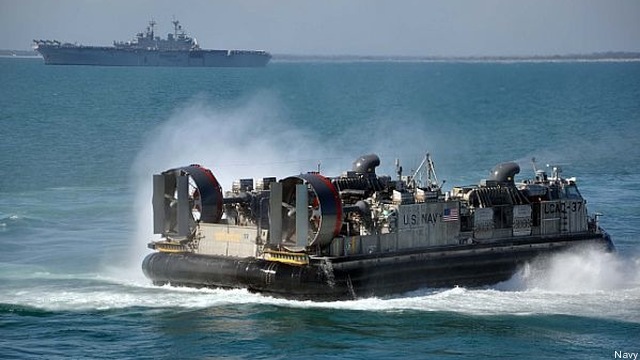
Aging Navy LCAC hovercraft like this one carry Marine vehicles, supplies, and heavy equipment ashore.
The Connector Challenge
So how do you get ashore swiftly from such distances? The new tactics will require new technology — specifically better and faster “connectors,” to use the Navy/Marine lingo for landing craft. But instead of landing on the beach, the Marines now want their connectors to drop amphibious vehicles off five miles from land. That keeps the connectors out of range of ground troops with anti-tank missiles, for one thing. In fact, the fastest current connector, the Landing Craft Air Cushion (LCAC) hovercraft, is so lightly protected the Navy refuses to land it on any defended beach. But the LCAC and other current landing craft are designed to bring Marines all the way to the shore, not drop them off in the surf.
So what’s the solution? A short-term fix may simply be new ramps, said Mullen. The Marines want to modify current landing craft so an amphibious vehicle can drive straight into the water rather than waiting for the ramp to touch the beach. They’re even considering modifications to the ramp on the Joint High Speed Vessel, an ocean-going ship (albeit a small, short-ranged one), to let vehicles “launch in-stream” from a JHSV at sea.
Currently, the JHSV isn’t intended for amphibious assault at all: It’s based on a civilian high-speed ferry that unloads at piers and ports. Using such a large, fast vessel as a “mothership” for an amphibious assault would be a major step forward.
For now, the Navy is sticking to its current program to replace the current LCAC and Landing Craft Utility (LCU), and the Marines are looking at modifying those vessels, not some radical alternative. But, Mullen went on, “long-term, we need to identify some leap-ahead ‘connector after next’ ideas.”
One option being considered is called the Ultra-Heavy-Lift Amphibious Connector (UHAC), which would paddle through the water and then straight ashore on buoyant, air-filled tracks. Another is a semi-robotic high-speed sled that could carry a single Amphibious Combat Vehicle, drop it off in the water, and then find its own way back to the fleet.

Data overload threatens decisionmakers as autonomy expands
Reducing cognitive overload on warfighters while improving “time to trust” for autonomous systems is a matter of design.
But the Marines are eagerly seeking new ideas. They recently had a “connector summit” with Navy and private-sector representatives and will soon issue a formal Broad Area Announcement (BAA) of desired capabilities, Mullen said. Then, “[we’ll] see what comes back from industry in terms of feasibility.”
Some 75 years ago, an eccentric Louisiana boat-builder came up with the design for what would become the ubiquitous landing craft of World War II. “Andrew Higgins is the man who won the war for us,” said to D-Day commander Dwight Eisenhower. That’s the kind of innovation the Marine Corps needs from industry again.