
CAPITOL HILL: Five Maryland-based Army researchers, senior veterans of campaigns against Ebola, HIV, MERS, and more, are leading urgent R&D on the COVID-19 coronavirus, Gen. James McConville told me here this afternoon:
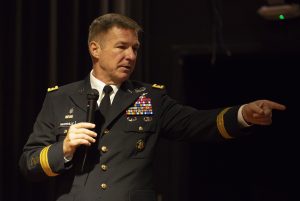
“The secretary and myself met with them last night,” said McConville, the Army Chief of Staff. He and Sec. Ryan McCarthy had mentioned some, but not all, of the experts in their testimony this afternoon to the House Armed Services Committee.
After the hearing, when I asked an aide to help me spell the names, McConville interjected: “I’ll save you the time.” He grabbed a card out of his briefing folder, double-checked it contained no sensitive information, and handed it to me. “That’s the team we met with last night,” he said:
- Dr. Margaret Pitt is the deputy science director at the US Army Medical Research Institute for Infectious Disease (USAMRIID), Fort Detrick, where she previously headed the aerobiology (airborne infection) and virology units.
- Dr. Sheila Peel, veteran of Army research on HIV/AIDS, is chief of lab diagnostics & monitoring at the Walter Reed Army Institute of Research (WRAIR) in Silver Spring, Md.
- Dr. Nelson Michael, a retired Army Medical Corps colonel, heads the Center for Infectious Diseases Research at WRAIR, where he formerly headed the HIV/AIDS unit.
- Dr. Kavyon Modjarrad is both director of emerging infectious diseases at WRAIR and an assistant professor at the Uniformed Services University of Health Sciences (USUHS) in Bethesda. He’s played a leading role in developing a Zika vaccine.
- Col. Wendy Sammons-Jackson is director of the Military Infectious Disease Research Program Area for the Army Medical Research & Development Command at Fort Detrick, where she previously coordinated the response to Ebola.
“They’ve been dealing with Ebola, they’ve been dealing with Zika, they’ve been dealing with MERS, and now they’re dealing with coronavirus,” McConville told me. “We met with them last night and they are passionate about getting after this.”

Data overload threatens decisionmakers as autonomy expands
Reducing cognitive overload on warfighters while improving “time to trust” for autonomous systems is a matter of design.

But, Maryland Democrat Anthony Brown asked during the hearing, isn’t Fort Detrick struggling with funding shortfalls? The infectious diseases center at the fort and its sister center for chemical warfare defense are largely funded by reimbursements from other government agencies, military and civilian, that contract with them to do research. Those reimbursements have been drying up, Rep. Brown said.
“There are some amazing individuals” doing research at the two centers, McCarthy told the committee, but “over the last year, the Army senior leadership recognized that the overhead rates for the labs were growing at double digit rates [to] over 74 percent last year.” Gen. John Murray – who as head of Army Futures Command now controls medical R&D as well – is taking a hand to reduce overhead and establish a stable system of rates for reimbursements from other agencies.
How The Army Is Helping
The Army’s coronavirus work proceeds apace, McCarthy assured the committee. The service is helping the Centers for Disease Control (CDC), National Institutes of Health (NIH), and other civilian agencies develop faster diagnostic tests to see who has the virus, find treatments for those already infected, and create vaccines to prevent further infections, McConville said.

“We are working very aggressively to … develop a vaccination in coordination with the CDC and other health services,” McConville told me after the hearing. “We are testing that on mice right now and we hope to have that in a very short order” – with the possibility of human testing within “months.”
“As far as detecting [COVID-19], we want to improve the ability to test at scale,” he continued. “We certainly have tests right now for the coronavirus, but we would like to see a much quicker and greater capability, so we are developing those testing kits right now.”
“We can do it in small numbers now, 50, 60, so many a day, but we need to get up to thousands” of people tested per day, McConville had told the committee. “These experts that… work for the Army that have told us that, in about two to three months, they can develop — with the right resources, and we have given them the resources —… a test capability that’s much larger in scale.”
Doing things on a massive scale – from medicine to logistics to satellite communications terminals – is, after all, has been one of the Army’s core strengths since at least World War II. Even decades before that, it was Army Major and medical doctor Walter Reed – yes, the one the hospital was named after – who discovered that mosquitoes transmitted yellow fever. Applying that knowledge, it was a US Army-led commission that drained and sprayed the malarial swamps of Panama to make possible the construction of the Panama Canal, an effort previously stymied by the massive death toll from yellow fever and malaria among the workers.

In fact, until the 20th century, infectious disease consistently killed more soldiers than combat. That’s the reason the Army has long had an acute interest in public health.
“Most people would not look at the Army to have that type of capability, but that’s kind of what we do,” McConville said. “When the nation has a crisis, this is what the United States Army does, whether it’s a hurricane, it’s a fire, a storm, [or] medical threats.”
While Army researchers develop countermeasures, commanders are carefully tracking the current health of the force. “Every single night we have a team that comes together and makes sure that our soldiers and families are being protected,” Gen. McConville told me. “It’s the leadership around the world,” including US Army Pacific, US Army Europe, US Army Africa (headquartered in Italy, which has shut down schools to contain the virus), and US Forces Korea, led by Army Gen. Robert Abrams.
The service is tracking “where is every soldier and family member on the Earth” for potential COVID-19 exposure, McCarthy told the committee. “The vice chief of staff of the Army, Gen. Joe Martin, heads this meeting every day, and they’re looking at where everybody is else and making risk based assessments — do we turn off exercises, do we re-deploy?”
With the virus spreading especially rapidly in South Korea, “we have certain screening we’re doing for all our soldiers coming back from Korea,” McConville told the committee. “We just had the 3rd Brigade of the 1st Cavalry Division come back, and…every soldier is being screened at multiple times during the redeployment to make sure they don’t have a problem.”
McCarthy: Esper Wants ‘Visibility,’ Not a Veto
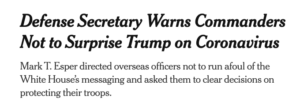
The New York Times reported yesterday, under the headline “Defense Secretary Warns Commanders Not to Surprise Trump on Coronavirus,” that Defense Secretary Mark Esper had warned Gen. Abrams not to take any steps against the virus without clearing them through the Pentagon first. According to the Times’ unnamed sources – who could have been any number of senior officers and junior aides listening to the high-level video teleconference – Abrams pushed back, saying there might come a time he would have to take urgent steps without consulting Washington.
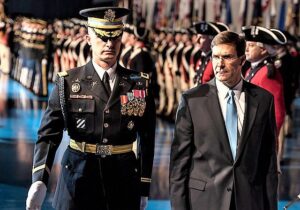
Pentagon spokesman Jonathan Hoffman denounced what he called the “inaccurately titled” Times story in a statement this afternoon, calling it “an anonymously-source [sic], dishonest misrepresentation.” Hoffman himself was on the call, he said, and he never heard Sec. Esper tell commanders to ask him for any kind of mother-may-I before taking necessary protective measures.
Ryan McCarthy, who succeeded Esper in the Army Secretary job when Esper was promoted to Defense Secretary, defended his longtime boss and close colleague this afternoon. “He wanted visibility,” no more, McCarthy told reporters after the hearing. “Clearly, we would need to know if they were changing the readiness posture on the peninsula, and how that would be perceived [i.e. internationally], so it would be something I think the Secretary of Defense would need to know about.”
But, one reporter pressed, would Gen. Abrams have to get approval from the Pentagon before taking steps to protect the health of troops and their families? “Clearly, we would try to move it quickly,” McCarthy replied (which implies some kind of consultation with Washington is expected).
“The life, health, and safety of our servicemen and women is paramount,” he said. “It’s just visibility as the decisions are being made, because it could have strategic implications.”
“Gen. Abrams is going to do what he has to do to protect our people. It’s just everybody needs to have awareness,” McCarthy continued. “He’s passing a lot of information back.”
In addition, the secretary said, Army scientists from Medical Research & Development Command have flown to South Korea to check on coronavirus cases there first-hand. At least one Army soldier stationed in South Korea and his wife have been diagnosed with COVID-19, though there’s no word yet on their infant child.
Has it complicated the coronavirus response, I asked, that the Army is in the middle of reorganizing its medical assets? Much day-to-day care is moving to the newly created all-service Defense Health Agency, medical supplies are moving to Army Materiel Command, and medical R&D is moving to the year-and-a-half old Army Futures Command.
“That’s not a problem,” Gen. McConville told me confidently.
“You’ve got to chew gum and walk at the same time,” McCarthy said when I asked him the same question. Yes, the secretary has raised concerns about transfer of Medical Treatment Facilities (MTFs) to the new Defense Health Agency (DHA). But, he told me, “what I’ve talked about publicly is the pacing of the DHA merger within the department. A lot of that is … taking care of MTFs and just the day to day clinical work that’s done at those hospitals, but it’s also the operating model, how they’re going to budget, how they’re going to develop personnel.”
The Army’s medical R&D experts are not slowing down for the transition, the secretary said. In some ways, in fact, this kind of crisis is all too familiar for them.
“If you look at the last five or 10 years, all of the challenges we’ve faced with Zika, Ebola, and SARS, these are challenges that are always going to arise,” Sec. McCarthy said. “So we have to be agile no matter what.”
“With regards to the coronavirus,” Gen. McConville told me, “it’s not a time to panic, it’s really a time to focus, it’s a time to communicate, and that’s what we’re doing within the Army.”