
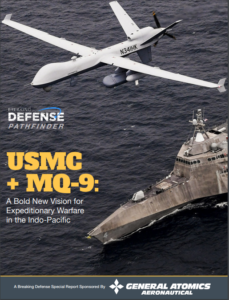
New challenges for the future of warfare have prompted the US Marine Corps to respond by doing three things it does best: improvise, adapt and overcome. The Marines have replaced outdated doctrine and assumptions with a fresh and bold new vision for expeditionary, amphibious and littoral operations in the coming century.
The Marine Air Ground Task Force Unmanned Aerial System Expeditionary program, or MUX – relying on the combat-proven MQ-9A — has emerged as the commandant’s top aviation acquisition priority to support naval warfighters.
In this Pathfinder article, General Atomics discusses why the MQ-9 is vital to the future vision for America’s naval forces, how the MQ-9 enables a plank of the Marines’ new expeditionary strategy known as “distributed postures”, and why the MQ-9B SeaGuardian is a state-of-the-art platform for anti-submarine warfare.
No registration needed.
Download this FREE PATHFINDER now!
