Land Warfare

Missiles and lasers: How the Army wants to advance its Indirect Fire Protection Capability portfolio

The service is on the hunt for a supersonic interceptor for Dynetics’ IFPC Increment 2 launcher, also dubbed Enduring Shield, and looking for a high-energy laser.

Dynetics enduring-shield-system (1)
Dynetics won a prototype contract to produce the Army’s Indirect Fire Protection Capability. (Dynetics)

Global Force 2023 — The Army is ramping up efforts to protect sites from incoming aerial threats with plans to find a second kinetic interceptor for a new ground launcher and to move forward acquiring a high-energy laser in the 100-plus kilowatt range.

With the rise of relatively cheap aerial threats like suicide drones, the service’s air defense effort, especially its Indirect Fire Protection Capability (IFPC), is certain to be a topic of much discussion at this year’s Association of the US Army’s Global Force show here in Huntsville, Ala., which officially began today.

Currently, the IFPC umbrella includes several programs, including IFPC Increment 2 — Dynetics’ Enduring Shield air defense missile launcher paired with Raytheon’s ground-launched AIM-9X Sidewinder missile — and directed energy weapons (both lasers and high-powered microwaves). This year service has issued two separate solicitations to make advancements in both arenas. 

For its IFPC Increment 2 initiative, the Army wants a second interceptor that can also be fired from the Enduring Shield launcher. 

The new interceptor will utilize an open system architecture approach to establish lethal kinetic effects against select targets within the IFPC Inc 2 threat set, specifically supersonic cruise missiles and large caliber rockets,” the service wrote in January. “The new interceptor requires future capability growth with minimal levels of system redesign to address objective level threat sets.”

The weapon should also be able to target unmanned aerial systems and subsonic cruise missiles. Although this is not a formal solicitation yet, in separate document answering industry questions, the Army said its tentative plan is to award companies with prototyping contracts. Then in the fiscal 2025 to 26 timeframe, it plans to conduct a technology demonstration to include a digital simulation and either a hardware-in-the-loop, and/or a live fire demonstration.

If the program proceeds as planned, a winner “can assume the start of production for the 8,000 interceptors to begin in FY29,” the service told industry in response to one question.

“The intent is that the mixed load capability will exist at the launcher,” it later added. “Each launcher will be capable of having both type of missiles in a mix of (all up round magazines).”

Ready to compete again for a part of the program is Rafael Defense, the Israeli company that lost the IFPC Inc 2 program during the initial competition with its Iron Dome and Tamir interceptor bid. 

Retired Brig. Gen. Ariel Karo, Rafael’ executive vice president for marketing and business development, told Breaking Defense in February that his company will vie for the contract with a “subversion” of its Tamir interceptor that meets the new requirements. 

Beyond Kinetic 

In addition to fielding a kinetic launcher and interceptors, the service is working on a IFPC high-energy laser and high-powered microwave programs (HPM).

For the former, the service wants the IFPC-HEL system to protect fixed and semi-fixed sites from incoming cruise missiles, rockets, artillery and mortars, UAS, and other aerial threats. 

The Army has been eyeing such a capability for several years, but earlier this month its Rapid Capabilities and Critical Technologies Office requested industry submit white papers for 100 kW+ class lasers and said it plans to award at least one company with a prototyping contract. 

“IFPC-HEL is intended to protect fixed and semi-fixed sites from cruise missiles, rockets, artillery, and mortars; unmanned aerial systems; and rotary and fixed-wing threats,” the service wrote. 

“This effort will provide up to four complete HEL weapon systems (e.g., HEL, beam control, beam director, battle management, and power and thermal management), integrated onto a government furnished property platform,” the service wrote. “The HEL weapon systems must be delivered no later than 20 months after award.”

Those HEL weapon systems will then be used on live fire testing against “operationally relevant targets.”

RELATED: HEL in Abu Dhabi: US defense giants Lockheed, Raytheon push laser tech at Middle East arms show

Interested companies have until Friday to respond, and several have been working on similar Department of Defense projects including Lockheed Martin with its 300-kW laser. 

In addition to its laser ambitions, the Army is pursuing an IFPC-HPM program. Epirus, a technology company developing directed-energy weapons, announced in January that it had won a $66.1 million contract to deliver four of its Leonidas high-powered microwave prototypes to the Army for testing against swarms of aerial drones.

While this is one line of effort with the government for an established program, General Dynamics Land Systems has also been working with Epirus on a separate initiative to integrate the Leonidas high-power microwave onto A1 Stryker combat vehicles to provide soldiers with a more mobile weapon. The duo unveiled the design last year and are now in the process of increasing the number of arrays from 9×9 row and column configuration to a 12×12 one. 

“We’re still working on the design,” Kendall Linson, GDLS’s manager for US business development for Stryker, said during a March 21 interview, but noted that enhanced power configuration could be ready in 2024.

PHOTOS: AUSA Global Force 2023

PHOTOS: AUSA Global Force 2023

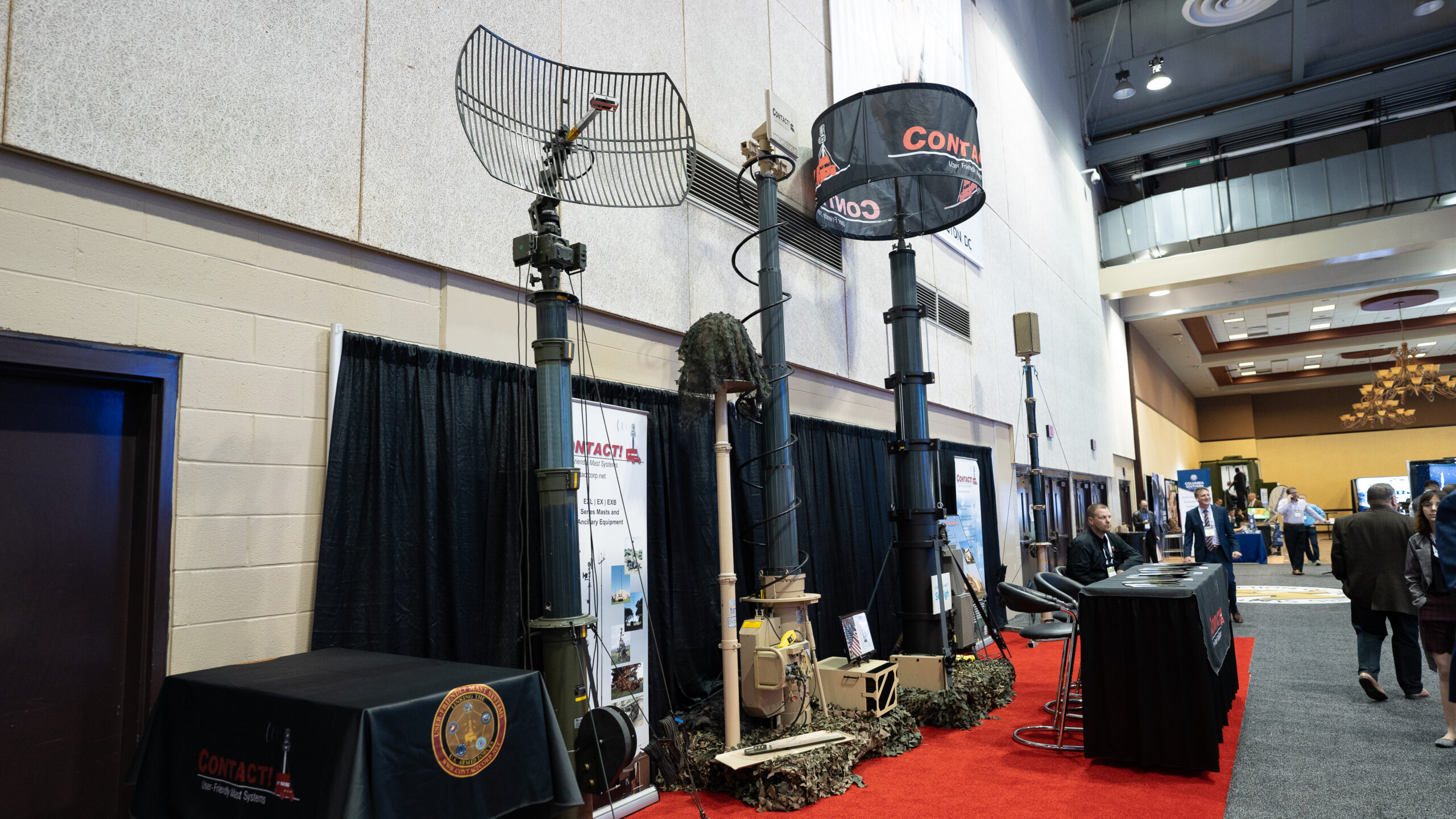
The Contact! Corporation booth had their various satellite mast offerings out. Among them was is the SkyHigh their “newest innovation on tactical vehicle masts.” The company claims the “20 meter mast is deployable in less than 2 minutes." (Brendon Smith / Breaking Defense)
RHEINMETALL had a large booth displaying their various new tech. Their MK93 Mount Upgrade Kit is touted by the company as “the future of mounting solutions." (Brendon Smith / Breaking Defense)
An interesting display by the Invariant corporation showed their deployable container system capable of supporting various weapon systems. (Brendon Smith / Breaking Defense)
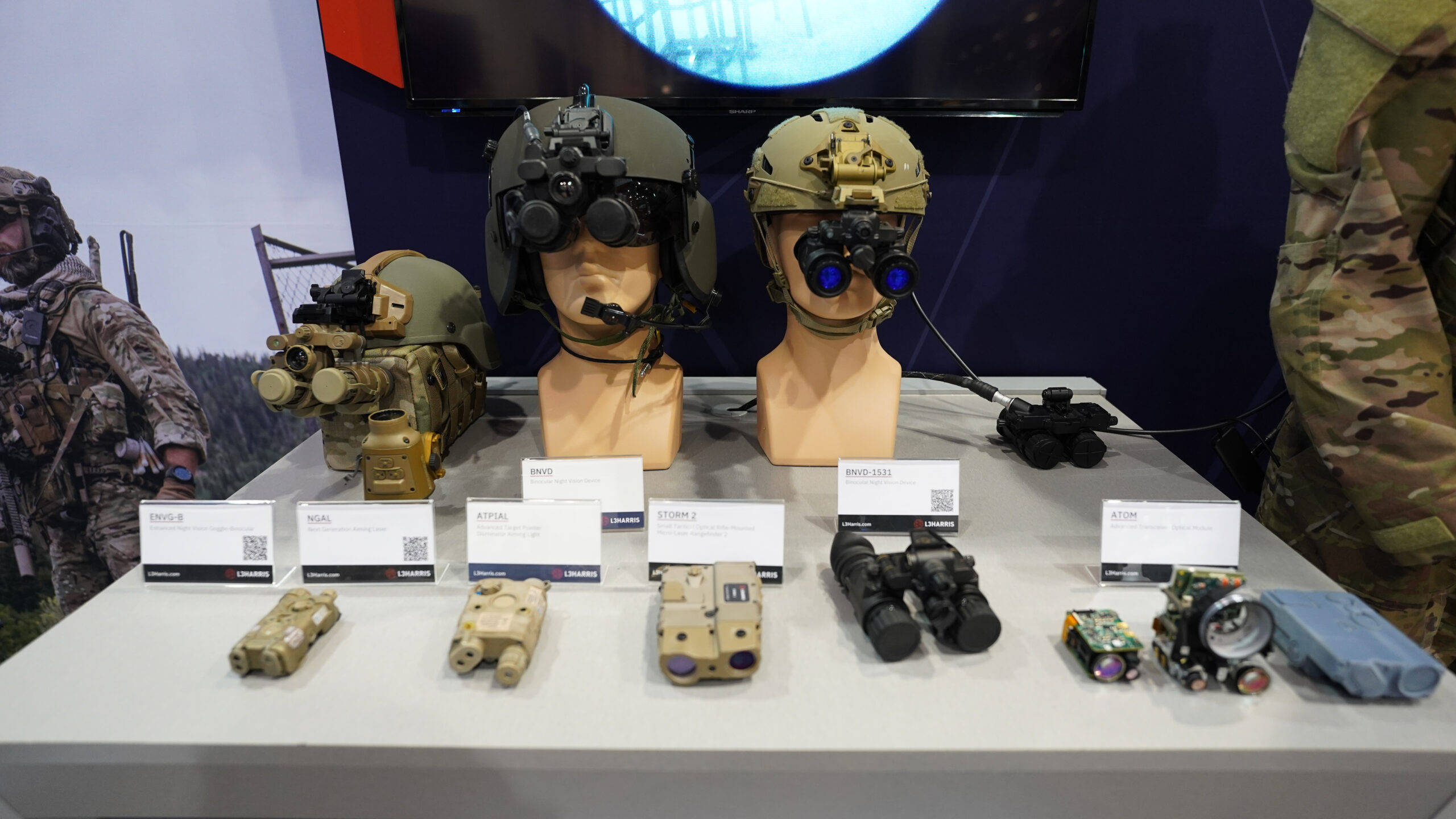
An array of various night vision goggles was on display at the L3HARRIS booth. Models such as their ENVG-B are advertised by the company as also offering Augmented Reality capabilities. (Brendon Smith / Breaking Defense)
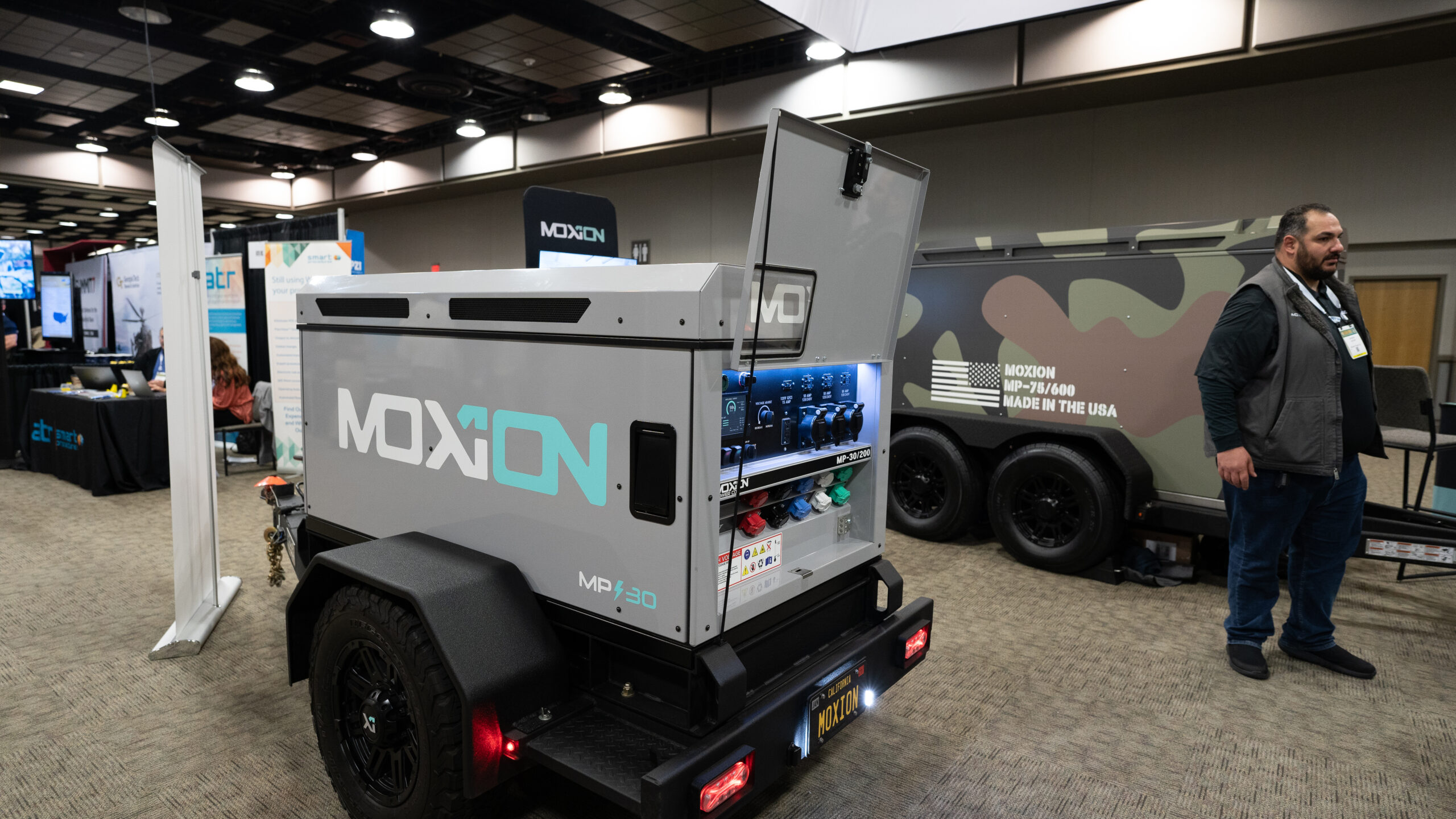
A portable energy solution by Moxion was prominent in the East Hall. The company claims the portable battery has “storage capacity of a nominal 200 Kilowatt Hours and a usable 180 Kilowatt Hours” also boasting a "charge time of only 5 hours”. (Brendon Smith / Breaking Defense)
Collins Aerospace has sky high hopes for its new oxygen supply system meant for “parachutists executing high altitude jump missions”. The company claims the new system “uses significantly less oxygen for a complete jump”. (Brendon Smith / Breaking Defense)
Part of the outdoor exhibit area at AUSA Global, Elbit Systems showed off two of their air defense systems on a tank. The Sling Mobile Mortar System and The MATR-X Multi-Mission Tactical Surveillance Radar. Elbit claims the MATR-X system “can simultaneously scan, identify, track and target thousands of low-altitude airborne targets including small drones, low flying manned aircraft, cruise missiles and other munitions.” (Brendon Smith / Breaking Defense)
AM General displayed their new “Soft Recoil Technology” on the new 2-CT Hawkeye Mobile Howitzer. The company claims the new howitzer improves on earlier models with “lower maintenance costs and converts current towed systems to self-propelled systems.“. (Brendon Smith / Breaking Defense)
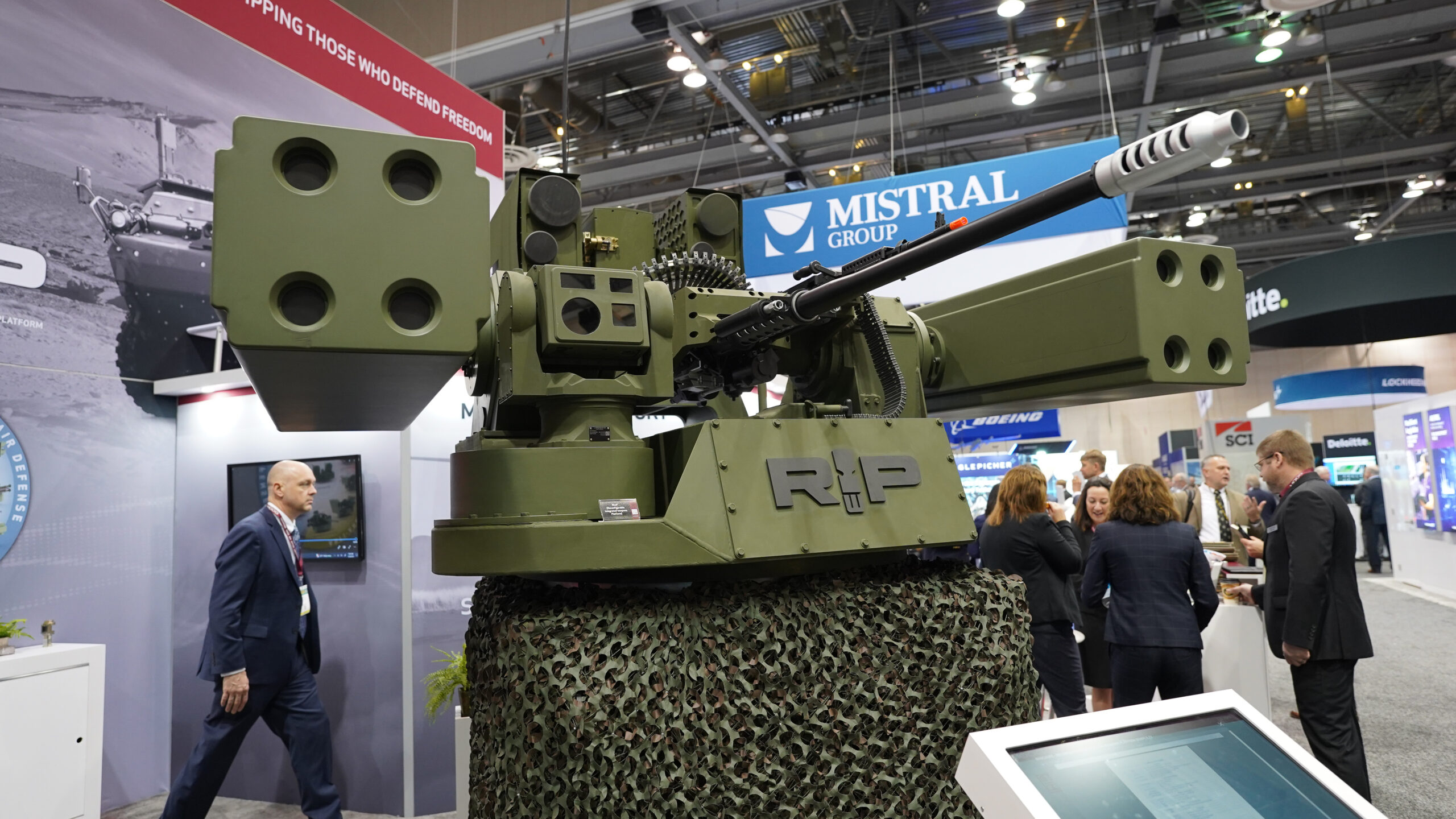
An interesting display by MOOG exhibited their reconfigurable weapons platform. Offering various weapon combinations the platform is described by MOOG as offering "air defense, anti-armor, or multi-mission capabilities. Designed to be weapon, sight, and platform agnostic, RIwP accommodates firepower growth to support future mission requirements.” (Brendon Smith / Breaking Defense)
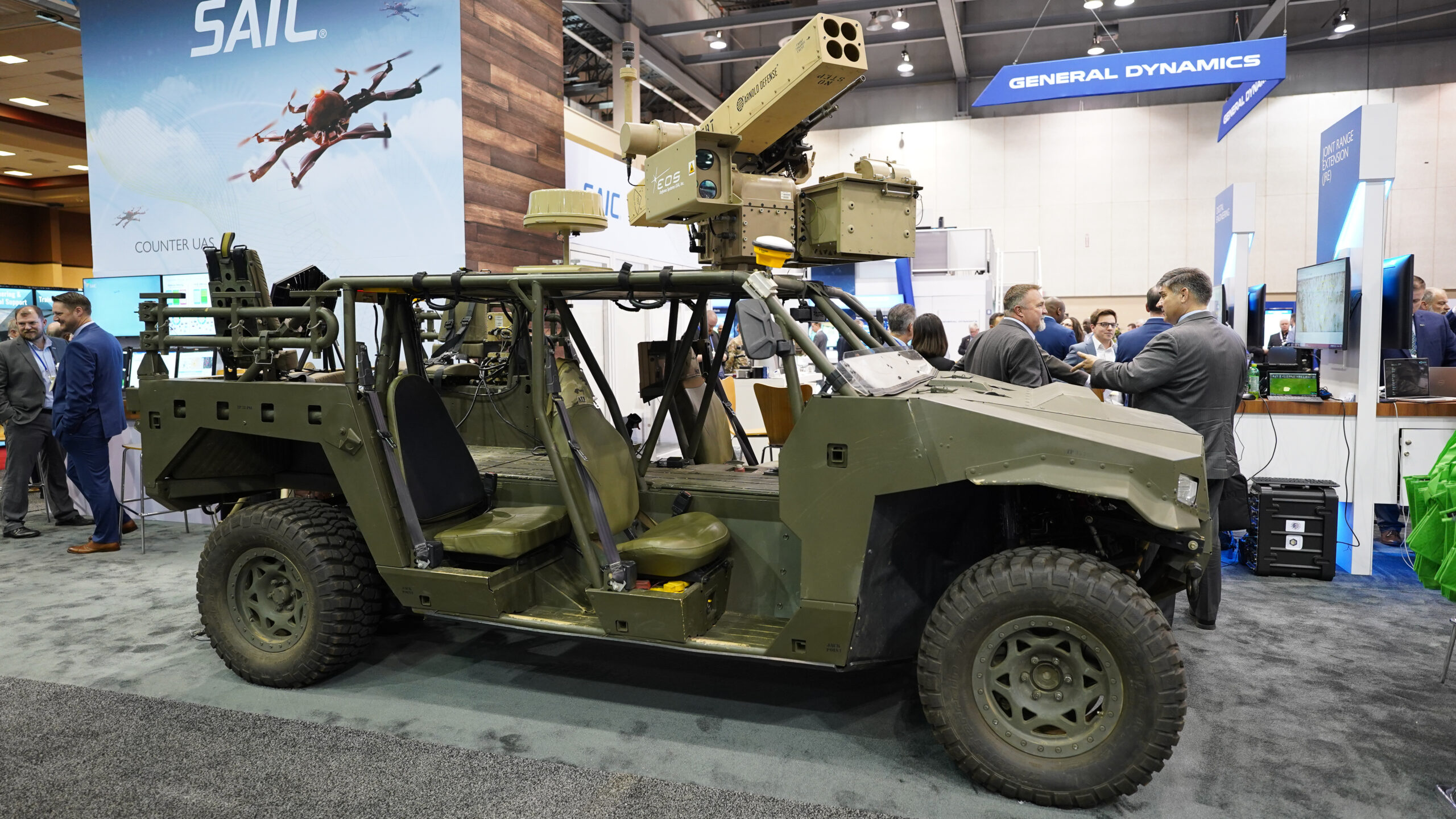
SAIC had a large center booth emphasizing their ground vehicles capability to easily pair with other defense systems. (Brendon Smith / Breaking Defense)
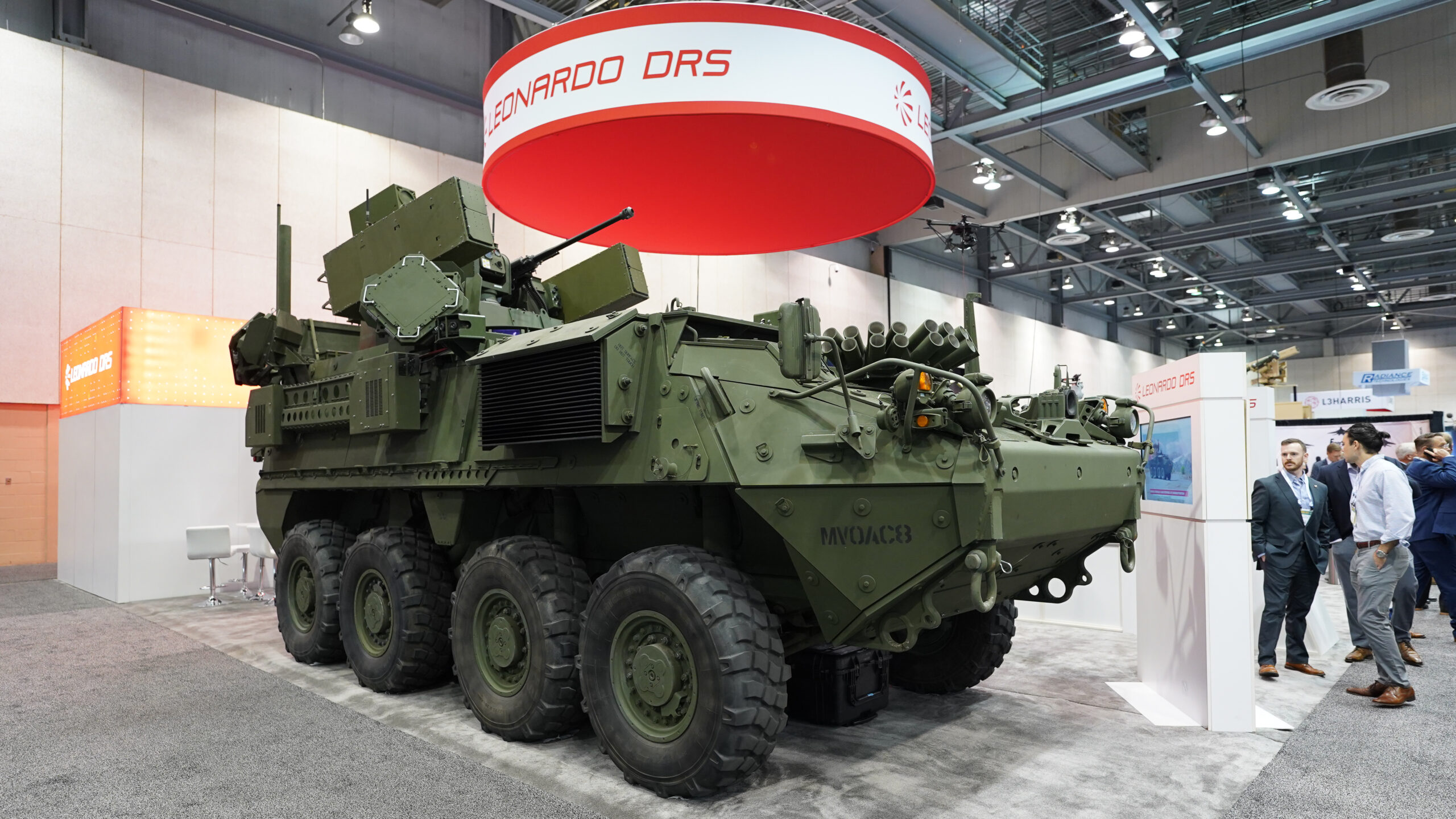
On display by Leonardo DRS is their high-profile C-UAS solution, the Stryker. According to the company, the vehicle “allows soldiers to detect, identify, track and defeat Group 1-3 UAS” with both kinetic and non-kinetic technologies. (Brendon Smith / Breaking Defense)
At the Quickset booth, the company showed off their equipments sensor and surveillance capabilities. Reps discussed the TAURUS-R camera system, which they claim are “optimized for the harshest mobile and stationary applications." (Brendon Smith / Breaking Defense)
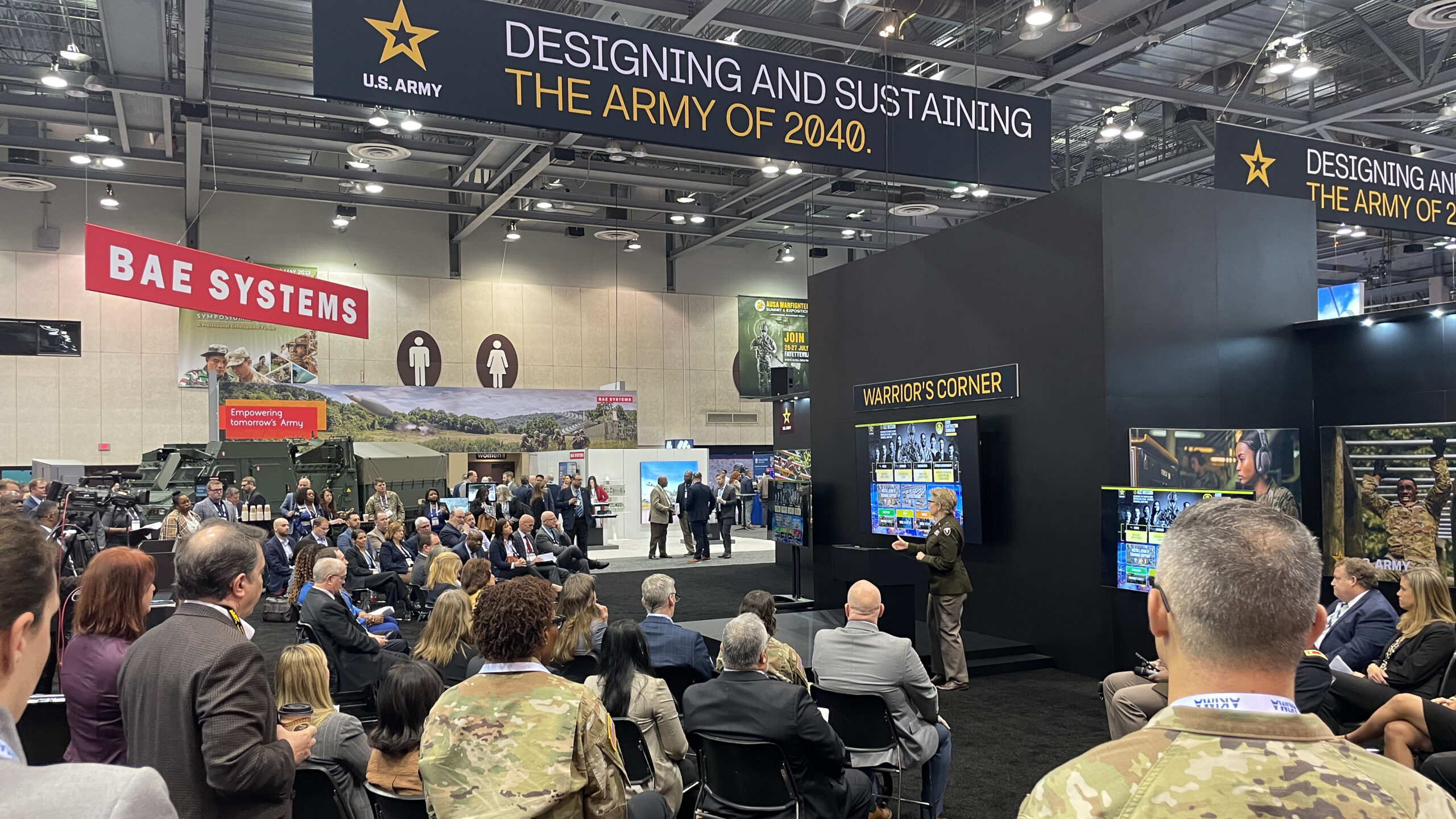
Brigadier General Christine A. Beeler speaks to a large group at the Warriors Corner regarding Army Contracting at AUSA Global Day 2. (Brendon Smith / Breaking Defense)
Minstrel Group describes the THOR VTOL Mini-UAS as “a low altitude multi-rotor platform designed for a wide range of surveillance and reconnaissance missions.” Key Features they highlight include programmable flight patterns, fast deployment, low sound profile and signature, and a clear 360 degree view. (Brendon Smith / Breaking Defense)
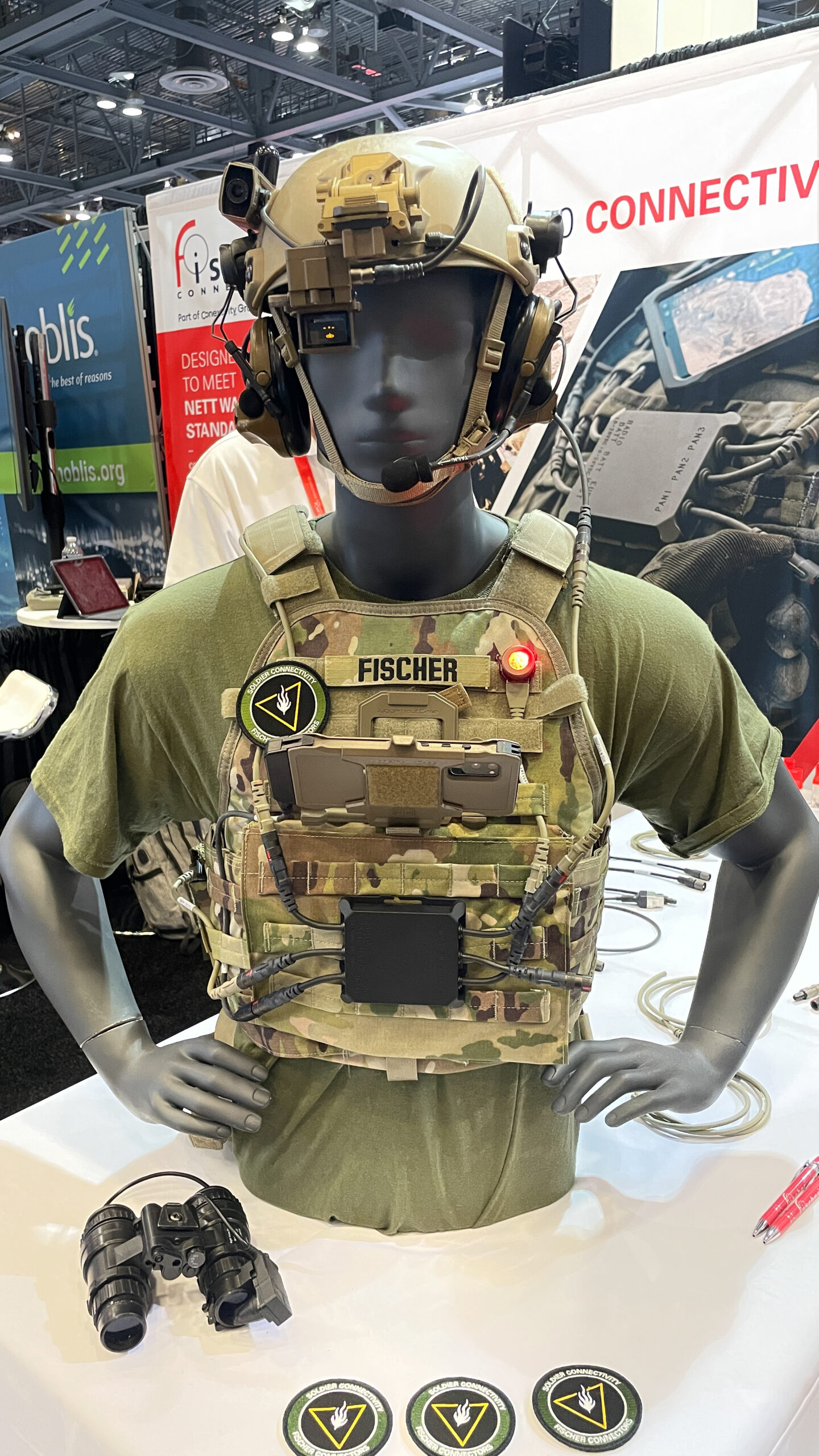
The “Multiport Tactical Hub” being touted by FISCHER a “easy to use” platform that pairs with an all in one application to manage both power and data flows of all connected devices soldiers might need. Connection to a HUD is designed to allow soldiers to view and manage their systems without looking down at a screen. (Brendon Smith / Breaking Defense)
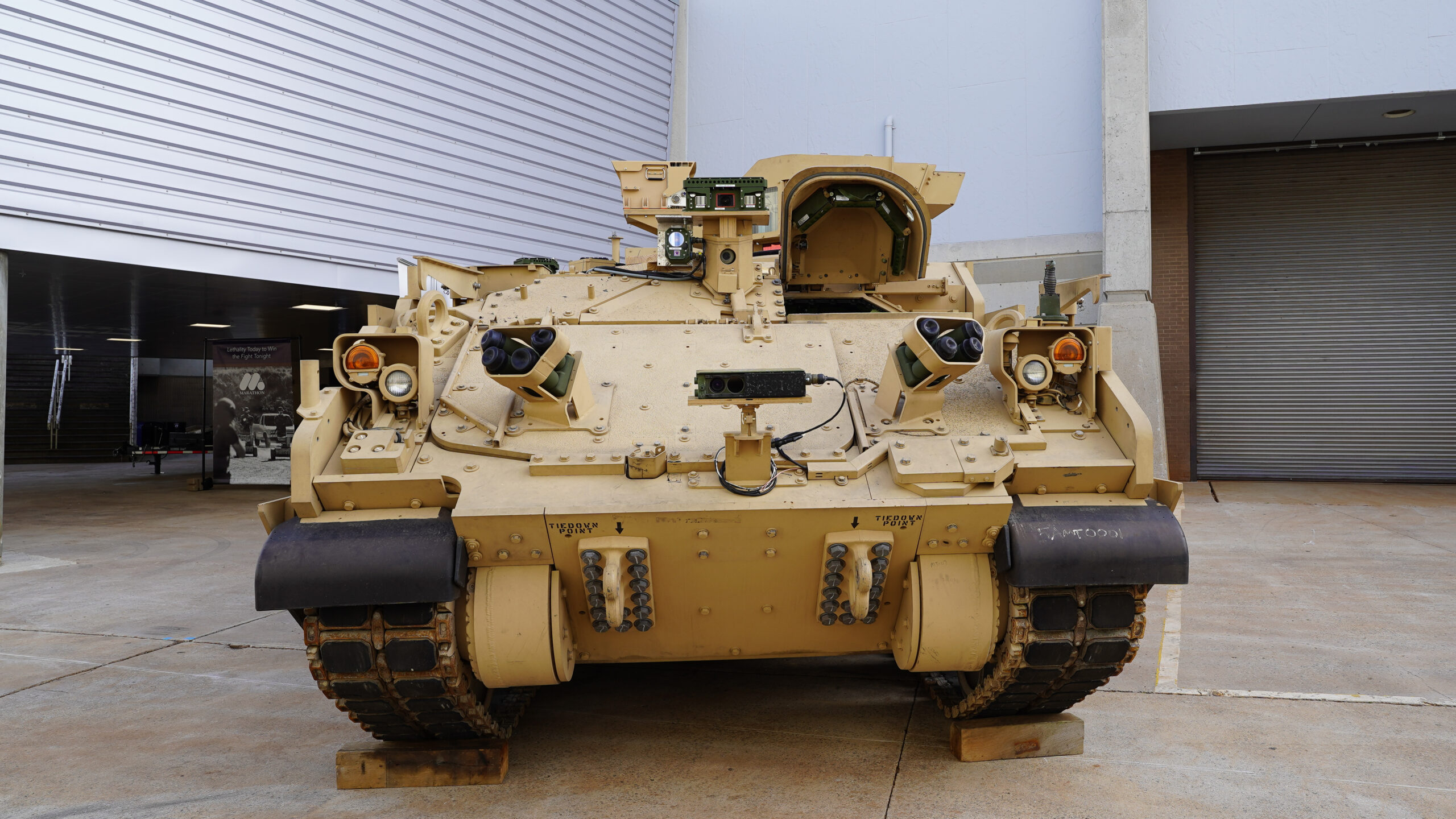
For armored vehicles and tanks working in low visibility,the SetasVR system on display by HENSOLDT consists of a series of mounted cameras and sensors that provide a 360 degree view to soldiers operating the vehicle from inside. (Brendon Smith / Breaking Defense)
A medium weight fully robotic combat platform on display by General Dynamics showcases one of the many possible equipment variations. (Brendon Smith / Breaking Defense)
The BvS10 all terrain vehicle was displayed at a booth belonging to BAE SYSTEMS, showing off what the company said was the platform’s equipment flexibility for a variety of missions. (Brendon Smith / Breaking Defense)
Maker Northrop Grumman says this next generation of the Bushmaster Chain Gun reduces weight while also increasing gun stability and lowering gun recoil. Also showcased are new advanced munitions designed to take on the next generation of aerial threats. (Brendon Smith / Breaking Defense)