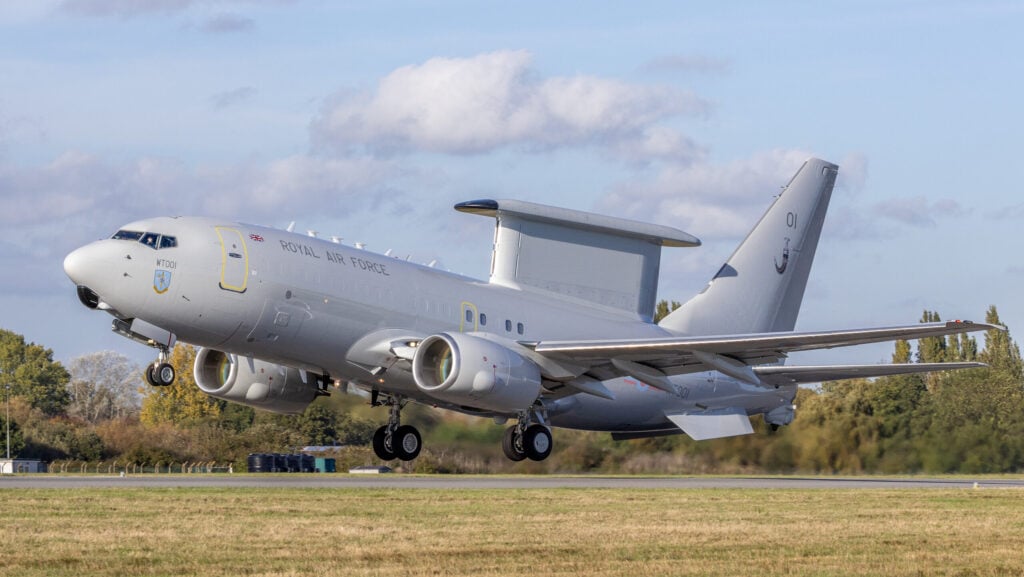
BELFAST — Amid ongoing British E-7 Wedgetail Airborne Early Warning and Control (AEW&C) acquisition troubles, an official charged with leading UK defense reform and investment planning took aim at US giant Boeing today, citing the manufacturer’s internal “difficulties.”
Rupert Pearce, national armaments director at the UK Ministry of Defence, said the MoD had expected to get an E-7 that had largely been “proven out” in Australia, which has been flying the plane for more than a decade, but it took so long for Boeing to deliver that there was a “much higher level of obsolescense.” The certification of new components, he said, caused additional “very significant delays.”
“What we’ve discovered with Wedgetail is [problems with] producer timing,” said Pearce, as he addressed lawmakers from the UK Defence Committee. “[W]e’ve also found that Boeing has been a troubled partner. … They’re trying very hard, but as we know … they’ve had their own difficulties inside their own aircraft programs, and that has led to a much higher level of scrutiny of the certification process inside” the company.
Despite the UK once committing to field Wedgetail in the “early” 2020s, it was revealed last year that a new timeframe of 2026 had been approved. Breaking Defense has reached out to Boeing for comment.
London originally signed a $1.98 billion contract with Boeing for the procurement of five E-7 aircraft to replace its E-3D Sentry fleet, but subsequently decided on a reduced buy of three units on cost grounds. The UK MoD has also agreed to pay for all five of the Northrop Grumman Multi-Role Electronically Scanned Array (MESA) radars, arguing that the two additional sensors can be used as spares.
In February, Ben Wallace, former UK defense secretary, said on X that the Royal Air Force and Boeing went “behind” ministers backs to procure the five radars. “It was one of the worst examples of dishonesty I saw from an armed service,” he added. The RAF and Boeing did not comment on the matter at the time.
The UK was left with an airborne early warning capability gap when the E-3D aircraft were retired in 2021. But with E-7 progress slower than anticipated, the program has drawn the ire of lawmakers and received damaging appraisals from equipment assessments.

Localizing tactical communications for sovereign, NATO-ready C3I
Beyond foreign sales, Rafael’s model enables tech transfer, local engineering, and is a template for NATO partners.
“Challenges within the [Wedgetail] global supply chain, retention of an appropriately skilled workforce at the modification facility and an increase in certification complexity and requirements has caused delays to the In-Service Date and subsequent milestones,” noted a local Infrastructure and Service Transformation Authority annual report, last year. Putting forward the factors involved in a 5 percent budget variance, it also noted, “Defence financial challenges and internal spend commitment controls have led to a different spend profile to that initially envisaged.”
Douglas Barrie, senior fellow for military aerospace at the UK-based International Institute for Strategic Studies (IISS) think tank, previously told Breaking Defense that it has long been recognized three planes “is not enough.”
When the range of E-7 missions are considered, including air support for ballistic missile submarines he said, “five aircraft was the absolute minimum that could actually cover … what you needed to do, ideally, seven would have been good.”
The UK is keeping faith in the program despite NATO allies assessing “alternatives” in the immediate aftermath of ending an order of six aircraft — citing the loss of “strategic and financial foundations.” The US Air Force attempted last year to cancel the program, but was overruled by lawmakers who ordered continued development of the plane in the fiscal 2026 defense budget.
Elsewhere in the defence committee hearing, Pearce apologized for previously telling lawmakers that the UK’s long-delayed defense investment plan would be published in a matter of days. The document, set to lay out national weapon system procurement priorities for the next decade, was initially due to be released in the fall of 2025.
The MoD has since resorted to not disclosing a timeline.
“I admit I got it wrong,” said Pearce, of his erroneous forecast made in December. “It’s an extremely complex reset, 10-year reset. There’s so many moving pieces here. It has just taken a lot, lot longer than I thought it would to get this right and to agree it across government.”
Breaking Defense Video