STOCKHOLM — Brazilian Defense Minister José Múcio Monteiro Filho announced today that he wants to buy an additional 20 Gripen E jets, which would bring Brazil’s fleet to 56 fighters.
The announcement came during a press conference today, wrapping up the minister’s four-day visit to Sweden. During a joint presser, Swedish Defense Minister Pål Jonson confirmed that negotiations are advancing on a deal to amend the existing Gripen agreement to add in additional jets, although both men stressed no deal has been reached.
Gen. Marcelo Kanitz Damasceno, the Brazilian air chief, told Breaking Defense on the sideline of the event that the need for extra jets was born from a serious look at Brazil’s air power.
“Our staff studies signalized for us a [requirement] of between 50 and 60 fighter aircrafts, something like that, to maintain the sovereignty of our country. So we started from 36 [Gripen] to 56 [Gripen] or a little bit more than than 60 … It’s a number that you can do well with,” Damasceno said.
After Saab beat out the Boeing F/A-18 and Dassault Rafale in 2014, Brazil ordered a total of 36 Gripen fighters: 28 single-seat Gripen E models and eight two-seat Gripen F variants. Eleven aircraft have been delivered to date.
Final assembly of the single-seat Gripen E is carried out at Embraer’s facility in São Paulo, which remains the only Gripen production line outside Sweden. The first fully Brazilian-assembled Gripen E was rolled out there in March 2026.
The Air Chief stressed that the contract signed in 2014 on the 36 jets gave an option for increasing by 25 percent. Now Stockholm and Brasilia are figuring out how to step up to 56 Gripens.

Localizing tactical communications for sovereign, NATO-ready C3I
Beyond foreign sales, Rafael’s model enables tech transfer, local engineering, and is a template for NATO partners.
“So we started months ago the discussion with Saab and in the Sweden how to deal with, how can you use this 25 percent in this contract,” he said.
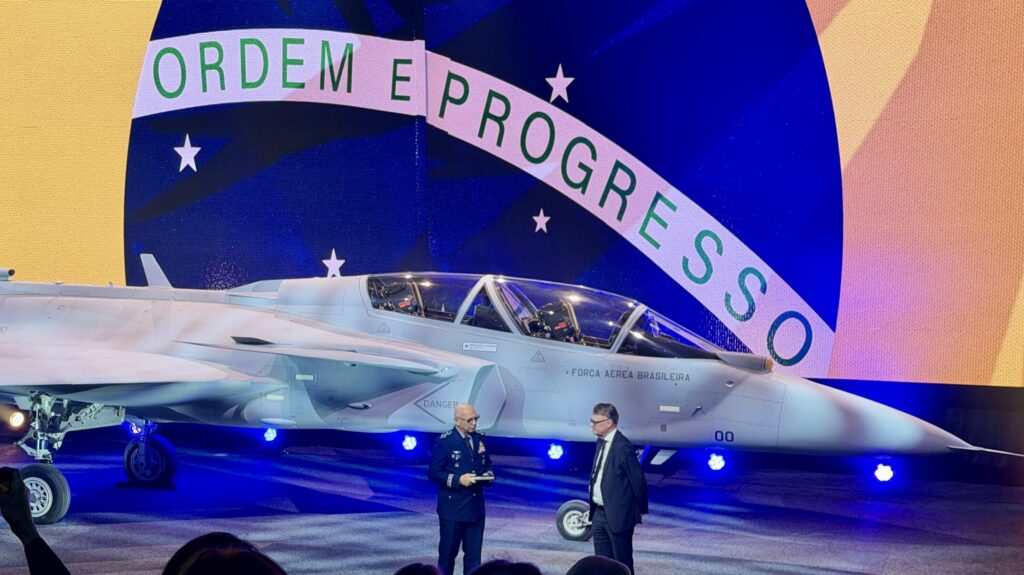
The announcement comes just two days after Saab rolled out the first Gripen F two-seat fighter jet for the Brazilian Air Force during a ceremony at its facilities in Linköping, south of the Swedish capital.
The Gripen F is essentially the same as the Gripen E but with an additional seat. Jonson said that all E-version aircraft for Brazil will probably be built locally.
“That would be my expectation. This is, of course, a negotiation process taking place in the business to government agreement between Saab and Brazil, but what there is since last fall, there is a production site for the Gripen system in Brazil. So I think it’s natural that they use that one,” the Swedish defense minister told Breaking Defense.
The additional Gripen Fs that Brazil ordered could also be built in Brazil, he said, “which is good for Sweden, because we have our hands full right now,” as the past ten months have marked a record period for the Gripen’s global footprint.
Last week Stockholm and Kyiv announced Ukraine’s plan to acquire up to 20 new Gripen E/F jets, with Stockholm also donating 16 older C/D models. (The contract for the new jets is not yet signed).
Thailand has prevíosly ordered four E/Fs, and Colombia has signed for 17 aircraft last year, with deliveries starting in 2026. Canada is also expected to announce if they will acquire a batch of Gripen in addition to American F-35’s.
These developments strengthen the Gripen’s footprint worldwide and support Sweden’s own transition to the more advanced E-variant. The Swedish Air Force received its first JAS 39 Gripen E last year – the lead aircraft of a 60-jet order – and deliveries are expected until 2030.
The surge of interest in Gripen should be no surprise, Jonson said, given the state of the world.
“It comes at a time when there’s a lot of countries right now investing into the defense capabilities, and having the Gripen system as a new fighter, and as a fighter that can also use an AI agent, causes a lot of interest around the Gripen system, in combination with its world-leading electronic warfare capabilities, and its low life cycle costs,” he said.
“The [larger the] user club we have for the Gripen system, the better it is,” Jonson said.
Breaking Defense Video