BELFAST — With the Strait of Hormuz off Iran’s southern coast virtually closed, British Prime Minister Keir Starmer said that the UK is working with its allies on ways to reopen the crucial waterway and protect commercial vessels that brave its tight corridors.
What Starmer didn’t say Monday was how, exactly, the British navy may play a part in any international security operation. So far, the UK has opted for a very light maritime footprint in the region since the US and Israel launched massive aerial attacks on Iran on Feb. 28, despite Iranian retaliatory strikes that in at least three instances endangered British troops or facilities abroad.
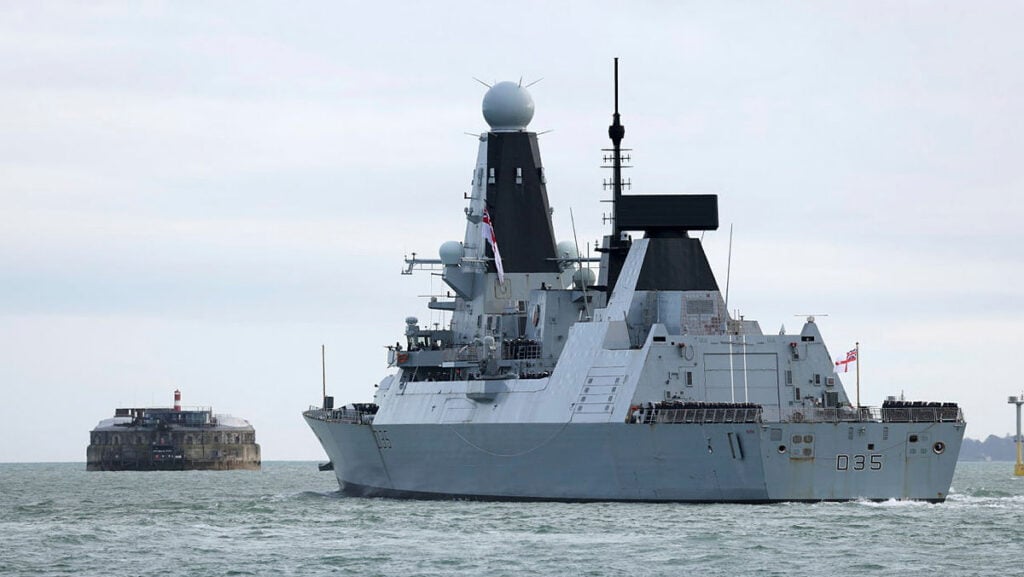
The decision earlier this month to send a single Type 45 destroyer to the Mediterranean, rather than a more forceful deployment like that of the French navy, raised the question among analysts and observers about whether Britain’s stance is reflective of prudent strategic calculus or of the realities of a distressing maritime capability gap.
As UK naval expert Emma Salisbury put it: “Why haven’t we committed to doing a similar kind of wider regional security mission to what the French have committed to? Is that because we don’t want to? Is that because we don’t believe it’s necessary, or is it because we can’t?”
Starmer’s office referred Breaking Defense’s questions for this report to the Ministry of Defence. A spokesperson there said the destroyer’s deployment “is one element of our wider approach and builds on the capabilities we’ve been deploying since January, including Typhoons, F-35 jets, air defence systems and an extra 400 personnel into Cyprus.
“Those preparations made a real difference, enabling our troops to conduct defensive operations from day one,” the spokesperson said.
Salisbury said that for the narrow mission the UK has publicly taken on, its deployment seems appropriate. But she and others said options appear to be limited beyond that.

Europe’s military advantage depends on sovereign command of the ground truth
As NATO and European governments accelerate investment in space-based intelligence, decision advantage will depend on how quickly sovereign and commercial capabilities can be fused into a trusted operational picture.
“I think this is exposing some gaps in the Royal Navy coverage which have been extant for 30 years at this point, and it’s really showing that contrast between the readiness of the French Navy versus the readiness of the Royal Navy,” she told Breaking Defense.
It is, she said, “a bit of a wake up call [and] hopefully for the government that this stuff really needs to be sorted out.”
Opting Not To Send An Aircraft Carrier
Since the beginning of what the US calls Operation Epic Fury, Tehran has lashed out at innumerable targets in the Middle East, including sites in Bahrain, Iraq and Cyprus that are home to British military facilities or troops.
It was after the strike on a Royal Air Forces base in Cyprus that the UK ordered the HMS Dragon, one of six Type 45 air defense destroyers in the Royal Navy, to the region. And though UK Defence Secretary John Healey praised the navy for getting the Dragon ready, it took six days for the ship to get underway, reportedly in part due to software issues with the high-tech vessel.
Announcing the Type 45 deployment plan earlier this month, the UK MoD said in a statement that the ship “will strengthen the UK’s ability to detect, track and destroy aerial threats, including drones.” Central to air defense capabilities of the vessel is its Sea Viper anti-air missile system, that can fire eight missiles in less than 10 seconds and guide up to 16 missiles at the same time.
The UK opted not to send the Prince of Wales aircraft carrier, the only available carrier as the Queen Elizabeth is docked in Scotland as part of a planned refit.
US President Donald Trump criticized the decision not to send the carrier at the outset of hostilities, but then said publicly that UK aircraft carriers were not necessary, suggesting the UK would be trying to “join Wars after we’ve already won!”
The MoD told Breaking Defense last week the Prince of Wales “has always been on very high readiness and we are increasing the preparedness of the carrier, reducing the time it would take to set sail for any deployment.”
With UK sea power in short supply, France has offered up a much more formidable naval contingency, deploying close to half its fleet of major surface combatants to the Eastern Mediterranean, headlined by the sailing of its Charles de Gaulle aircraft carrier. French President Emmanuel Macron cited the attack on RAF Akrotiri when explaining the decision to move the ship, noting too that Cyprus is a European Union member.
It’s a commitment that analysts said the UK just may have been hesitant to make with the fleet it has.
A second UK defense analyst, who spoke on the condition of anonymity, said that deciding to deploy the Prince of Wales carrier would run the risk of other operational plans being “bent out of shape,” and would be problematic considering that the UK’s wider strategic focus is wedded to the North Atlantic, not the Mediterranean.
Likewise, former ambassador Jon Wilks said Monday that UK defense capabilities on the whole, are “pretty stretched at the moment, and very much focused on Ukraine, the North Sea, the high north.
“So the ability to play a big role” in the Middle East region “is going to be a test for the UK,” Wilks, formerly Britain’s top diplomat in Iraq, Oman and Qatar, said at an Atlantic Council event.
Matthew Savill, director of military sciences at the Royal United Services Institute, wrote in an analysis last week that it is “fair to ask whether a Type 45 should have been sent earlier: the announcement of the deployment of the [US Navy’s] Ford carrier group in February was probably the key indicator that military action of significant scale was likely.”
But, he said, “We don’t know what threat assessment was made for the region, and why a single drone striking Cyprus now necessitates new deployments.” Savill was more concerned with ground-based air defenses on Cyprus than additional maritime assets.
Overall, in his analysis Savill wrote, “[T]he deployment of a CSG [Carrier Strike Group] into a combat zone would commit almost the entirety of the Royal Navy’s deployable ships.”
All Eyes On The Strait
The question of British maritime capability could resurface in coming days as Trump attempts to corral an international coalition to help protect the Strait of Hormuz and get oil shipping through the critical pathway.
Last week Healey suggested UK-registered ships transiting through the Strait could be protected by the Royal Navy. Speaking at the UK’s Permanent Joint Headquarters at Northwood on March 12, Healey informed local media the Ministry of Defence (MoD) is considering options to protect commercial shipping navigating the strategic sea lane.
Britain does have mine countermeasure (MCM) capabilities that could be useful in clearing any ordnance laid by Iran.
Ironically one Hunt-class MCM vessel, the HMS Middleton, sailed home from Bahrain just prior to the conflict “to undergo a planned upkeep period,” the MoD spokesperson said. They said that once the Middleton is “regenerated,” it would return to the fleet, though no timeline was offered.
“The Royal Navy currently operates six minehunting vessels as part of our transition towards a hybrid Navy, where uncrewed vessels and autonomous systems will increasingly take on these roles,” added the spokesperson.
Starmer said Monday that the Strait must be opened again to ensure market stability.
“We are working with all of our allies, including our European partners, to bring together a viable, collective plan that can restore freedom of navigation in the region as quickly as possible,” he added.
Andrew White contributed to this report from London