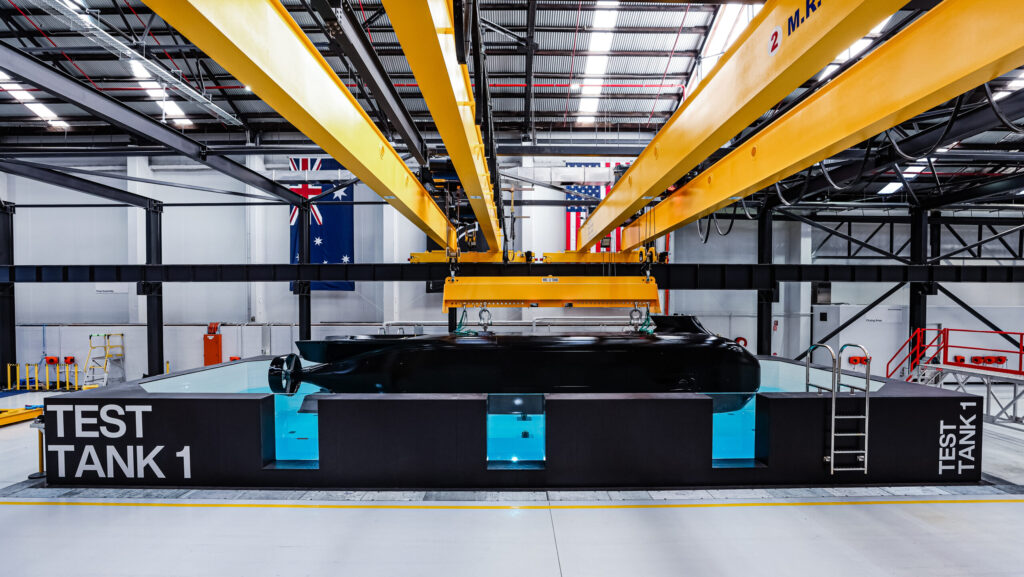
SINGAPORE — The three members of the AUKUS pact have signed an agreement cementing the joint development of technologies that will be deployed for Uncrewed Underwater Vessels (UUVs).
This marks the first project to be officially announced under Pillar 2 of AUKUS, which is designed to pool the capabilities of the US, Australia and the United Kingdom’s respective defense sectors to develop advanced military capabilities, according to a press release from the latter’s Ministry of Defence.
The agreement will see the development of payloads such as sensors and weapons systems that can be deployed across all three nations’ UUV fleets.
According to a joint statement issued by US Defense Secretary Pete Hegseth, UK Defence Secretary John Healy and Australian Defence Minister Richard Marles following a meeting at the sidelines of the ongoing Shangri-la Dialogue in Singapore, the first deliveries of the unspecified payloads will begin in 2027.
“This project is intended to significantly enhance AUKUS partners’ ability to protect critical national seabed infrastructure; deploy cutting edge surveillance, reconnaissance, and strike capabilities; conduct logistics operations; and bolster superiority in anti-submarine and anti-surface warfare, mine countermeasures, electronic warfare, and contested littoral manoeuvre,” it added.
UK Secretary John Healy said at the opening remarks of the meeting that the project, which his government has committed £150 million ($201.8 million) to, will give the AUKUS partners the ability to detect, deter, and to deal with maritime threats including those against underwater cables and pipelines.
“Make no mistake, this is a big step forward. It’s a breakthrough that has not been achieved in the AUKUS partnership before now,” he added.
A fact sheet issued by the UK MoD said that the project will increase AUKUS interoperability through key enablers, including shared standards, trilateral operational concepts, and common control systems.
Each AUKUS partner nation will first focus on a different type of effect the payloads will deliver, which will be interchangeable and integrated by each nation, before jointly developing and producing trilateral payloads and enabling technologies.
The joint statement also announced changes to Australia’s plan to acquire Virginia-class submarines from the US under AUKUS Pillar 1, which would see Australia transition to a nuclear-powered submarine force.
The changes would see Australia streamline its acquisition of Virginia-class submarines by “simplifying supply chain management, operational and maintenance requirements, and maximising cost efficiencies.”
It would enable Australia to acquire three in-service US Navy Virginias instead of a mixture of new and in-service boats. Australia had originally intended to acquire a pair of Block IV boats alongside a new-build Block VII boat to build up a nuclear submarine capability while developing the new SSN-AUKUS class submarines with the UK for entry into service in the 2040s.
Finally, the AUKUS leaders “confirmed their support for expanding the breadth of the AUKUS license-free environment between AUKUS partners by taking expeditious and practical steps to narrow the list of excluded technologies.” However, further details were not available.
Breaking Defense Video