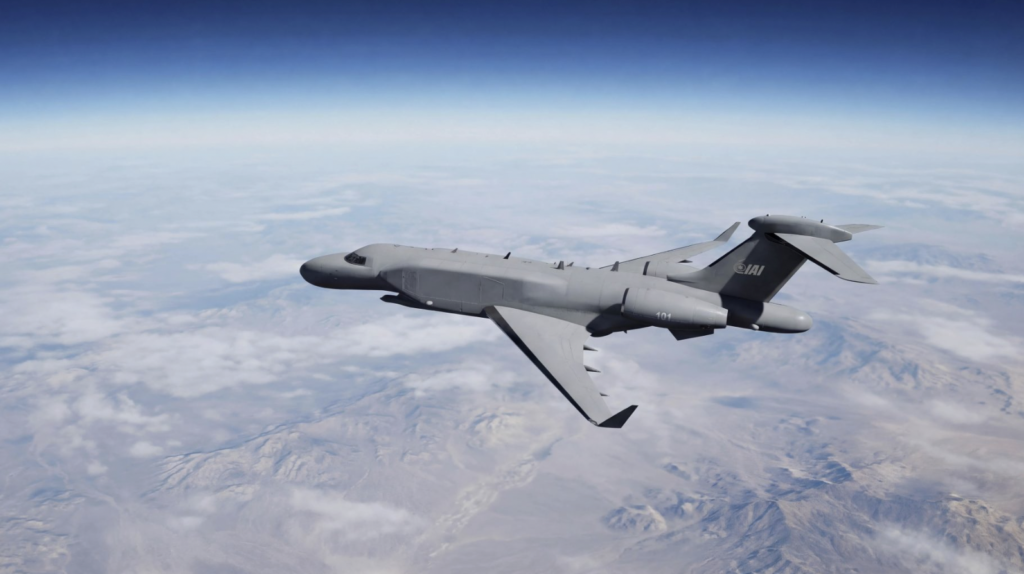
JERUSALEM — Israel’s aerospace defense giant Israel Aerospace Industries recently unveiled a new multi-mission aircraft system dubbed Ellyon, designed for electronic attack and “advanced Intelligence Surveillance Target Acquisition and Reconnaissance (ISTAR) capabilities.”
The system, unveiled as defense officials and industry gather at the Farnborough Airshow outside London, features “full-spectrum frequency jamming and coverage, advanced intelligence gathering capabilities, SIGINT, long-range SAR/GMTI radar, electro-optical sensing, and wide-band satellite communications (SATCOM) into a unified ‘all-in-one’ airborne platform,” IAI noted.
The platform “represents a technological leap forward, combining stand-off operations with the ability to sense, understand and shape the electromagnetic battlespace,” Dror Bar, CEO of IAI subsidiary Elta Systems and executive vice president at IAI, said in a company release.
In a flashy video online, the multi-mission aircraft system was shown on a modified Bombardier Global 6500, which the company said has the “speed, altitude, range and short turnaround to fully exploit the aircraft’s array of sensors and effectors.” But the company said the system is “platform-agnostic” and can be integrated on other business jet platforms.
The IAI video of the system shows it operating at a stand-off range off the coast with a crew packed into it using various terminals to deal with threats such as air defenses and also managing intelligence gathering and an AESA radar. It also has threat detection and countermeasures to protect the aircraft.
As with many advanced military technologies, the new aircraft incorporates AI-based systems. In this case, the AI-based technology includes a multi-mission management system that IAI says “processes information from onboard sensors, generates intelligence insights, and transmits them in real-time via satellite communications to command centers, ground control stations, and additional airborne platforms.”
IAI says that the technologies behind Ellyon are operationally proven, noting that it is part of Elta’s “family of intelligence aircraft developed for the Israel Defense Forces and allies around the globe.”
The company added that “these aircraft have accumulated extensive operational experience, supporting air defense, intelligence superiority and strategic operational capabilities.” Israel has been involved in a multi-front war in the wake of the Oct. 7, 2023, Hamas attack. This has included intensive operations by the Israel Air Force in Gaza, Lebanon, as well as long-range missions against the Iranian-backed Houthis in Yemen and also in Iran.
Israel generally keeps the work of its multi-mission aircraft veiled in secrecy. However, the Israeli Air Force noted in 2012 that the work of the Nahshon squadron that operates them has a “primary goal is to keep the Israeli aerial territory secure. In order to complete our objective we have to be aware of everything. Once the G550 is at work we, have less to worry about,” according to an IAF officer at the time.
The new plane configuration was announced alongside another new platform, Hypnosis, which is a navigation warfare air defense system which operates against unmanned aerial systems (UAS). This technology is designed to be used against various threats, such as drone swarms that rely on satellite positioning.
“The satellite navigation systems onboard aerial systems need to receive the position and time data from the satellites in order to accurately reach their targets. When these systems are disrupted or neutralized, the aerial threats can no longer accurately navigate to their intended targets,” IAI noted in a separate statement.
As with Ellyon, IAI Chairman of the Board Boaz Levy noted that Hypnosis is part of IAI’s work against evolving aerial threats.
“Today’s battlespace demands integrated, multi-layered defense capabilities that can address multiple threats,” he said, according to a statement distributed by IAI.
Guy Barlev, who IAI announced as the new CEO today, added that Hypnosis “provides a critical and highly effective soft-kill defense layer, enabling nations to address the growing spectrum of GNSS-based aerial threats. The system represents a significant leap forward in protecting strategic assets.”