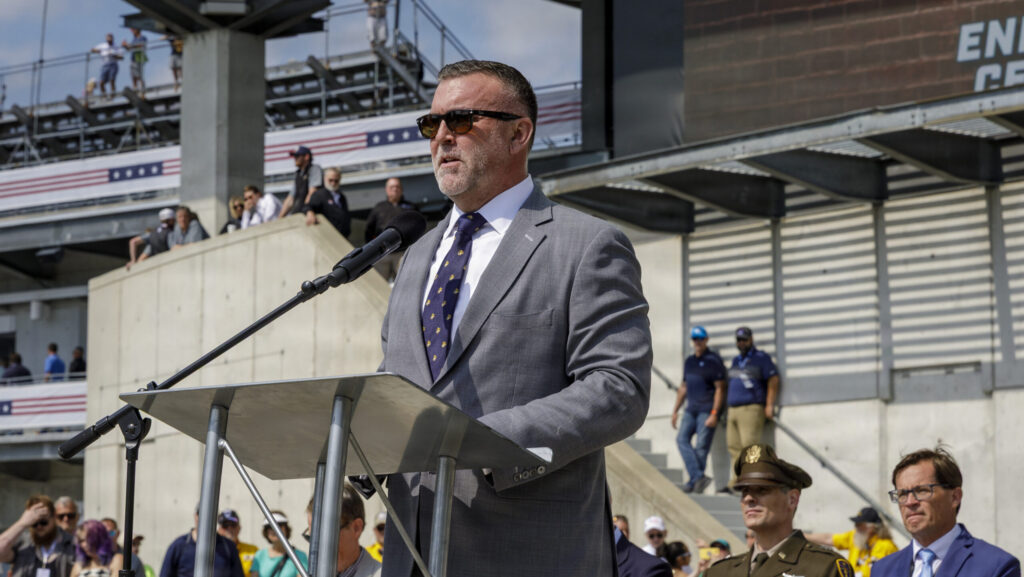
WASHINGTON — The Pentagon announced Wednesday it has picked Crane Naval Surface Warfare Center in Indiana to host a next-gen nuclear reactor — a decision, one top official told reporters, that was primarily driven by a need meet President Donald Trump’s ambitious deadline to deploy a first reactor on a military base “no later than September 30, 2028.”
“Time had priority for us….looking at site selection,” Michael Dodd, assistant secretary of defense for critical technologies, told reporters Wednesday afternoon. “The site selection was less about, ‘are we going to connect it to an AI data center or a DE [directed energy] system or power parts of the critical infrastructure,’ [than] ‘where could we actually meet those timelines?’”
“The timelines are aggressive, to put it mildly,” he said on the sidelines of the NDIA Emerging Technologies Conference on Wednesday. “We needed a delegation that was going to lean forward and work with us very collaboratively in order to do that. Indiana and the governor and our delegation were just tremendous.” (Gov. Mike Braun, both Senators, and all seven House members are Republicans).
In the drive to deliver on deadline, some major technical issues remain to be determined, Dodd acknowledged.
“You may be getting a little bit in front of where we are in the process,” Dodd told reporters when pressed for specifics on the advanced design. “We have not released yet the Commercial Solutions Opening” — a form of streamlined government solicitation — “[or] begun any sort of source selection, down-selecting.”
“Our announcement today, earlier today, is really first and foremost that we’re going to meet the president’s executive order [deadline],” Dodd said. “But the performers therein have not yet identified their systems, all the redundancies and safety and security that will be part and parcel for how we select and then ultimately deploy those systems.”
That said, Dodd emphasized that the Army’s JANUS program, which is leading the military’s nuclear power push, is “well underway…identifying different systems and performers that meet the program requirements.”

Island surge: the Army’s Next Generation Command and Control in action
Lightning Surge exercises are turning soldier feedback on NGC2 into operational software changes in days, not years.
In August, JANUS awarded five companies a total of $2.2 billion to build prototypes. Army official Jeff Waksman acknowledged significant unknowns, from regulatory issues to technical questions about safety, security, and nuclear waste.
Speaking a day later at the same NDIA conference, Pentagon CTO Emil Michael called the program the leading edge of “a renaissance in nuclear technology” that will accompany “an explosion in the abundance of energy. ”
Afterwards, Michael told reporters he was confident that previous Pentagon efforts had set the program up for success in meeting the president’s deadline. “We know from an R&D standpoint where these companies are in terms of their ability to deliver an SMR [Small Modular Reactor],” he said. “We think we’re going to get there by ’28.”
Just getting agreement on a site is a big achievement, Michael argued, after decades of stymied nuclear power projects across the United States.
“This is not a simple thing,” Michael told reporters. [In] this country, we have made it impossible to build a nuclear reactor…You have to get regulatory approval for those things, and that’s not been an easy process in this country.”
Just getting from last May’s Executive Order to this week’s site selection, he argued, is “good progress.”
As for the safety concerns that hamstrung nuclear power projects in the US after the Three Mile Island accident — which resulted in zero deaths and no clear evidence of increased cancer rates — Michael argued those were overblown even for older reactors, let alone the advanced designs under consideration for Crane.
“We know it’s clean, and we know it’s safe, and we know it can be made safer,” he told reporters. Meanwhile, he argued, demands for electrical power are rising rapidly in both the civilian and military sectors, in large part by AI and the giant data centers required to run it.
“You’re having this explosion of data centers,” Michael said. “I call them ‘combat compute commands,’” he added, because of how increasingly important they are for day-to-day Defense Department operations.
That doesn’t mean the military plans to put the new microreactors on forward bases in range of enemy strikes, Michael told reporters. “We have a hundred other means for energy that’s efficient and clean before you get to active battle zones,” he said.