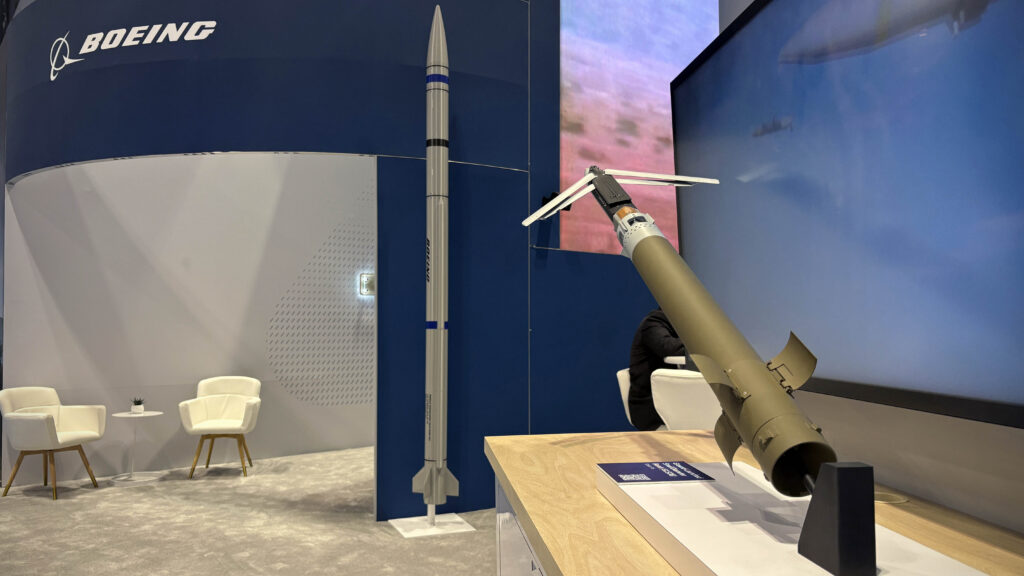
WASHINGTON — The Army has selected Lockheed Martin and a Boeing-Anduril team to move onto the second phase of the service’s second Indirect Fire Protection Capability (IFPC) Increment 2 interceptor prototype program, a service spokesperson told Breaking Defense today, knocking a US-subsidary of Israeli company Rafael out of the competition.
The companies have been “selected to advance to the demonstration phase of the development effort. Additional information regarding the competitive effort will be released when appropriate,” the Army spokesperson said in a statement.
The Army’s IFPC Increment 2 program is designed to fill the capability gap between short-range air defense systems and longer-range air defenses, like the Patriot and Terminal High Altitude Area Defense systems.
In October 2025, the Army awarded Lockheed an other Transaction Authority (OTA) for phase one of the program. That was followed by the December 2025 announcement by the Boeing-Anduril team’s inclusion, and finally, the addition of Rafael in February.
Lockheed Martin deferred queries about the decision to the Army, and Rafael did not respond to a request for comment. Boeing said in a press release yesterday that its interceptor “combines seeker technology, a compact form factor, a solid rocket motor supplied by Anduril Rocket Motor Systems and a Modular Open Systems Architecture.”
Further, Bob Ciesla, vice president of Boeing Precision Engagement Systems, said in the release that the company’s “scalable production approach is designed to provide a reliable, affordable layer of defense against a range of aerial threats to protect the warfighter with practical, dependable capability when it matters most.”
Today’s news comes more than two years after the Army began its search for a second interceptor for its developmental IFPC Increment 2 launcher. The Army awarded the current IFPC Increment 2 deal for the first interceptor to Dynetics, a Leidos subsidiary, and RTX in late 2024. That solution included Dynetics’s new developmental launcher called Enduring Shield, paired with a ground-launched AIM-9X Sidewinder from RTX.

Engineering decision advantage for the warfighter
Multi-orbit mission capabilities are accelerating decision making across domains.
Service officials discovered while using Enduring Shield that soldiers would need a second “more capable” interceptor to target lower flying, supersonic cruise missiles, then-Brig. Gen. Frank Lozano, the service’s current Program Acquisition Executive for Fires told Breaking Defense in June 2024. (Lozano now has a third star.)