WASHINGTON — The Army plans to see how its prototype for Next Generation Command and Control (NGC2) architecture operates in the crushing heat of the Mojave Desert ahead of further contract awards.
“Two days ago, it was 106 degrees Fahrenheit out here. So that brings a whole new aspect to anything you do with electronics and communications,” Lt. Gen. Michael McCurry, commanding general of the Army Futures and Concepts Command, told Breaking Defense in an interview Monday regarding 4th Infantry Division’s upcoming participation at Project Convergence Capstone 6 (PCC6).
The experiment, which runs from July 20-29, serves as the culmination of a year-long series to build, scale and refine the NGC2 ecosystem with 4th ID.
NGC2 is one of the Army’s top modernization priorities, updating how units share and pass data across the battlefield. For the last year, 4th ID has been prototyping the architecture, rebuilding its network from the ground up.
Simultaneously, 25th Infantry Division has been prototyping NGC2 components. But unlike the 4th ID layer, the 25th ID has been outfitted with a modernized network baseline called C2 Fix. The separate tests will help the Army determine what mix of capabilities are needed for an architecture across the entire service, which has a combination of legacy and modernized kit.
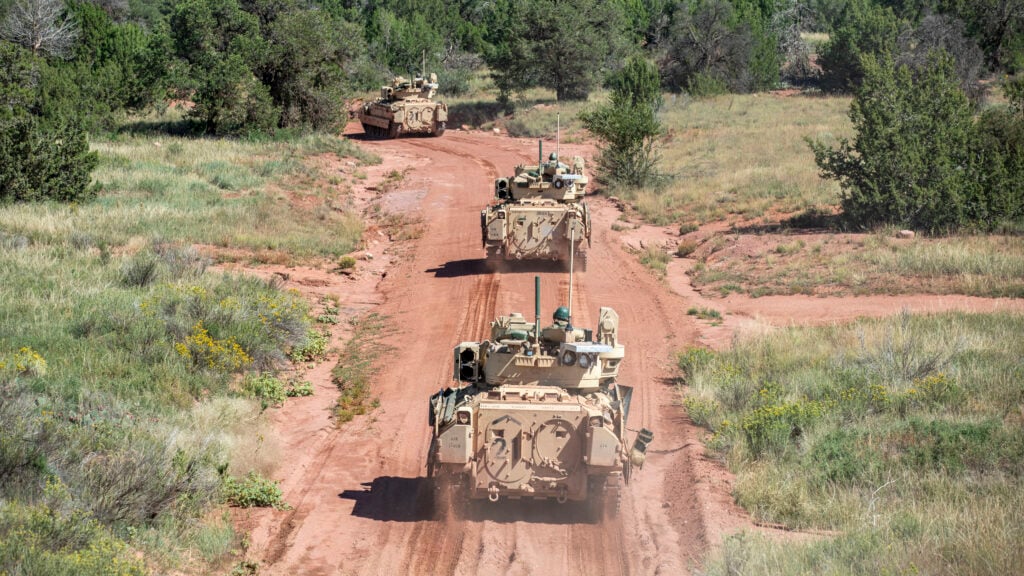
In May, 4th ID held Ivy Mass, the first full division test and first electromagnetic and cyber contested event of the architecture at Piñon Canyon Maneuver Site, Colorado. While that event was conducted in rugged, arid terrain, it is nothing compared to the crushing July temperatures expected during upcoming tests at the National Training Center on Fort Irwin, California, which also contains mountain peaks that can pose communications challenges.
“It involves a totally different kind of terrain,” said McCurry, who is also the director of PCC6.

AGVs vs. UGVs: A new class of ground autonomy takes the field
One commander, many robots: Fully autonomous ground vehicles are reshaping the battlefield.
“When you get out here to Fort Irwin, you’re going to see [Tiefort] Mountain and the Northern Ridge, and big rugged rocky terrain that places new stressors on communications,” McCurry added, referencing a 5,000-foot peak.
Moreover, the heat will help the Army test its commercial-first approach, a process the service believes is key to quickly providing soldiers with kit at scale.
“Given some of the extreme environmental conditions, we anticipate getting some feedback on where we may need to do some work on potentially housing, cooling, [and it] may influence product evaluations and things like that,” Joseph Welch, portfolio acquisition executive (PAE) for C2/Counter C2, told Breaking Defense. “The good thing is we have a range of different capabilities out there and technologies, so we’ll be able to well assess the strengths and weaknesses and many of them have other implementations or versions that we could be using.”
This Project Convergence test also boasts to be the largest combat training center (CTC) rotation the Army has ever conducted – though officials note it’s not a true rotation, but rather an experiment – with 9,700 soldiers compared to the 4,000 who normally trek to CTC rotations.
The National Training Center is home to the 11th Cavalry Regiment, described by the Army as a “world class” opposing force. While a battalion within 4th ID served as the opposing force for Ivy Mass, the “Blackhorse Regiment” simulates fighting an Army brigade every month, all year, making it a true professional opposing force and a much tougher test for the soldiers to maneuver the network against.
Welch said he expects to learn a lot from the exercise.
“A lot of the integrated data, the AI-enabled decision aids, and things like that, I mean, they’re not just helpful tools, they actually can reshape how you may frame planning and operations,” Welch said. “We’re looking to learn a lot more out of that.”
This Project Convergence capstone will also help the Army make finishing touches on NGC2’s prototype phase to inform upcoming contract awards as it looks to begin fielding gear to units at I Corps next year.
“We’re looking to ensure that [technologies] get exercised to a greater extent [following Ivy Mass] to give us more feedback on really the selection of the equipment and … a lot of the configurations,” Welch said.
Those include capabilities for what the Army calls auto-PACE, which stands for primary, alternate, contingency and emergency communications, as well as software-defined networking capabilities and edge compute.
When it comes to hardware, the Army has a pretty good handle on what it needs, though it is still looking at the density of those technologies and how each formation could have a different mix. But Project Convergence will help refine some of the software buys.
“This is a good time for us to be calibrating really the criticality of some of the software technologies that have been brought in and then some others that quite frankly may have come in a little bit late or maybe a little bit less mature to understand whether or not we see those as baselines moving forward into continued fielding or something that needs to continue refinement,” Welch said.
Breaking Defense Video