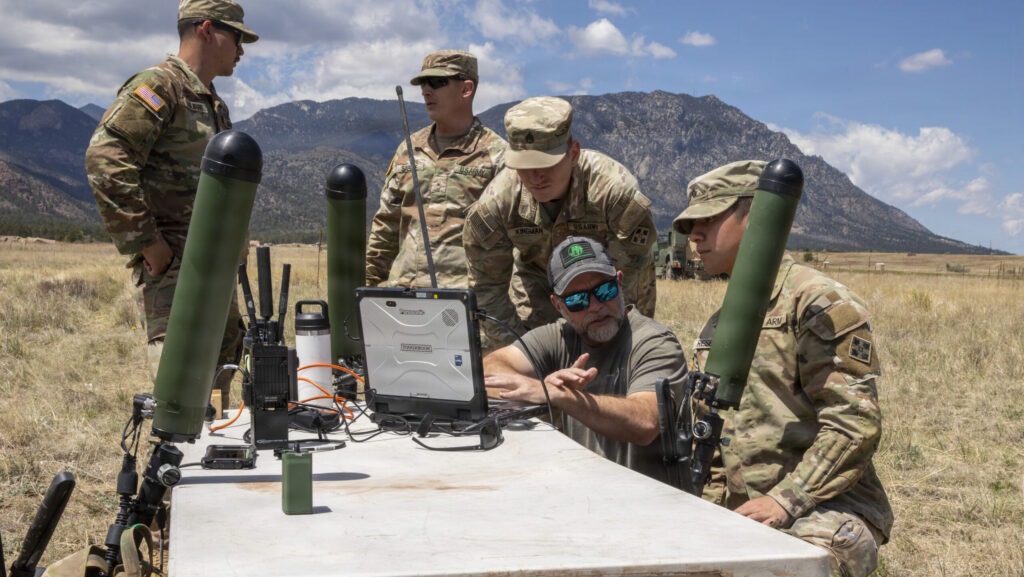
PIÑON CANYON MANEUVER SITE, Colo. — Surrounded by empty desert, a group of Army soldiers was debating a dangerous choice.
Their communications equipment wasn’t working as it was supposed to. Network connectivity and bandwidth issues aren’t foreign — it could be weather related, issues with the satellites in orbit, or user error — but can pose challenges in the middle of a fight. So, the unit sought workarounds and tried to troubleshoot their problems.
As they fiddled, the enemy unit across the battlefield silently cheered because a clever ruse had worked. They were actually jamming the soldiers’ communications, but only partially — not so drastically that the soldiers would realize it and actually employ the counter-jamming gear they had.
The decision by the soldiers of the 4th Infantry Division that they weren’t being jammed could have had fatal consequences in a real fight. Luckily for them, this was all a training scenario playing out specifically to see what electromagnetic warfare techniques work best against the US Army. And as it turns out, there was a lot to learn.
Ivy Mass, which took place for several weeks in May, was the culmination of a series of incremental events slowly scaling a prototype of the Army’s Next Generation Command and Control (NGC2) initiative to a full division. Breaking Defense was given exclusive access to the red cell efforts charged with designing the scenario and running the jamming effects against the 4th ID soldiers operating in the field.
The event was the first time the Army threw combined jamming, space, GPS and cyber threats against the network architecture as it was being maneuvered by units, with Army leaders hoping to stress the system under the most realistic battlefield conditions ahead of acquisition and fielding decisions for future units.
“We’re learning how these soldiers are facing EW for the first time in their careers, a lot of them. They haven’t faced it at this magnitude,” Brig. Gen. Michael Kalootian, director of the Command and Control Future Capability Directorate, told Breaking Defense. In “28 years in the Army, I’ve never seen a more comprehensive and larger DDL [Denied, Degraded, Intermittent, and Limited] assessment, especially against a division size force.”

How the industrial base is responding to Air Force, Space Force needs
Demand signals from leadership are shaping investments in design, engineering and manufacturing.
Ivy Mass was “by far the largest employment of effects in one place that I’ve had in my 31-year career,” added Maj. Gen. Patrick Ellis, commander of 4th Infantry Division.
How big? The Army brought significant effects into the field as it sought to replicate the kind of jamming and EW that the military would face in a Pacific scenario — aka, combat with China. That meant 11 cyber red team units seeking to conduct vulnerability assessments, hitting everything from gaps in the network to spoofing WiFi passwords; space capabilities that can replicate contested GPS effects; and a dozen high-powered jammers.
The latter included modified commercial-off-the-shelf systems or lab-developed capabilities, with many man-packable for more mobility in the training site. The Army also, for the first time, broke out the MAMBA-E, a massive trailer-based, high-powered jammer that is based on “the latest pacing threat that we find in intelligence,” Troy Bedsole, multidomain operations team lead at the Threat Systems Management Office, told Breaking Defense. (Interestingly, the Army declined to say what MAMBA is an acronym for.)
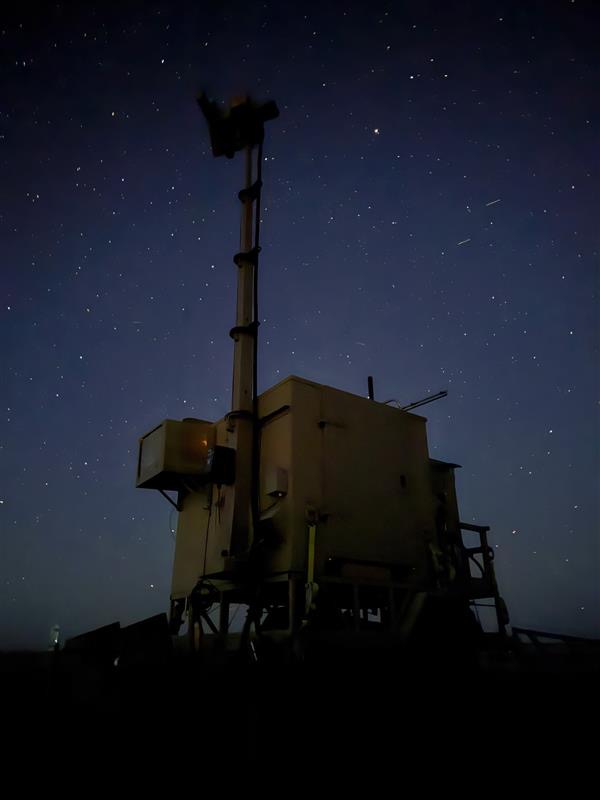
Importantly, none of the effects were “white carded,” a term that means exercise planners would simply tell the unit they were being jammed and they had to adapt without actually deploying the effects. For Ivy Mass, those effects were actually being felt on the ground, within the systems, presenting real dilemmas. (The one exception is that real GPS jamming couldn’t be employed due to domestic restrictions, but other devices replicated those capabilities.)
The Army has been on a decades-long journey to upgrade its electromagnetic warfare arsenal. The service divested much of its capability, as well as its know-how, after the Cold War. While modernization efforts were made over the last decade, the Army proved adept at launching new programs, only to cancel or change course on many.
Ukraine served as a wake up call, Kaloostian said, emphasizing the commercial-first approach Kyiv’s defenders have employed. Now, the service is rushing to train up its forces for the kind of battlefield experience they might encounter.
The red team, at least in theory, are the most prepared for this kind of fight, but Lt. Col. John Brasher, 2-23 Infantry Commander, who was serving as OPFOR commander for Ivy Mass, acknowledged that his group was only moderately more experienced than the blue forces. The hope, he told Breaking Defense, is that as the team worked through Ivy Mass and up to Project Convergence in July, they’ll grow to know their EW capabilities and, in turn, understand how to mitigate the enemy’s systems.
Blue forces, meanwhile, learned how to work their effects and requests up the chain all the way to the division staff, and also learned about some of the options they have to push back with their own EW systems out in the field.
Kaloostian noted there will likely be changes to Army doctrine and tactics stemming from the event, but said “I think we need more reps on this as an Army to figure that out.”
So, what were the takeaways from the event?
Degrading Can Be More Effective Than Jamming
A key finding is that the opposing force had great success not by fully jamming the blue force, but merely degrading their systems.
If the blue force knew they were being jammed, they’d activate their sensing equipment to triage. But if they thought their systems simply weren’t working properly, they initially didn’t think to use sensing gear and tried to troubleshoot other ways. That futile effort took attention away from the fight as soldiers had to troubleshoot the network, while stymieing efforts to get data and communications to the right place, affording the enemy an advantage.
“That’s actually more helpful than just shutting it down, because like any system, the brigade is going to find workarounds the longer it is,” Brasher told Breaking Defense, citing the scenario from the top of this story.
Brahser noted they tried to randomize their jamming against the blue force to create confusion and de-synch their operations, which is where they found a lot of success.
The good news for the blue forces: Algorithms being developed as part of NGC2 will be able to better sense patterns in the network and tip users off if systems are merely down, or being disrupted by jamming techniques such as just denial.
‘Uncomfortably Dispersed’
A key lesson from the Ukraine battlefield is the value of dispersing units to avoid being targeted. But based on the findings of Ivy Mass, units might need to be even more dispersed than previously thought.
“We called it ‘uncomfortably dispersed.’ If you are uneasy about how dispersed you are, you’re probably about right,” Brasher said. “We were obsessed with dispersion … We were obsessed with being as far apart as possible and creating some confusion about what they were seeing, both on the spectrum and visually” to confuse unmanned systems.
Brasher described the “chess game” of determining how far away to operate in order to exact the right effects while not being targeted or in range themselves.
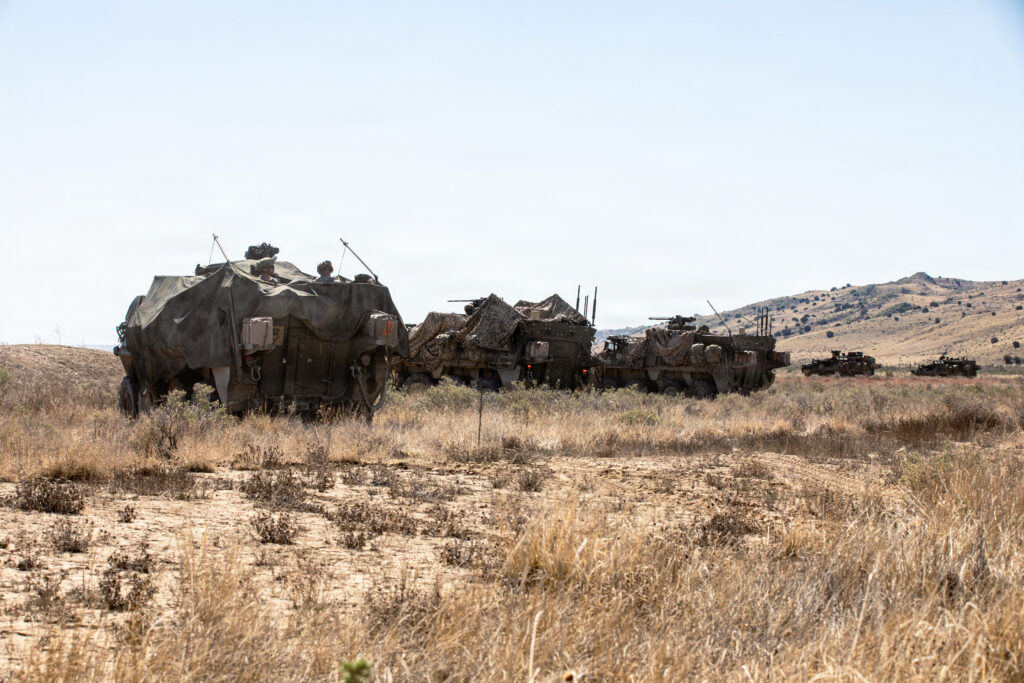
“We learned that there was a certain distance that we close with and they were able to detect fairly accurately the drones and EW,” he said. “Our counter to that was just to push the distance for most of our nodes that are doing the most communicating, the most frequently on voice or other data streams, push that as far away from them as possible, because we know they have limitations and how deep that they can detect with some of their organic assets.”
As long as they kept their command posts out of contact, they were still able to communicate with further back elements, he added, noting the NGC2 architecture has enabled this type of dispersion.
“With the new technology, [what] that allows us to do is, we are completely disaggregated,” Ellis, the 4th ID commander, said. “We can now command and control from anywhere. I think the sky’s the limit. I think we’re just learning how far we can actually disaggregate this.”
Equipment Gaps And TTPs
While the Army brought out several high powered jammers for the first time for this event, planners noted they don’t want this type of training to be a one-off.
“We want to ensure this is repeatable, so this is not a one-and-done. This has to be something that we can do and do at home station,” Kalootian told Breaking Defense.
“The Army shouldn’t have to wait until a unit goes through a [combat training center] rotation at [the National Training Center] or [the Joint Readiness Training Center] to actually be contested in the electromagnetic spectrum. We should be able to do this at home station more effectively.”
Many of the threat systems they brought to Ivy Mass were modified commercial-off-the-shelf capabilities or lab-developed capabilities. Several were smaller and man-packable to allow them to be placed around the training range and even at high altitudes such as mountains for greater effect.
Those smaller systems can provide similar capabilities that can be fielded at home stations.
“We start talking more about, how can we make this more repeatable at home station, it’s probably systems like these that are less exquisite, less expensive, that we can field more broadly to the force,” Kalootian said.
“I’m not saying there isn’t a need for the more exquisite, more expensive systems, because there are, but we don’t have to just focus on those larger jammers. We can also focus on the smaller ones and thinking through, like, okay, if we layer them properly, we still get the same training value during an exercise like this.”
Some of the current program of record equipment still has gaps, including the Terrestrial Layer Manpack (TLS) system, a dismounted electronic attack system that soldiers can use for direction finding and limited jamming on the move.
“TLS Manpack, there are some certain jamming they’ve been doing that we haven’t been able to fully assess because just the lack of capability on our part,” Warrant Officer 1 Jacob Wiley, an EW tech for 2nd Brigade’s cyber and electromagnetic activities section, said. “Going up to certain frequencies [with Manpack] has been making it difficult for us to assess that outside of having a division level asset.”
However, at the highest level, the challenges facing the Army are as much about the Tactics, Techniques and Procedures (TTPs) the service has in place.
“In some of those categories I don’t have a ton of the technology for that right now, because we just aren’t equipped with that right now. But a lot of what you’re talking about is actually just [TTPs] where when you sense that you’re getting interfered with, you move to different terrain, you move to higher ground, you move here,” Ellis said.
“We’re not going to tech our way out of this problem. We also have some tactics we need to adapt.”
Which doesn’t mean the tech isn’t important. Those systems will continue to be proven out at the Project Convergence in July, which will serve as a final check on the system. And after that, the service hopes to make real acquisition decisions and begin fielding to I Corps, with a focus on the Pacific.