WASHINGTON — For the past several years, Defense Department and Intelligence Community (IC) leaders have been vocally touting their determination to take better advantage of cutting-edge commercial space technology — with a handful of studies, strategies and experiments in various stages of completion, including a new commercial acquisition strategy that Pentagon sources say is now on the desk of Space Force chief Gen. Chance Saltzman.
But a chorus of industry insiders have told Breaking Defense over the last few weeks that they have a simpler answer to the conundrum: Show me the money.
Tracking spending by DoD, the Space Force, US Space Command, the National Reconnaissance Office and the National Geospatial Intelligence Agency (NGA) on commercial space tech and capabilities is an art, rather than a science, as there are myriad, mostly small programs scattered within each. Further, the NRO and NGA budgets are classified. But space industry reps and government officials widely agree that even in total, it’s not enough.
In public speeches, space leaders have all put on a staunchly pro-commercial face, but spokespeople for the relevant offices largely avoided commenting on industry’s concerns when asked by Breaking Defense. And ultimately, the perception of industry matters more than the perception of the Pentagon: industry doesn’t feel it is seeing enough money going to its bottom line to keep working with defense, it simply won’t.
“The old adage holds — show me your budget and I’ll show you your priorities. So far, the Space Force has not budgeted for commercial space services in a meaningful way, which means it must not be a real priority,” Todd Harrison, managing director at Metrea Strategic Insights, said in an email, echoing concerns from a handful of industry officials, most of whom spoke to Breaking Defense on the condition of anonymity.
“The NRO has made more progress along these lines … but even they have struggled to develop an acquisition strategy that works with commercial business models. Not having regular on-ramps to qualify new capabilities makes it difficult to entice new entrants (and private investment) to work with them. That model mainly works for the traditional defense primes, not the new companies that are driving innovation in the space sector,” Harrison added.
Admiring The Problem
DoD, the Space Force, US Space Command and the IC have a number of ongoing efforts to exploit commercial space innovation — some old and some new; some focusing on experiments and demonstrations, and a few on directly acquiring commercial produce and/or services — with the aim of providing warfighters and decision-makers with state-of-the-art capabilities.
But so far, according to sources inside and outside the government, there has been less progress than hoped. This is especially true for commercial space services, which increasingly is the market model being used in the private sector.
Steven Butow, head of the Defense Innovation Unit’s space portfolio, told a National Defense Industrial Association webinar on Jan. 11 that if DoD wants state-of-the-art space capabilities, it needs “to make sure that we’re investing properly in the research-and-development area to include prototyping activities that we do with commercial companies, new and old, that are doing really interesting things to give us that competitive advantage in space.”
Further, Butow stressed that R&D investment needs to be followed up with “meaningful contracts” to allow companies to make it over the “valley of death” between prototyping and actual procurement dollars — something that isn’t happening as often as it should.
To that end, the Pentagon has two new commercial integration strategies in the works: one jointly crafted by DoD space acquisition czar Frank Calvelli and Space Force chief Gen. Chance Saltzman; and another one being developed by DoD’s space policy shop headed by John Plumb.
“The Space Force is finalizing a Commercial Space Strategy (CSS) to take full advantage of the speed, innovation, and capabilities offered by the commercial space sector to create strategic advantage and is working to get final approvals. The strategy is intended to institutionalize, operationalize, and integrate commercial space goods, services, and activities to support Joint operations by providing coherent, unifying guidance to the Space Force on how to further integrate commercial efforts,” a Space Force spokesperson told Breaking Defense.
In perhaps a harbinger of the strategy’s substance, Calvelli told the National Security Space Association Defense and Intelligence Space conference on Jan. 24 that one thing being looked at by DoD is how to adopt NRO’s acquisition model, which involves simply allocating a “chunk” of its requirements for commercial companies to fill.
While the spokesperson did not address timing, a handful of sources told Breaking Defense that the strategy is sitting in Saltzman’s inbox — noting that the release date is anyone’s guess, perhaps coming as early as this week at the annual Air Force Association conference or instead becoming entangled with Plumb’s effort and being delayed until year end.
Plumb’s office did not respond to questions about the aim of the study and when it is expected to be completed.
In addition, the Office of the Director of National Intelligence recently solicited industry input on a study of how to overcome the barriers to the use commercial satellite imagery and analytical services by the IC and DoD.
“Although it is the policy of the United States to eliminate impediments to the timely delivery of space capabilities and accelerate the use of commercial capabilities, frequently commercial industry encounters challenges to working with the U.S. Government and spending on commercial analytic products remains relatively small compared to spending on commercial satellite data,” the Aug. 23 request for information explained.
Industry responses, the solicitation adds, “may help develop solutions and inform funding decisions.”

Money — That’s All We Want
Industry officials, and indeed even a number of government officials involved, are not overly enthusiastic about those efforts, however, saying the bottom line is, well, the bottom line. Little will change in the continued absence meaningful funding, these sources contend.
The Space Force has a long-standing program to buy commercial satellite communications services, but up to now that funding comes from the Defense Working Capital Fund managed by the Defense Information Systems Agency (DISA). That is going to change in the near future, however, with the establishment of a new Enterprise Space Activity Group (ESAG) and the transferral of contracts management authority from DISA to Space Systems Command’s new(ish) Commercial Space Office, or COMSO.
“The ESAG is a new activity group (e.g., like a “checking account”) under the Air Force Working Capital Fund (e.g., think of the Fund as a “Bank” under which there can be many accounts or activity groups),” Col. Rich Kniseley, COMSO director, told Breaking Defense.
The ESAG Charter was approved by the DoD comptroller in May 2022, with an “initial cash corpus” of $167 million planned, and will be managed by COMSO “in partnership with the ESAG,” Kniseley added, but noted that it will initially be limited to acquiring commercial satcom.
Kniseley further told Breaking Defense in June that he is working with Congress in hopes of getting approval to establish a specific funding line for commercial services in the fiscal 2024 budget, that hopefully can then be filled started in FY25.
Harrison said this is something desperately needed by the Space Force, along with “an acquisition strategy for how they will start qualifying companies and awarding contracts and subsequent task orders for services.” However, he added, if no funding is available until FY25, “that’s simply too late for many of the companies that have already started deploying capabilities on orbit. This is something that should have been put in place two years ago.”
Harrison’s concerns were echoed by numerous industry officials, especially those representing startups who have only a few years to prove their financial viability to their venture capital funders. Indeed, several industry reps who spoke to Breaking Defense on the condition of anonymity cited the recent bankruptcy of Luxembourg-based Kleos Space, which last September was among the six vendors awarded an NRO study contract for RF geolocation data, as a potential gloomy portent.
Even the NRO — which at least has one program of record for electro-optical imagery and a process for instituting more for other types of imagery, such as synthetic aperture radar (SAR) — isn’t spending substantial amounts to do so, according to sources.
“NRO is talking a big game about their use of commercial but they’re not putting their money where their mouth is, other than the EOCL (Electro-Optical Commercial Layer),” one industry rep said.
While the NRO’s budget is classified, it is an open secret in industry circles that its commercial budget hovers at about $400 million a year, with most going for the EOCL program (under which three firms have contracts). About $10 million or so of that total goes to the 17 other commercial imagery/data study contracts under its Strategic Commercial Enhancements Broad Agency Announcement (SCE BAA) program. In addition, the agency is getting supplemental funding from Congress to gather commercial imagery relating to the ongoing war in Ukraine.
An NRO spokesperson told Breaking Defense that the while the budget is classified, “The EOCL and SCE BAA contracts are all part of NRO’s budget. The FY23 Ukraine Supplemental is providing additional funding to NRO for additional commercial remote sensing collections over the Ukraine/Russia Area of Interest.”
Further, the spokesperson added, the agency’s “FY24 budget request sustains our investments in commercial remote sensing data.”
As for NGA, its budget is also classified, and its acquisition of commercial products complicated as it involves myriad different programs and funding lines. It does make an annual budget request for commercial geospatial analytics, although sources familiar with that request say it is not very big.
“NGA has a range of acquisition vehicles that are used to buy commercial data … for specific problem sets,” an NGA spokesperson said. “NGA has a variety of commercial analytic services on contract,” including for example, “commercial SAR imagery, change detection for infrastructure and activities, climate change monitoring, foundational military intelligence, etc.”

Cultural, Process Barriers Also Abound
Even if there was more available funding, there remain challenges to actually integrating commercial capabilities into those government-owned systems developed by the IC agencies and the Space Force. That includes concerns about the security and validity of commercial data and systems, as well as policy-related challenges such as classification.
Perhaps a bigger problem, however, is finding a way to work commercial buys of newly available tech into the years-long process for developing requirements and then setting programmatic budget levels specifically to meet them.
“Everybody will tell you, ‘Well it’s about the requirements and we’ll make sure we fulfill the requirements and align budgets to that.’ The counterpoint is that programs that are getting fielded in the next one or two years were in formulation in 2018,” said one industry rep. “So, how do you set aside some money to just make sure you’re not missing any opportunity to take advantage of what commercial has delivered in the last 12 months?”
David Gauthier, former head of NGA’s commercial space operations and now chief strategy officer at consulting firm GXO, said, “We have established norms in the Intelligence Community that don’t lend themselves to purchasing commercial capabilities and adapting and adopting them to operations quickly.”
“That being said, I do think the Space Force has an opportunity because they lack the established culture and doctrine and position that are being used by the intel community to do something different and more responsive for the warfighter,” he added.
Finding ways to contract for services — the use of which may fluctuate over time — rather than products whose development and procurement are meticulously mapped under the traditional DoD and IC budgeting and oversight processes, has further proven elusive.
A new study by RAND’s Project Air Force finds that while commercial space services “can provide additional capacity and resilience to existing space capabilities or provide new ones,” but “present new integration challenges.” The study, “Levering Commercial Space Services: Opportunities and risks for the Department of the Air Force,” was done at the department’s request. It makes three main recommendations for refining how commercial space services are acquired:
- Invest in greater market intelligence capabilities to be able to stay abreast of developments in technical capabilities, as well as financial viability and market dynamics.
- Increase the sophistication of contracting capabilities to be more adept at negotiating contracted services.
- Build flexible resourcing options so that service contract negotiations can be conducted in a more timely fashion.
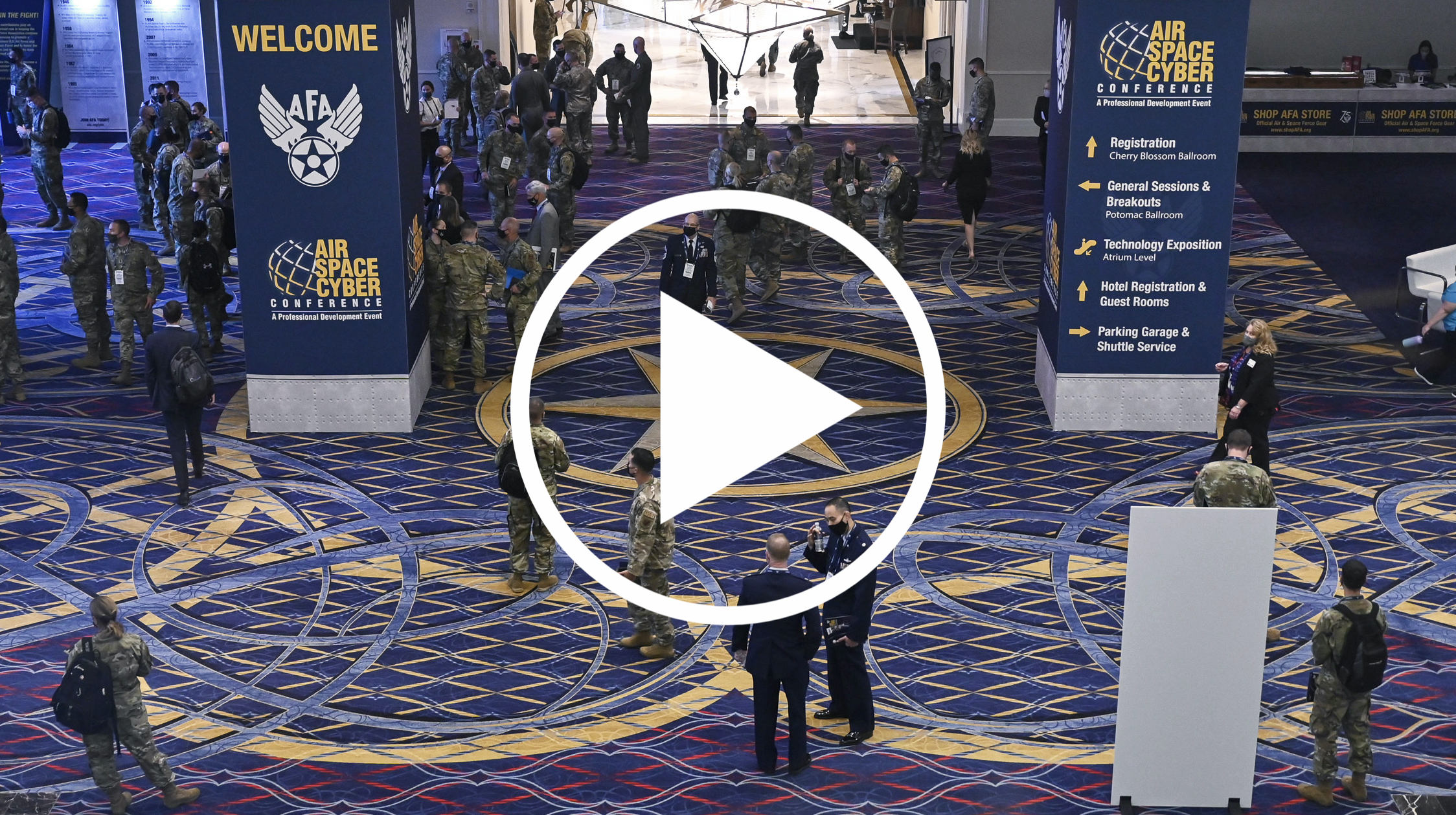
PHOTOS: AFA 2023
 Gallery