

In this Q&A with Somewear CEO and co-founder James Kubik, we discuss the technology that bridges the gap between LTE and tactical radio, how it works, and what it means to warfighters – especially in contested environments.
Breaking Defense: What’s the significance of the name Somewear?

Kubik: The name directly correlates to why we started this. I lost a friend to a sailing accident on Lake Michigan when I was younger. They somehow got separated from the boat, and when the boat washed up on shore they were not on it.
What always stuck with me was that they had the right technology onboard to call for a rescue. They had an EPIRB (emergency position-indicating radio beacon) that most every sailboat has, strapped to the side of the boat and a marine radio below deck. The realization for me was that those products were not available in the moment of need.
As an engineering student at Northwestern University, I started working on a project to build something that could’ve changed the outcome of that event. That was the kernel that started Somewear, and from there we’ve built something that works anywhere in the world. It’s small enough to fit in a breast pocket or pants pocket, light at only four ounces, and unobtrusive so that the operator can focus on the mission and not the technology.
Breaking Defense: We hear about the last mile when it comes to telecommunications and fiber to the home, for example, but what’s the definition of the last mile of JADC2?
Kubik: Simply put, it’s getting information to or from the operator in the field. While that sounds extremely simple, when you look at any JADC2 OV-1 network diagram of how people are thinking about the future of tactical and strategic networking you often see one label that just says ‘edge node or end user.’
That last link is critical and there’s so much that needs to happen just at that moment. We’re excited for what JADC2 is going to bring to tactical operations, but the edge node cannot be overlooked.
We often say that we are the last mile of JADC2. What we mean by that is once you get to that edge node, you have another more tactical multi-domain operation out in the field that needs to be supported. It’s an extension of JADC2, where warfighters in disconnected environments need the ability to send and receive the most critical data to maintain situational awareness and maximize operator safety.
Breaking Defense: Describe how your software works.
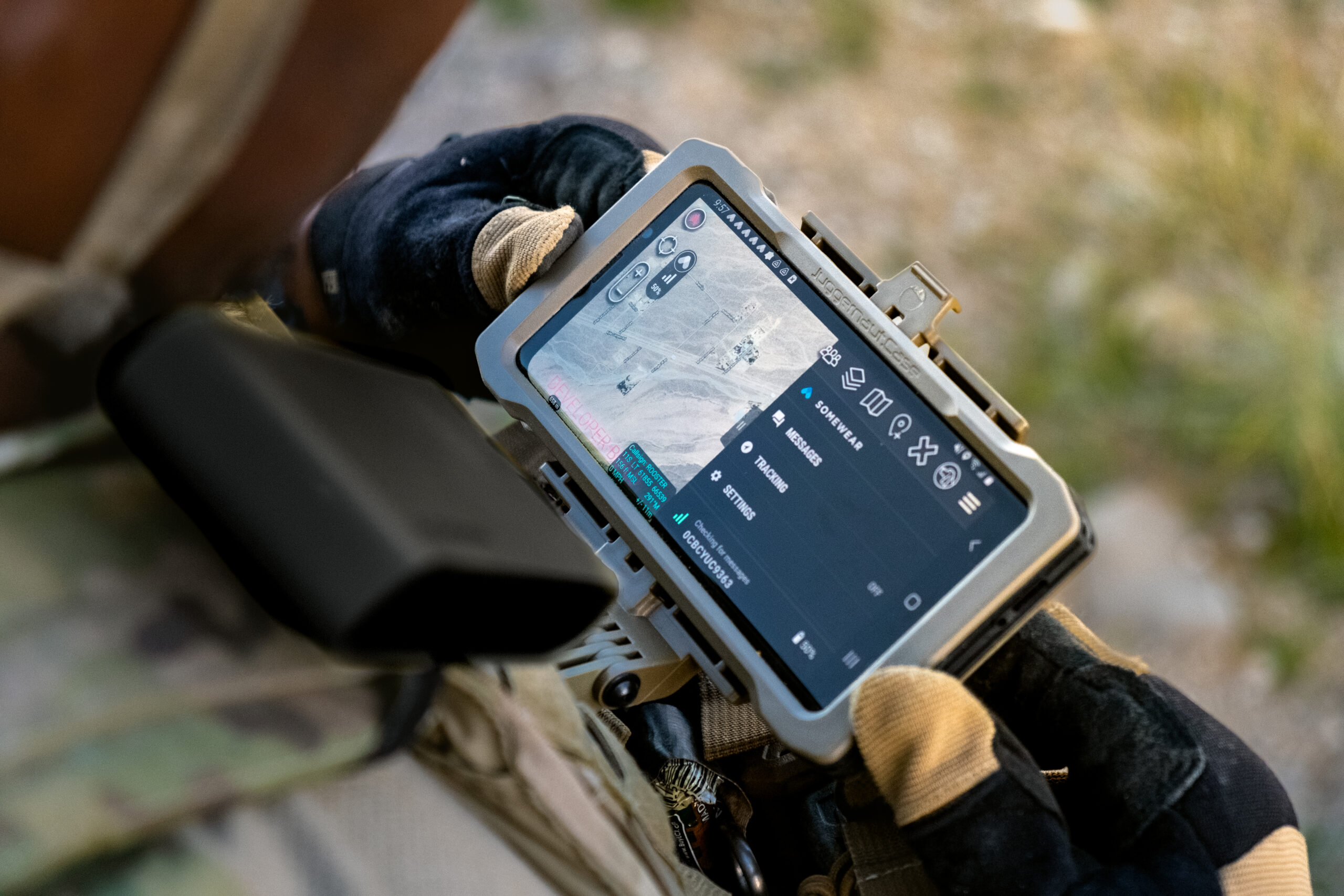
Kubik: Somewear Grid is our software platform. The goal of the platform is to make sure that the operator can maintain situational awareness and communications in any environment. We have commercial iOS and Android applications, and an easy to use, intuitive web application that can serve as a lightweight common operating picture (COP).
We’re not trying to replace any GOTS or existing C2 systems, but what we find is that, in a lot of environments, you might have a capable bespoke system that’s set up at a TOC, but you might also be setting up a hasty TOC or FOB where you don’t have reliable infrastructure or connectivity. That’s where our web app solution comes in. With limited infrastructure, our web app serves as a mobile command center and empowers teams to communicate and manage their resources and it can fully integrate into a more strategic COP upstream.
We’ve also developed a powerful integration framework that allows us to introduce our capabilities to third-party applications. Most notable is our integration with ATAK (Android Tactical Assault Kit). ATAK is a government owned and operated mapping software that allows you to see where you are, and place other tactical elements on top of that map.
That becomes much more powerful if you’re able to network with other people that have the same application and mapping software. Now you can see where the rest of your team is or see information that they’re plotting on the map. Historically that’s been done over either broadband LTE or a tactical radio system, and there is a massive gap between the two.
That is where Somewear fits in – bridging the gap between traditional terrestrial networking and a more exquisite tactical networking system. We are the first, and still only, low-bandwidth satellite solution to fully integrate and enable ATAK for comms and SA (situational awareness) when traditional networks are unavailable.
Pair our rugged and lightweight network enablers to the Somewear Grid platform and operators can ensure they have access to mission critical information in any environment.
Our technology is engineered to reduce the cognitive load on the operator. We do that by automating the PACE (primary, alternate, contingency and emergency) plan. When they lose LTE they’re going to fail over to our mesh network, and when they fall out of mesh range they’ll automatically utilize the resilient, agile satellite connection. Our platform does the heavy lifting and determines the most effective network to route data, allowing operators to focus on the mission at hand.
Breaking Defense: How does Somewear maintain the network in contested environments in order for leadership to maintain control, not just command authority?
Kubik: That is where the Somewear Node comes in. Node, in and of itself, is a new piece of hardware weighing 5.5 ounces in a small form factor that combines the resilience of satellite communications with the efficiency of mesh communications.
Node gives warfighters multiple options to get data out or in – through private or public LTE systems, ad hoc mesh networks, and low-bandwidth satellite transports. The first thing to understand is the path of least resistance. Maybe one or two of those communications options are going to be jammed, but probably not three. Right there, there’s built in resilience.
Additionally, we understand that we have to play well within the ecosystem. As mentioned, it’s not just about our first-party solutions but how that software integrates with third-party solutions.
We are making PACE plans more robust just with this one solution from Somewear. We also recognize that our customers will employ other solutions so we’ve developed our software to support integrating those third-party solutions into our platform.
Breaking Defense: Final thoughts?
Kubik: We’re bringing a fresh perspective to how the operator needs to be supported as they adapt to the evolving landscapes, ones that our warfighters haven’t been exposed to as much in the last 20 years.
We are a commercial company that has learned in the government space to make sure that the operator of the future is enabled with best-in-class technology that’s coming out of Silicon Valley. We really do care about this mission set and we’re dedicated to it.
Most importantly, this is not just a theory. We have real solutions in real world operations, and an understanding that that can be a powerful piece of the overall success of a larger program like JADC2.