
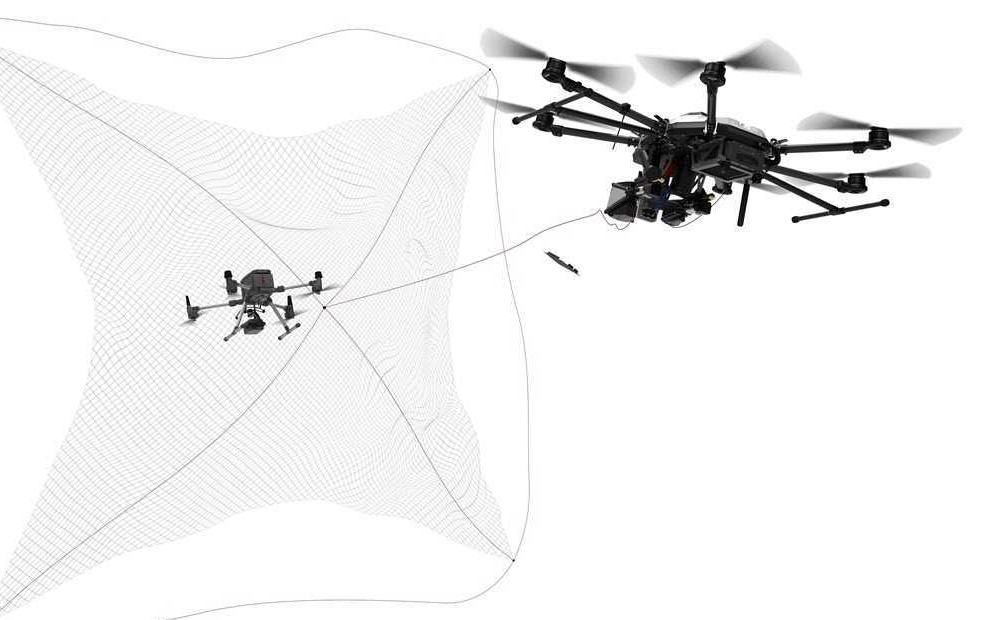
In this Q&A with Fortem CEO Jon Gruen, we discuss the no-collateral aspect of how Fortem’s Sky Dome System utilizes artificial intelligence fused with data from the solution’s multiple radars, and how the counter UAS DroneHunter is being improved to address drone swarms.
Breaking Defense: What’s the threat scenario driving the need for a no-collateral counter-UAS system having both civilian applications like sporting events and military applications like base protection?

Gruen: The threat-mitigation profile between civil security and defense is similar. You’re looking for a low-collateral-effect interceptor anywhere that you have a populated environment. If you have drones that are approaching military bases that have populations nearby, it is much preferable to remove that threat from the sky with a net that mitigates collateral damage because there’s no debris falling from the sky, no explosion in the air, none of those type of kinetic effects that have secondary effects on populations nearby.
That’s also applicable to stadiums and any critical infrastructure – anywhere that you don’t want to have that larger kinetic effect and the repercussions from that.
The other benefit of having a low-collateral-effect interceptor is actually being able to grab the drone and exploit it in some way, whether that’s for forensics to understand who’s building the drone, who’s sending it at you, or potentially – and we’re seeing it in Ukraine – the reuse of the drone. You now possess a drone that presumably costs a good amount of money, and being able to repurpose that for your own is an asymmetric advantage for the user.
Breaking Defense: Tell us about DroneHunter operations in Ukraine.
Gruen: We initially put two of our systems into Ukraine a year and a half ago, which meant they were earlier-stage DoD prototypes like the commercial variant that we had provided to the World Cup in Qatar. It was well suited at the time to the operating environment – stadiums in controlled airspace and non-battlefield deployment without anything like electronic warfare. You’re in a permissive environment where it’s just rogue threats and/or non-compliant drones.
When we put them into Ukraine, and we were one of the first to do so, we therefore were one of the first to understand the actual operating environment of that battlefield with electronic warfare from both sides. The challenge was to get our fully autonomous drone to operate in that environment and be just as effective as it was in more permissive environments.
We’ve now gone through a year and a half of technology development along those lines to deal with not only the EW environment but also different types of threats.
For example, the Iranian Shaheds were not there when we first went in; we were going after the Russian Orlan-10 ISR drones and others like it. The Shaheds changed that, and we adapted our system to take these long-range, large 200-kilogram drones out of the sky. That required a change to the software and the effectors, and how we use different nets and parachutes to do that.
Then there is the proliferation of smaller armed drones, as we’ve seen the modification of DGI Phantoms and similar types of drones to carry mortars. Having the sensors to detect and grab those kinds of drones off the battlefield was a big challenge.
The full system, from our ground radars through our command-and-control software and DroneHunter itself has been through a year and a half of incredibly fast development to deal with those new realities.
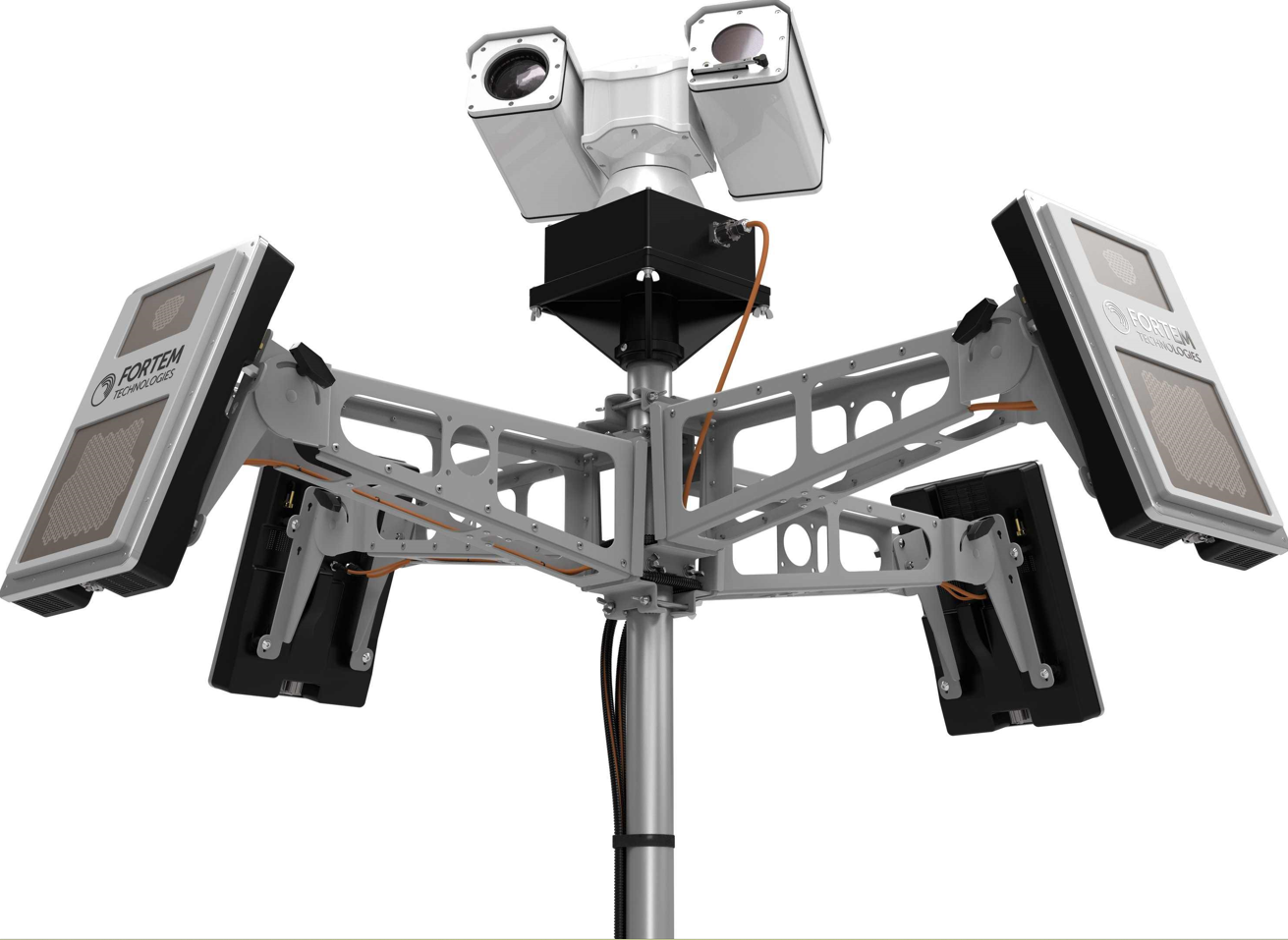
Breaking Defense: Let’s talk about the DroneHunter platform — how it’s controlled and how it deploys its defeat system. Then we’ll discuss the most important element — the radar.
Gruen: DroneHunter itself is very mature at the TRL9 level. It is a vertical takeoff and landing drone approximately four times the size of a DGI Phantom, but we are 100-percent US produced and manufactured. Currently the initial effectors are nets, which come in two variants. We use a smaller net for what we call ‘attack mode,’ which is where we go chase down a drone. And typically, that’s a Group 1 through low-end Group 2-size drone.
Then we have a larger net head that we call ‘defense mode’ where we get in front of a drone, shoot the larger net head, and the drone runs into the net. We use those for the larger Group 2s to low-end Group 3 fixed wing, faster drones.
A standard configuration for DroneHunter includes one of each net head, and our R20 radar on the front as a seeker, Once airborne it actively seeks targets with its own organic radar, which means it doesn’t require ground sensors to take it through terminal firing.
It also includes artificial intelligence that we’ve been developing for six years on the platform itself. It determines the threat, size of the threat, classifies it, and then determines whether attack or defense mode is going to be the best to take down the drone – all governed by
Rule-based controls through our command-and-control software, whether that’s through geofencing in the sky or certain types of targets that you want to mitigate. It then autonomously executes.
For scenarios where you’re deploying numerous panels over an area, our system fuses the data from different panels for track correlation so when you look at the tracks on your C2 software you see one, seamless track. It is a fully autonomous system.
We’ve also just released a modification to DroneHunter that includes four net heads at a time. The DroneHunter is completely reusable so once those are used up it comes back, you put four new net heads on, throw a new battery in, and it’s back up into a fight and another sortie. That creates a ratio of one to four for each sortie.
When you talk about drone swarms of the future, that’s taking us on a path to get to about 1 to 10 for maximum effectiveness. Again, we’re talking about a reusable drone. So that 1 to 10 is just a sortie. You can reload and go back up for another 10, as opposed to most other effectors that are one shot, one kill.
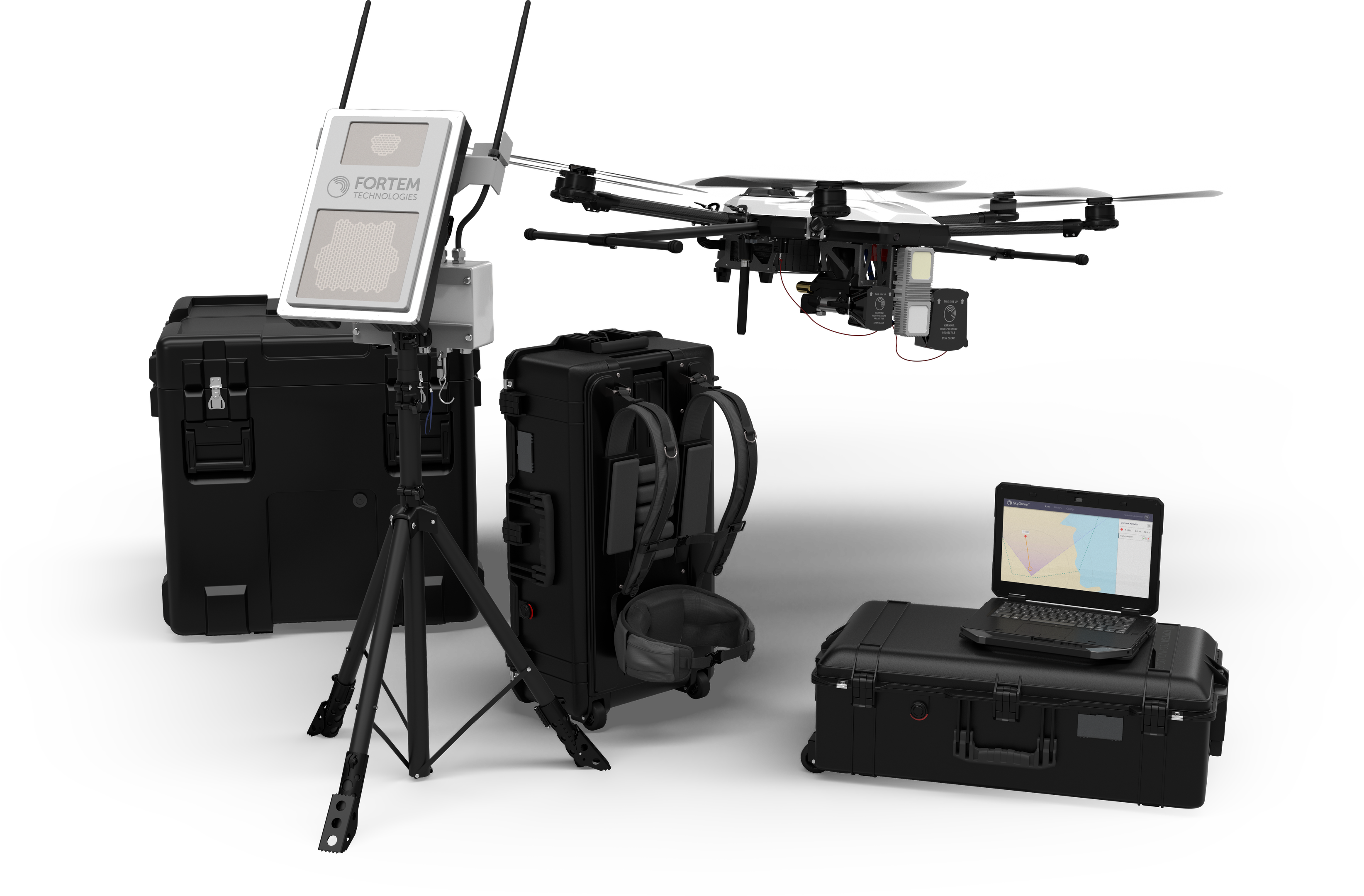
Breaking Defense: The key to Fortem’s SkyDome system is its ability to detect, track, identify and mitigate via its TrueView family of radars. Tell us about them.
Gruen: Our radar technology is what we initially spun out of the company. It’s an AESA phased array radar at very low size, weight, and power, and highly optimized for populated environments like urban areas. They provide very low radiation. Being in front of one of our radars is like being in front of a campfire.
The phased array element allows it to track a hundred targets at a time from a small panel. It is lightweight, which is why the R20 is able to be put on drones that are the size of a very small VTOL drone at this point. We’re also doing development work for applications of the future, such as electric VTOLs and the Jobi and Wisk platforms that will be unmanned eVTOLs taxis in urban environments for last-mile delivery drones off of Walmart roofs.
The R20 family is about the size of a pencil box. Then there’s the R 30, which is the size of a laptop and typically used as a ground panel for longer-range early detection. You can set up a network of R30 panels to be a corridor- or border-protection detection radar. That then cues the DroneHunters to go up, and once they’re up the R20s take over as the active seeker.
If you have a communications link, then the radars can still talk to the DroneHunter as much as it can to make sure it has the most accurate location of the threats. They work in tandem with each other and it’s all autonomous, which means there doesn’t have to be a person in the loop. If you set up the rules with the C2 software and say, ‘anything that crosses this geofence in the sky, go get it,’ then the system will work autonomously and execute that.
At AUSA this year, we are also releasing a new panel with an increased range about 1 1/2 times that of an R30. We’re getting out to four kilometers plus of being able to detect very small drones down to a DGI Phantom size and out to that distance and at low altitudes, which typically most radars completely miss.