Breaking Defense: Airbus wants to provide scalable solutions to address DoD need statements. What are some of those needs? To solve what problems?
Geckle: For the last decade, the Department of Defense has been pivoting to more of a peer/near-peer, data-centric deterrence, with a particular focus on Asia-Pacific. As a result, I have seen additional interest in allied integrated defense and interoperability. These shifts in focus require that we innovate and field capabilities quickly, and that we scale quickly.
Thinking about surface to space more broadly, I look at how we can better support the transmission of massive amounts of data and synthesize that data across multiple domains and in a range of different environments, in real-time.
That problem statement fits nicely with what Airbus U.S. supports. We have a strong industrial footprint in the United States where we’re able to deliver innovative technology, on time and at scale. We also have extensive experience supporting U.S. allies and partners, including a strong industrial footprint in NATO and allied Europe
That allows us to provide a faster pace of technology, innovation, fielding, and scaling given that resources are constrained across the allied defense industrial base. These are the types of solutions that the nation requires right now.
Breaking Defense: Airbus in the U.S. is well known for its Lakota helicopter in the Army and Army National Guard fleets, which we’ll talk about later. You’re also heavily involved in other aspects of defense, as your name Airbus U.S. Space & Defense says. Let’s start first with your work in Joint All-Domain Command and Control (JADC2) and connectivity for all-domain operations.

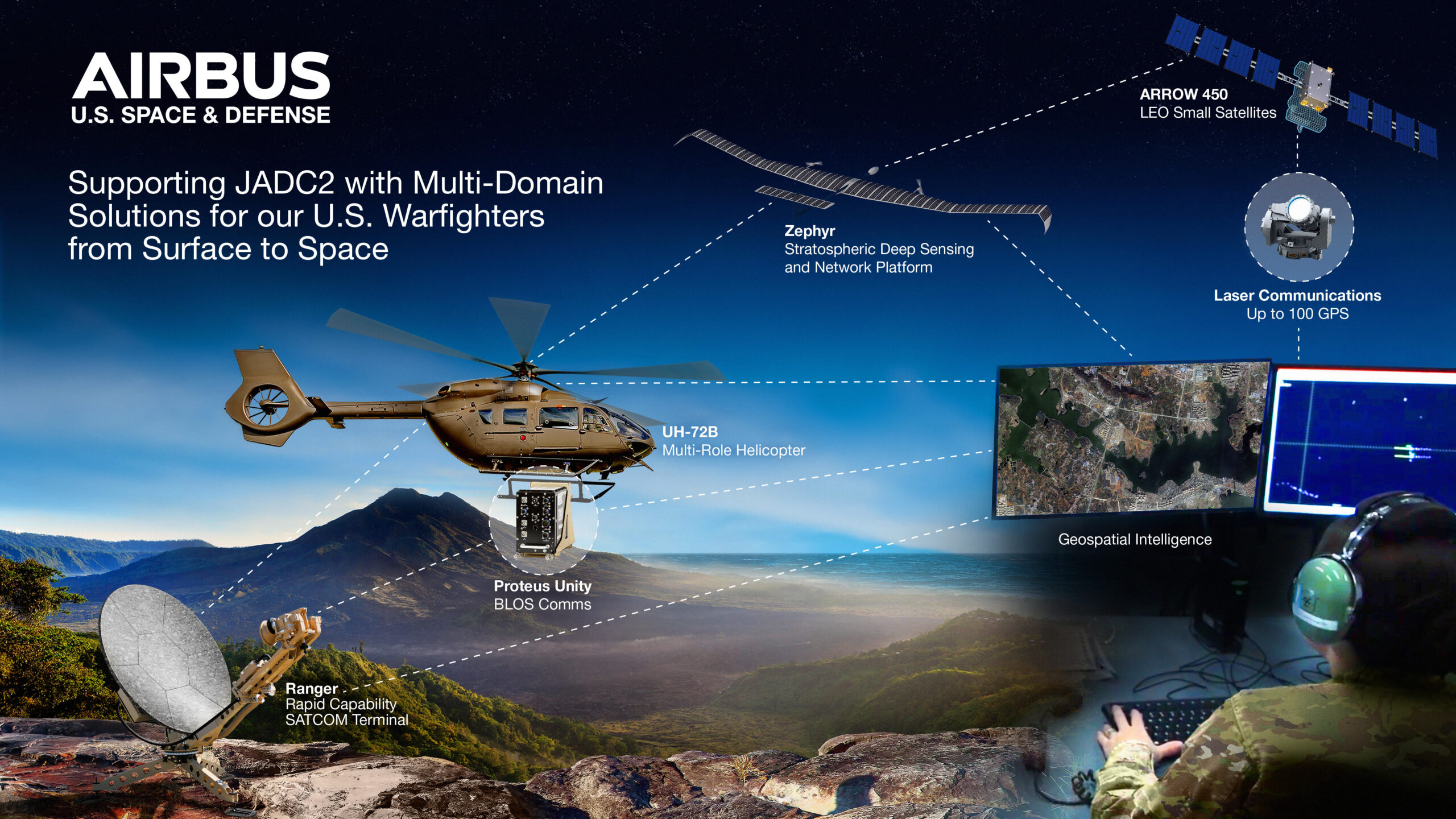
Geckle: With respect to JADC2, Airbus U.S. and its affiliated group of companies have some interesting offerings for the resilient mesh networks that comprise JADC2. The Space Development Agency’s Proliferated Warfighter Space Architecture and its set of proliferated low-Earth orbit satellites is one part of the mesh network, and we’re pleased to be building satellite buses for them.
We are also supporting the DoD with optical communication terminals under our TESAT Gov brand of laser terminals. This allows the DoD to move information with high-throughput and low sensor-to-shooter latency that will allow satellite-to-satellite, satellite-to-airborne, and space-to-ground communications. That’s critical for this entire JADC2 network.
For the ground segment, we have technologies that support JADC2 with our series of mobile Ranger tactical ground SATCOM terminals. These allow the warfighter to move quickly and maintain exquisite ground communications supporting JADC2, forward logistics and agile basing.
Moving into airborne and near space, this is where Airbus U.S. discriminates itself. In addition to communications and space-based assets, we have platforms that fit into the nodes of JADC2. In airborne, we have fixed wing, multi-mission aircraft that we support out of Mobile, Alabama. We have helicopters that we build and support out of Columbus, Mississippi.
Additionally, we have technologies that allow those platforms to tie in as nodes to this communications network. For example, our platform-agnostic Proteus Unity System allows for beyond line-of-sight satellite communications that can be pulsed through helicopter rotor blades, can be integrated onto mixed fleet and UAS solutions and can tie into space-based networks.
In near space we have some unique stratospheric assets, particularly the Zephyr solar-powered unmanned aerial system.
If you look at all these domains, there are very few where we are not relevant in terms of offering a solution to step to that problem statement
Breaking Defense: You call the Zephyr High Altitude Platform Station the ‘first stratospheric UAS of its kind.’ What’s its applicability to the Army and defense?
Geckle: It’s unique in its ability to fill several capability gaps, particularly in ultra-long persistent, deep sensing for long-range precision fires and network extension. Currently in terms of operational stratospheric assets, you’re looking primarily at balloons. While appropriate for certain missions, balloons are not capable of station keeping over a point on the ground. They are vulnerable in that they are easy to see and sense.
Finally, unlike Zephyr, they cannot be flown precisely along sensitive borders during periods of competition like we’re in now with near-peer threats without drifting into these areas and creating a crisis, or worse – conflict with potential adversaries. During periods of crisis or conflict, Zephyr is optimal for deep-sensing over denied areas as an uncrewed and attritable asset that could be rapidly replenished with more Zephyrs.
When you look at our Zephyr platform, it’s achieved multiple endurance and altitude records. Last year it flew over 64 days at more than 60,000 feet and traveled over 30,000 nautical miles. That flight, launched from the continental United States (CONUS), demonstrated an operationally relevant payload over Central America and returned to CONUS. If you think about assets that can loiter and be part of this mesh network for months at a time, at an attritable price point – that’s key – you can step to a demand signal in a way that I don’t see other assets can.
Breaking Defense: Airbus is a major manufacturer of small satellite buses. Tell us about your rapid, repeatable assembly line, and ability to flex and change payloads.
Geckle: Airbus U.S. is known to be an excellent manufacturer, both across commercial aircraft and other platforms. We’re experts at design to manufacturing, serial manufacturing and manufacturing at scale. We’re able, in this case, to develop technology for the commercial space market and apply it to national security space or government markets.
For example, our joint venture, Airbus OneWeb Satellites, has delivered over 600 low-Earth-orbit satellites to space for our partner OneWeb’s commercial constellation.
That proven manufacturing and on-orbit experience has allowed us to move at speed and scale, and to offer our capabilities to support customers like SDA’s Proliferated Warfighter Space Architecture, the backbone of JADC2, with an aggressive schedule to go from contract to on-orbit in as fast as two years. With this customer demand, we have been able to expand our factory footprint to increase our manufacturing capacity and adapt these commercial satellites to fit the national security space mission on a cost-effective basis at scale and at a fast schedule.
Breaking Defense: Moving to new aircraft platforms and existing ones like Lakota, how are you making it possible for them to better connect, extend mission range, and fill gaps in capability?
Geckle: We have been working to find innovative ways to improve the pilot experience, taking safety, capability, and performance into consideration, while at the same time reducing sustainment costs on the Lakota aircraft. The result is our UH-72 Bravo.
Some of the improvements include the introduction of a five-bladed, bearingless rotor system with reduced components. This increases the aircraft’s useful load while reducing sustainment expense and improving maintainability. It has an advanced Airbus Helionix avionics suite and a 4-axis auto-pilot, which provides the most innovative and intuitive human-machine interface vastly reducing pilot cognitive workload. Features like synthetic vision allow some overlays to be put into your flight displays to improve situational awareness.
As additional UH-72Bs are procured, it presents an opportunity for exploration and insertion of future technologies that enhance performance and expand the aircraft’s capability across ranging missions while improving overall lifecycle cost.
Breaking Defense: Final thoughts?
Geckle: Airbus U.S. Space and Defense is building on the success that we have had with platforms: Ranger terminals, fixed-wing, multi-mission aircraft, our UH-72 Lakota, our Zephyr HAPS and the Arrow family of satellites.
At the same time, we’re moving into network-centric, data-centric, near-peer, warfighting relevance, particularly in Asia-Pacific. We’re able to do that with JADC2-relevant and ISR technologies.
We are continuing to respond to the demands and priorities of the Department of Defense with our capabilities here in the U.S., and also with a reach back to technologies that we can deliver out of Europe or incubate, industrialize and improve here in the United States with cleared U.S. employees.
PHOTOS: AUSA 2023

 Gallery