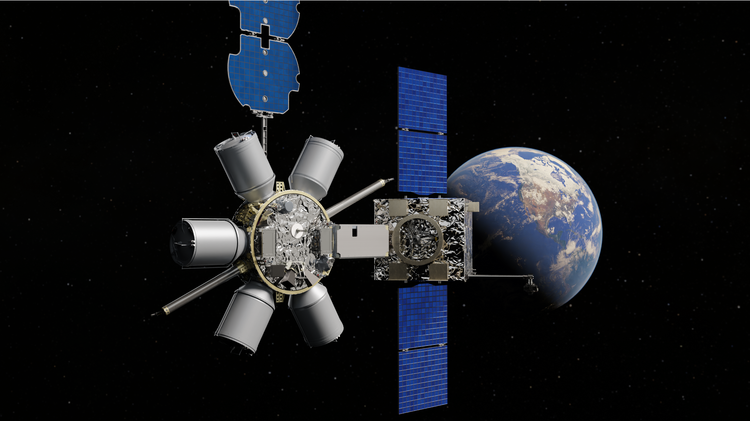
WASHINGTON — As a part of an ongoing effort by the Space Force to develop an overarching architecture for future space mobility and on-orbit logistics systems, the service has tagged Northrop Grumman to provide a “preferred” standard for the design of satellite refueling capability.
Space Systems Command (SSC) has been studying Northrop Grumman’s Passive Refueling Module (PRM) since 2021, and the company also has been collaborating with the Defense Department’s Defense Innovation Unit (DIU) to develop in-space refueling technologies. Refueling is considered by the Space Force to be a foundational capability for “dynamic space operations (DSO)” that will allow military satellites to maneuver on orbit with (relative) speed over the course of their lifetimes without worrying about running out of power.
“In-space refueling changes that equation and enables sustained maneuverability that … is key to dynamic space operations,” Lauren Smith, Northrop Grumman’s program manager for in-space refueling, told Breaking Defense in an interview. “Over the past several years, our [DoD] team has been hard at work really advancing with us the state-of-the-art for in-space refueling and we’ve truly been maturing all elements of the refueling architecture across multiple government contracts and internal investment.”
While not the only system under study and likely not the last to be accepted by the Space Force, Northrop Grumman’s PRM is the first system to receive the thumbs up from SSC. This means that the government now owns the design blueprint and can share it with contracted operators who want to equip their satellites with a refueling capability, an SSC official explained.
“Prior to being designated an SSC enterprise preferred solution, interface specifications/standards must go through a rigorous Engineering Review Board (ERB) process where they are evaluated on criteria such as technical maturity, mission need, effectiveness, availability, and adherence to Modular Open Systems Approach (MOSA) principles,” Mark Honda, SSC chief engineer told Breaking Defense in an email.
“The PRM was put under SSC engineering configuration control because it met the ERB criteria and is a US Government-owned design. This design is available to US Government contractors who wish to implement the solution. SSC acknowledges this design may not be an appropriate solution for all missions. SSC desires industry consensus specifications, interfaces, and standards that encourage competition and innovation through application of MOSA principles in technical solutions and offerings to avoid vendor lock,” he said.


How the “Doomsday Plane” contract highlights the rise of mid-tier primes
Midsized companies can offer flexibility and agility while keeping intellectual property in the hands of the government.
Smith said that the PRM is “mature” technology, and is “already baselined to fly on government and commercial satellites starting in 2025.”
Northrop Grumman also intends to fly the PRM on its own commercial Mission Robotic Vehicle (MRV) being developed to undertake a number of on-orbit servicing missions under a public-private partnership between the Pentagon’s far-future research agency DARPA and Northrop Grumman’s SpaceLogistics. The program hopes to launch in early 2025, according to officials involved.
“The PRM on the MRV not only enables the MRV to be refuelable, but also to serve as a client for a future on-orbit refueling demonstration with a tanker. In particular, the cameras and lights on the MRV enable the opportunity to closely monitor the status of refueling operations. In addition, in the event of an in-flight malfunction with the tanker, the MRVs’ robotic arms can be used for anomaly resolution,” Robert Hague, Space Logistics president, told Breaking Defense in an email.
Further, the PRM is set to fly on a future SSC mission, under the Rapid On-orbit Space Technology Evaluation Ring (ROOSTER) effort to design small, low-cost satellites to geostationary Earth orbit, Lt. Col. Michael Rupp, SSC’s materiel leader for Long Duration Propulsive EELV Secondary Payload Adapter, LDPE/ROOSTER, told Breaking Defense in an email.
“The ROOSTER-5, manifested for a 2027 launch, is expected to accomplish demonstration of on-orbit refueling. SCC finds great value in demonstrating the capability prior to operationalizing it,” he said.
Smith noted it is important to understand that the PRM includes both an intake valve mechanism and a docking system to allow a refueling spacecraft to inject the fuel. And alongside PRM, SSC last fall also awarded Northrop Grumman a study contract for such a space tanker.
The plan is to “mature” the Geosynchronous Auxiliary Support Tanker (GAS-T) tanker to a “Systems Requirement Review (SRR) level of maturity in early 2024,” Maj. Sophia McCollum, SSC’s Advance Concept lead, told Breaking Defense in an email.
Daren Gillespie, Space Mobility and Logistics project manager, added that “GAS-T culminates with a System Requirements Review (SRR). SSC’s Assured Access to Space, Servicing, Mobility, and Logistics office is evaluating the future architecture of on-orbit servicing.”
Smith elaborated that GAS-T “enables SSC to inform potential future requirements, analyze risk reduction activities and form [concepts of operation], and really act as a pathfinder for industry.”