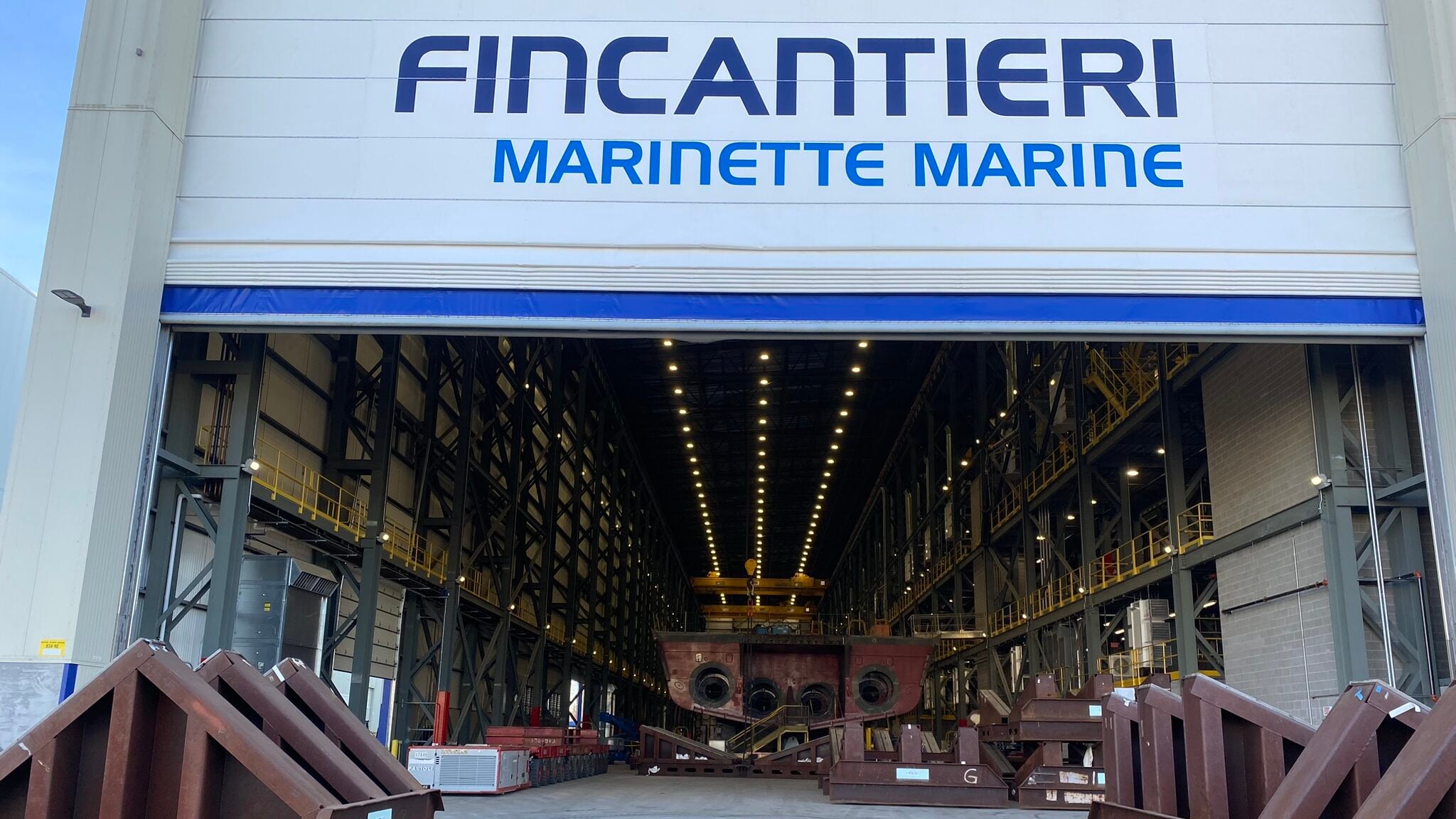
WASHINGTON — The Navy’s search for a second Constellation-class frigate shipbuilder has officially commenced, and the top shipbuilders in industry have begun staking out their positions for what will likely be another high-profile competition.
The service last month put out a call to industry to start determining which shipyards might be capable of building the Constellation-class frigate, the first batch of which were awarded to Wisconsin-based shipbuilder Fincantieri Marinette Marine in 2020. Since then, the service has engaged in private discussions with at least six shipbuilders, and a contract could come in fiscal 2027, USNI News reported.
It was not immediately clear which companies began discussions with the service, and a Navy spokesman declined to make that information public when contacted by Breaking Defense this week.
Government RFIs are not legally binding, meaning the Navy has the right to discontinue its search at any time, but that scenario is unlikely. Since the 2020 award to Fincantieri, lawmakers — particularly those who represent constituents that work in shipyards — have pressed service officials year after year to select a second shipyard. That pressure is compounded by a review of Navy shipbuilding programs earlier this year by Secretary Carlos Del Toro, which acknowledged the current frigate program is already facing steep delays — up to three years in the worst-case scenario.
Breaking Defense reached out for comment from the four shipbuilders who, alongside Fincantieri, sought the first frigate contract, as well as one potential new entrant to the competition.
At the top of that list are Austal USA, based in Mobile, Ala., and HII’s Ingalls Shipbuilding, located just down the road in Pascagoula, Miss. Both shipyards have long histories building surface combatants for the US Navy, and executives from those companies have previously been vocal in their interest in vying to be the second frigate builder.


Multi-channel data link reshapes Navy’s communications capabilities
The Network Tactical Common Data Link system enables secure comms and ISR for carrier strike groups and their air and naval assets.
For Austal, the award would add to an already growing and increasingly busy portfolio. The shipyard has picked up numerous contracts, including work on submarines, in recent years and is in the middle of both expanding its facilities as well as its workforce.
RELATED: In expansion, Austal USA undergoes ‘unique evolution’ beyond a two-trick shipbuilder
“We are aware of and tracking the Navy’s plan for a second builder for the frigate and will continue to assess the opportunity as it develops,” said Larry Ryder, vice president at Austal USA for business development and external affairs.
Kari Wilkinson, the chief at HII’s Ingalls Shipbuilding, told Breaking Defense earlier this year her yard has plenty of space for new work, but ramping up the labor force to meet a larger workload will be the challenge, an issue facing many of the country’s shipbuilders right now.
“Ingalls is committed to supporting our customer in ways that align to our shared objectives. We are interested in the discussions surrounding the frigate program and will continue to follow the Navy’s acquisition strategy development,” Kimberly Aguillard, spokeswoman for HII’s Ingalls Shipbuilding, told Breaking Defense.
RELATED: At Ingalls, plenty of space for shipbuilding but ramping up workforce will be the challenge
Like its competition in the south, Maine-based shipbuilder General Dynamics Bath Iron Works has a long history building surface combatants — primarily Arleigh Burke-class destroyers — for the Navy. That yard was also a known bidder in the original competition to design and build Constellation class. A company spokesperson declined to comment for this story, citing the open competition.
Lockheed Martin participated in early frigate design refinement contracts alongside Bath Iron Works, Austal, HII and Fincantieri. Its bid would have hinged on a partnership with Fincantieri — where the frigate would be constructed — and using a design derived from the Freedom-class Littoral Combat Ship, a separate Navy program also stemming from a Lockheed-Fincantieri partnership. Prior to the Navy making its final award, Lockheed opted out of the competition, citing a desire to focus its efforts elsewhere.
“Lockheed Martin will not compete for future FFG-62 construction but will support any prime shipyard as the system integrator of current or future US Navy capabilities,” a company spokesman told Breaking Defense this week.
Rounding off this list is the Louisiana-based Bollinger Shipyards. That company did not compete for the original frigate contract, but was mentioned by Rear Adm. Kevin Smith, a Navy officer overseeing the program, last week as a potential second yard alongside the other shipbuilders contacted for this story.
Bollinger is known for its work building US Coast Guard cutters as well as several Navy auxiliary ships. In 2022, its acquisition of Mississippi-based Halter Marine resulted in Bollinger taking ownership of the Polar Security Cutter program, a top Coast Guard priority to produce new American heavy icebreakers for the first time in decades.
A spokesman for that shipyard did not respond to questions from Breaking Defense by press time.