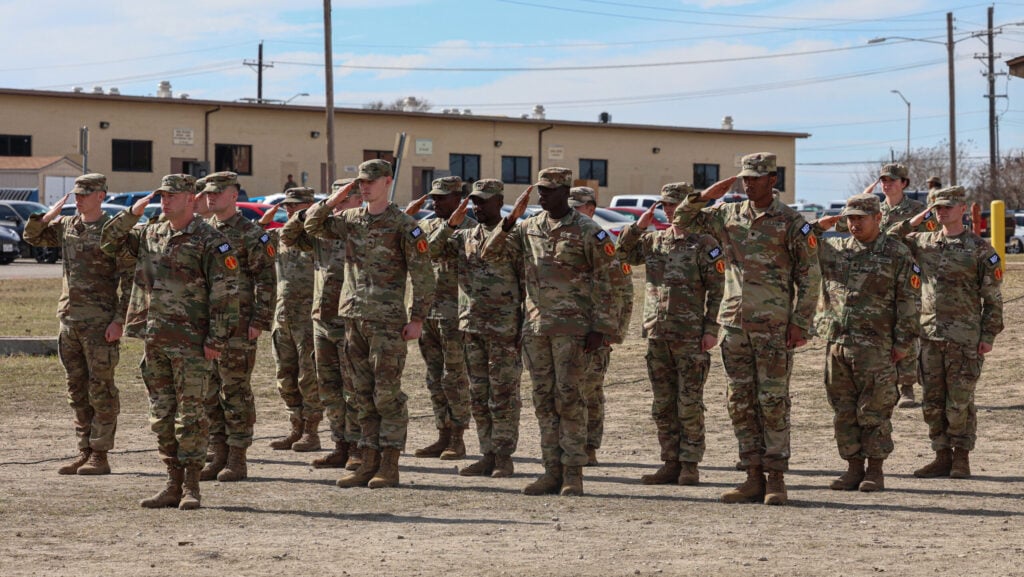
The following is an adapted excerpt from The State And The Soldier: A History Of Civil-military Relations In The United States, a new book from Kori Schake, Director of Foreign and Defense Policy Studies at the American Enterprise Institute. You can purchase the book, which is out now in Europe and October 26th in the US, by clicking here.
How is it that a country founded in fear of a standing army would come to think of its military as a bulwark of democracy?
There is no other country in which the military is so proficient, so respected, so influential in policymaking without becoming a threat to civilian governance. Standard models of civil–military relations would predict a military so constituted to be tempted by coups or state capture. Yet, for over 250 years, there has never been an organized attempt to overthrow the US government by its military. It is a precious, anomalous history.
Why that is the case isn’t simple. It’s partly the political culture of the colonies that would become the United States devising a government of distributed and counterbalancing power. It’s partly the restraining example of an extraordinary individual during state formation, giving time for civilian institutions and military norms to form and strengthen. It’s partly structural factors such as geographic expanse, rival and dispersed urban and commercial centers, and a benign international security environment coupled with urgent domestic insecurity (the “insider threat” of conflict with Native Americans) resulting in a weak federal army and strong militia. It’s partly adroit politicians demonstrating the skills that make them successful and simply outplaying ambitious military aspirants.
Which is to say that the American experience has proven beneficial and durable — but difficult for other states to emulate.
The main tenets of civil–military relations as established in the United States are that the military:
- owe their loyalty to the Constitution;
- are subordinate to both the president as commander in chief and to the Congress;
- can only either faithfully carry out civilian orders or resign their commission.

Next-generation C2 won’t be next-gen without the network transport
The network transport architecture for NGC2 could be a hybrid approach that combines high assurance communications with 5G, WiFi, and multi-orbit satellites.
There are almost no incidents of military insubordination during the nation’s actual wars. Whether the US is winning or losing, it is deeply engrained in the American military tradition that civilians determine the strategy and resourcing of wars, for better and for worse. The only example of wartime insubordination is that of Gen. Douglas MacArthur during the Korean War, and President Harry Truman’s firing of him rings down through the decades uncontested.
The US experiences more friction in the aftermath of wars, as civilians and the military argue over reduced forces and budgets. Those instances are hyperbolized as dangerous rebellions — the Admirals’ Revolt! — but are mostly the earnest actions of both civilian and military leaders, struggling to understand changing technologies and geopolitical developments, acting within the bounds of a political system designed for Congress to contest executive control by the president.
The creation of a volunteer force and the military becoming small relative to the population created another turn of the kaleidoscope. In those circumstances, the military has become a main source of public understanding about warfare in ways with which civilian leaders are often uncomfortable and which veterans capitalize on politically. As public confidence plummeted in most institutions of government and civic life in America, it held roughly constant for the military, leading the public to blame elected leaders and praise the military in ways that encourage broader military involvement in politics.
But contemporary concerns about the military becoming a partisan political force are largely unfounded. Despite norm-shattering behavior by a small but influential coterie of politicians, military leaders, and veterans, the constitutional, legal, and normative boundaries of civil–military relations in America remain robust.
And the central reason the US military abjures political involvement is that the leaders understand organically what survey research on civil–military has revealed: while partisan civilians encourage the military wading into our political and cultural disputes, it respects the military less when they do.
Needing to recruit a volunteer military, and reveling in the approbation of the public, the military consider it in their self-interest to restrain their own involvement. Such discipline doesn’t extend to veterans, whom the public do not separate from the military, and who have every right as citizens not in active military service to engage in politics.
There are basically only two essential tests of the health of civil–military relations in the US:
- can the president fire military leaders with impunity? and
- will the military carry out policies they don’t agree with?
The American military easily meets both of those standards. For all of the discomfort of our febrile political moment, the American military remains dedicated to not being a threat to democracy.
That professionalism has lasted 250 years, but may be facing its most strident test in the coming months. With what Pauline Shanks-Kaurin terms an “unprincipled principal” as president, Congress ceding even more of its constitutional authorities to the executive for partisan purposes, and governors eager to advance partisan policies by offering National Guard units to other states or the federal government, we appear headed to unprecedented times.
A Throughline Of History
What emerges from litigating the historical cases is a deep and abiding gratitude that this country had George Washington at its inception to establish the standard to which our military continues to aspire. Even other Founders lacked his starchy and often weary integrity on civil–military issues. In a system of government designed to distribute power and check abuse by building in contending forces, generations of American military leaders have navigated the inherent frictions by Washington’s example. Washington wasn’t always right, but he was exemplary often enough to validate Bismarck’s observation that God has a special providence for drunks, babies, and the United States of America.
The US ended conscription in 1973, and the American military rebuilt itself into a professionalized force, a transformation that consumed a decade but of which it is justifiably proud. The military it produced triumphed in the 1991 Gulf War and catapulted a legislatively empowered chairman of the joint chiefs of staff into the limelight. The assertiveness with which Gen. Colin Powell worked civilian leaders and sought to affect public attitudes was novel and uncomfortable for a civilian leadership in whom the public ceased to repose confidence.
America’s twenty-first-century wars saw the rise of veteran activism accusatory of civilian misjudgments but, given the wars’ extended duration and inconclusive outcomes, surprisingly little antagonism between civilian and military leaders. The arguments seldom had a clear civil versus military dynamic, the mistakes were predominantly civilian in nature, and the military accepted firings and made do with strategies and resources poorly aligned to political objectives.
What does come through clearly is that the disparity in public standing between politicians and the military incentivizes suits to hide behind uniforms when talking to Congress or the public, leading to suspicion by many politicians that military judgments are designed not solely as professional expertise but also for political effect. After all, a rare throughline of Presidents Obama, Trump, and Biden is that all believed the military was trying to limit their ability to enact preferred policies.
There are three domestic challenges to the American military remaining outside of politics: politicization in the broader body politic, mistakes by military leaders widening the aperture of vulnerability to political manipulation, and ambition by a political demagogue to break the good order and discipline of the military to recruit insurrectionists. The combination has produced a dramatic decline in public trust in the military — it is now at the lowest level in more than twenty years, roughly equivalent to attitudes in 1975.
Fortunes of war do not appear to negatively affect attitudes about the military: confidence dives only in 2018. Research by Peter Feaver demonstrates that the American public begins to view our military comparable to the Supreme Court: brimming with integrity when agreeing with respondents’ political views and disgracefully politicized when not. The public is actively pulling the military into the fray, and the only impediment to politicization is the professional restraint of the military itself.
Gen. Mark Milley isn’t the only military leader who stumbled into political thickets, but his choices exacerbated public perceptions of a military leadership actively engaging in political and cultural fractures. A main driver of perceptions about military politicization has resulted from veterans endorsing political candidates, speaking at political conventions, and claiming to speak for the active-duty force. And norms are eroding across the political spectrum of excluding military images from political advertisements and appearances.
But the arsonist of politicization is Donald Trump and the political movement he represents. In striking contrast to the deference generally shown the American military, Trump denigrated war hero John McCain, insulted a Gold Star family, reportedly referred to the military as “suckers and losers,” accused “the generals” of corruption, uses meetings with troops as campaign events, and pardoned servicemen convicted of war crimes at courts martial. He is now ordering troops into cities over the objections of governors and mayors on the false premise of civic emergency. These actions are putting political pressure on military leaders not seen since at least Thomas Jefferson was president, and probably not ever in American history.
It is requiring heroic discipline on the part of military leaders to navigate these political developments. At the time of this writing, they appear to be lowering their profile, interpreting their roles more narrowly, emphasizing regulations for behavior, and trying to discourage veteran political activism. However, it is both unfair and likely to be insufficient to rely solely on the military to police the civil–military relationship. Civilians have responsibilities they are shirking to respect the apolitical space our system is designed to provide the military.
Kori Schake leads the foreign and defense policy team at the American Enterprise Institute and is the author of The State and the Soldier: A History of American Civil-Military Relations.